

PROTECT YOURSELF with Orgo-Life® QUANTUM TECHNOLOGY
Orgo-Life the new way to the future Advertising by Adpathway An orange-red pigment found in feathers, hair, and skin may do more than create color. Experiments in zebra finches suggest that producing pheomelanin helps cells dispose of excess cysteine, limiting oxidative damage and revealing a possible evolutionary advantage. Credit: Shutterstock
Orange pigment may help protect cells by turning excess cysteine into inert pigment.
The same pigment that gives red hair and orange feathers their color may also help cells manage a chemical problem. Pheomelanin, an orange to red pigment found in human red hair, fair skin, and some bird feathers, is made using the amino acid cysteine. New research suggests that producing this pigment may help protect cells by drawing down excess cysteine before it contributes to cellular damage.
Pheomelanin has long presented an evolutionary puzzle. Earlier studies have linked the pigment to a higher risk of melanoma, raising the question of why genetic variants that encourage pheomelanin production have persisted over time.
To investigate a possible benefit, Ismael Galván and colleagues studied 65 adult zebra finches divided into treatment and control groups. In the treatment group, male zebra finches were given dietary cysteine along with ML349, a drug that blocks pheomelanin synthesis.
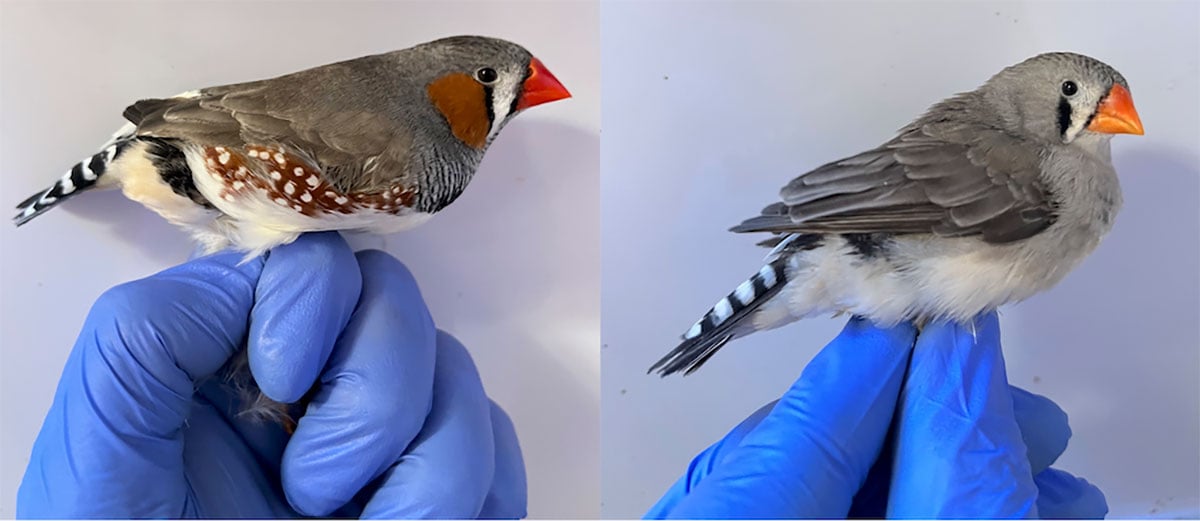 Male (left) and female (right) zebra finches. The orange feathers displayed by the male are colored by the pigment pheomelanin, which is also present in human skin and red hair. Pheomelanin is associated with an increased risk of melanoma, but also exerts a beneficial physiological function consisting in the avoidance of toxicity that an excess of the amino acid cysteine in the diet may cause. Female zebra finches, which do not produce pheomelanin like males, experience cellular damage when exposed to high dietary levels of cysteine. Credit: Ismael Galván
Pigment helps manage cysteine
The results suggest that pheomelanin production may help cells keep cysteine levels in balance. Male birds that received both cysteine and ML349 showed more serious oxidative damage in blood plasma than males that received cysteine alone, after the authors accounted for the overall expression of the antioxidant regulator produced by melanocytes.
The pattern was also seen in females, which do not produce pheomelanin. Female birds given cysteine alone tended to show more oxidative damage than female controls.
According to the authors, pheomelanin synthesis may help maintain cysteine homeostasis by converting excess cysteine into inert pigment. That protective role could help explain why pheomelanin-promoting genetic variants remain in populations, even though they are also associated with increased melanoma risk.
Reference: “MC1R depalmitoylation inhibition reveals a physiological role for pheomelanin” by Ismael Galván, Marina García-Guerra and Marta Araujo-Roque, 6 January 2026, PNAS Nexus.
DOI: 10.1093/pnasnexus/pgaf391
This study received funding by Ministerio de Ciencia e Innovación (MCIN/AEI/10.13039/501100011033) grant PID2020-114632GB-100 to I.G.
Never miss a breakthrough: Join the SciTechDaily newsletter.
Follow us on Google and Google News.




















 English (US) ·
  French (CA) ·
  French (FR) ·