

PROTECT YOURSELF with Orgo-Life® QUANTUM TECHNOLOGY
Orgo-Life the new way to the future Advertising by Adpathway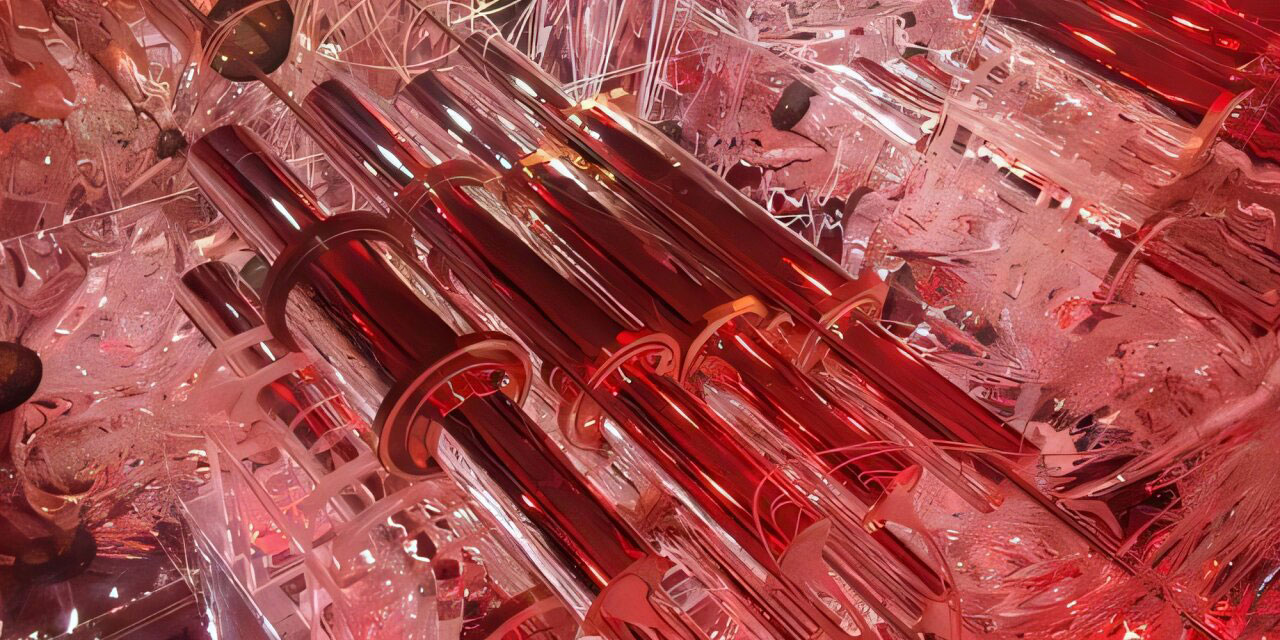 A decades-old dark matter claim is facing a decisive new challenge. The result clears the way for future searches to focus on unexplored signals and lower-mass dark matter candidates. Credit: Yale University
Two experiments designed to detect signals directly found no evidence for the signal reported by an earlier experiment.
For nearly three decades, one dark matter claim has refused to disappear. In 1997, the DAMA/NaI experiment detected a signal that changed with the seasons, a pattern that seemed to match what some physicists expected if Earth were moving through a halo of dark matter.
The follow-up DAMA/LIBRA experiment reported a similar annual pattern, keeping the claim alive. But many physicists remained unconvinced because other direct detection experiments did not see the same signal.
To test the result more directly, researchers built two sister experiments, ANAIS-112 and COSINE-100, using the same basic approach as DAMA/NaI and DAMA/LIBRA. In 2021, the first ANAIS-112 dataset showed no matching seasonal variation, weakening the case that dark matter caused the original DAMA signal.
A new study published in Physical Review Letters combining data from ANAIS-112 and COSINE-100 now rules out the dark matter explanation with greater confidence.
Same method tests the claim
All four experiments were designed to look for signs of weakly interacting massive particles, a leading class of hypothetical dark matter particles, scattering off nuclei inside sodium iodide crystals.
If dark matter were producing the signal, the rate should rise and fall slightly over the year. That is because Earth’s motion around the Sun changes the detector’s speed relative to the Milky Way’s dark matter halo.
DAMA/NaI and DAMA/LIBRA reported this kind of annual modulation. The problem is that their results have remained difficult to reconcile with other direct detection experiments and with theoretical model predictions.
Until recently, one major uncertainty remained. The DAMA signal had not been tested robustly using experiments with closely matched detector materials and methods.
Combined data rejects modulation
ANAIS-112 and COSINE-100 were designed to provide that comparison. Both used sodium iodide targets like DAMA, while adding features intended to reduce background noise and improve event detection.
When researchers combined the new datasets and analyzed the relevant energy ranges, they found no significant evidence of annual modulation.
The result effectively rules out dark matter as the source of the DAMA/LIBRA signal. It does not explain what caused the earlier observation, but it removes a long-standing obstacle for the field.
The researchers say the finding allows future dark matter searches to move forward without being weighed down by an unresolved detection claim.
Reference: “Combined Annual Modulation Dark Matter Search with COSINE-100 and ANAIS-112” by N. Carlin, J. Y. Cho, J. J. Choi, S. Choi, A. C. Ezeribe, L. E. França, C. Ha, I. S. Hahn, S. J. Hollick, I. S. Hahn, S. J. Hollick, S. B. Hong, E. J. Jeon, H. W. Joo, W. G. Kang, M. Kauer, B. H. Kim, H. J. Kim, J. Kim, K. W. Kim, S. H. Kim, S. K. Kim, W. K. Kim, Y. D. Kim, Y. H. Kim, Y. J. Ko, D. H. Lee, E. K. Lee, H. Lee, H. S. Lee, H. Y. Lee, I. S. Lee, J. Lee, J. Y. Lee, M. H. Lee, S. H. Lee, S. M. Lee, Y. J. Lee, D. S. Leonard, N. T. Luan, V. H. A. Machado, B. B. Manzato, R. H. Maruyama, R. J. Neal, S. L. Olsen, H. K. Park, H. S. Park, J. C. Park, J. S. Park, K. S. Park, K. Park, S. D. Park, R. L. C. Pitta, H. Prihtiadi, S. J. Ra, C. Rott, K. A. Shin, D. F. F. S. Cavalcante, M. K. Son, N. J. C. Spooner, L. T. Truc, L. Yang, G. H. Yu, J. Amaré, J. Apilluelo, S. Cebrián, D. Cintas, I. Coarasa, E. García, M. Martínez, Y. Ortigoza, A. Ortiz de Solórzano, T. Pardo, J. Puimedón, M. L. Sarsa and C. Seoane, 17 September 2025, Physical Review Letters.
DOI: 10.1103/9j7w-qp1c
Never miss a breakthrough: Join the SciTechDaily newsletter.
Follow us on Google and Google News.














 English (US) ·
  French (CA) ·
  French (FR) ·