

 1 month ago
90
1 month ago
90
PROTECT YOURSELF with Orgo-Life® QUANTUM TECHNOLOGY
Orgo-Life the new way to the future Advertising by AdpathwayEnergy
Key Facts
—The count. Staatsolie, Suriname’s state oil firm, has now taken in four exploration proposals in under a month.
—The spread. The bids cover three different offshore sectors, in both shallow and deep water.
—The round. The Open-Door Offering covers about 60 percent of Suriname’s offshore zone, with more than 90 identified leads.
—The neighbour. Suriname shares a basin with Guyana, where output has passed 900,000 barrels a day.
—The first oil. Suriname’s flagship GranMorgu field, led by TotalEnergies, is due to start pumping in 2028.
Interest in Suriname offshore oil is building faster than almost anyone expected. The state oil company has now drawn a fourth exploration bid in under a month, a run of activity that answers a question hanging over its big licensing round.

Just weeks ago, that round had a single bidder and an open question over whether more would follow. The answer, filed sector by sector through late June and early July, is a clear yes.
For a small country of about six hundred thousand people, this is a big deal. Suriname has watched neighbouring Guyana grow rich on oil while its own reserves stayed stuck on the drawing board, and every new bid narrows that gap.
The pace of incoming bids matters because it signals how seriously global oil companies view the opportunity. A slow trickle would suggest caution or limited interest, while a cluster of proposals in quick succession points to genuine competitive appetite for Suriname’s acreage.
One-stop reference
Company Intelligence
Every listed company in Latin America — financials, ownership and structure for 1,450+ companies across 26 exchanges, in one place.
How the Suriname offshore round works
The licensing round is branded the Open-Door Offering, and its rules are unusually flexible. Rather than a fixed auction date, companies can nominate any patch of open acreage they like at any time.
This rolling format is different from the traditional licensing rounds used in many oil-producing countries, where governments announce a single deadline and all bids arrive at once. The open-door approach keeps the process alive indefinitely, allowing companies to move when their own exploration budgets and strategies align.
Once a company names a block, a ninety-day clock starts, during which rival firms can file competing bids for the same ground. Only after that window closes does Staatsolie sit down to weigh the offers and negotiate.
The round throws open roughly 60 percent of Suriname’s offshore zone, an area holding more than 90 promising leads. To lure bidders, Staatsolie has published a free geological atlas and offers cut-price access to its seismic data.
A lead, in oil industry terms, is a geological feature that looks promising on seismic scans but has not yet been drilled or confirmed as containing oil. The more leads a basin holds, the more chances companies have to find commercial reserves.
Bidders also get a choice of terms. They can sign a full production-sharing contract and fund exploration outright, or take a lighter study-first deal that lets them examine the geology before committing real money.
Where the four bids landed
The first proposal, back on June 17, was for a deepwater area called Sector 4. It was the opening move, and for a while it stood alone.
Then the pace picked up sharply. In early July two separate bids arrived for a sector known as Demerara, followed a day later by a fourth for a shallow-water area, spreading the interest across both shallow and deep water.
That spread matters. A cluster of bids across different sectors, rather than a single block, suggests companies see broad potential in the basin, not just one lucky spot.
Shallow-water drilling is typically cheaper and faster to develop, while deepwater projects require more capital and technology but can unlock much larger reserves. The fact that bids have landed in both environments suggests companies are evaluating Suriname across the full spectrum of risk and reward.
Why investors are watching Suriname
The draw is geology. Suriname sits on the same prolific basin as Guyana, where an ExxonMobil-led group has pushed output past nine hundred thousand barrels a day and transformed the neighbouring economy.
Roughly half of Suriname’s offshore acreage is already under contract, spread across seventeen blocks. The contract holders read like an industry roll-call, including Chevron, TotalEnergies, Petronas, QatarEnergy, Shell, PetroChina and APA.
The state firm is already a fiscal pillar. Staatsolie said its 2025 results allowed a contribution of four hundred million dollars to the national treasury, a substantial sum for an economy this size even before the offshore boom arrives.
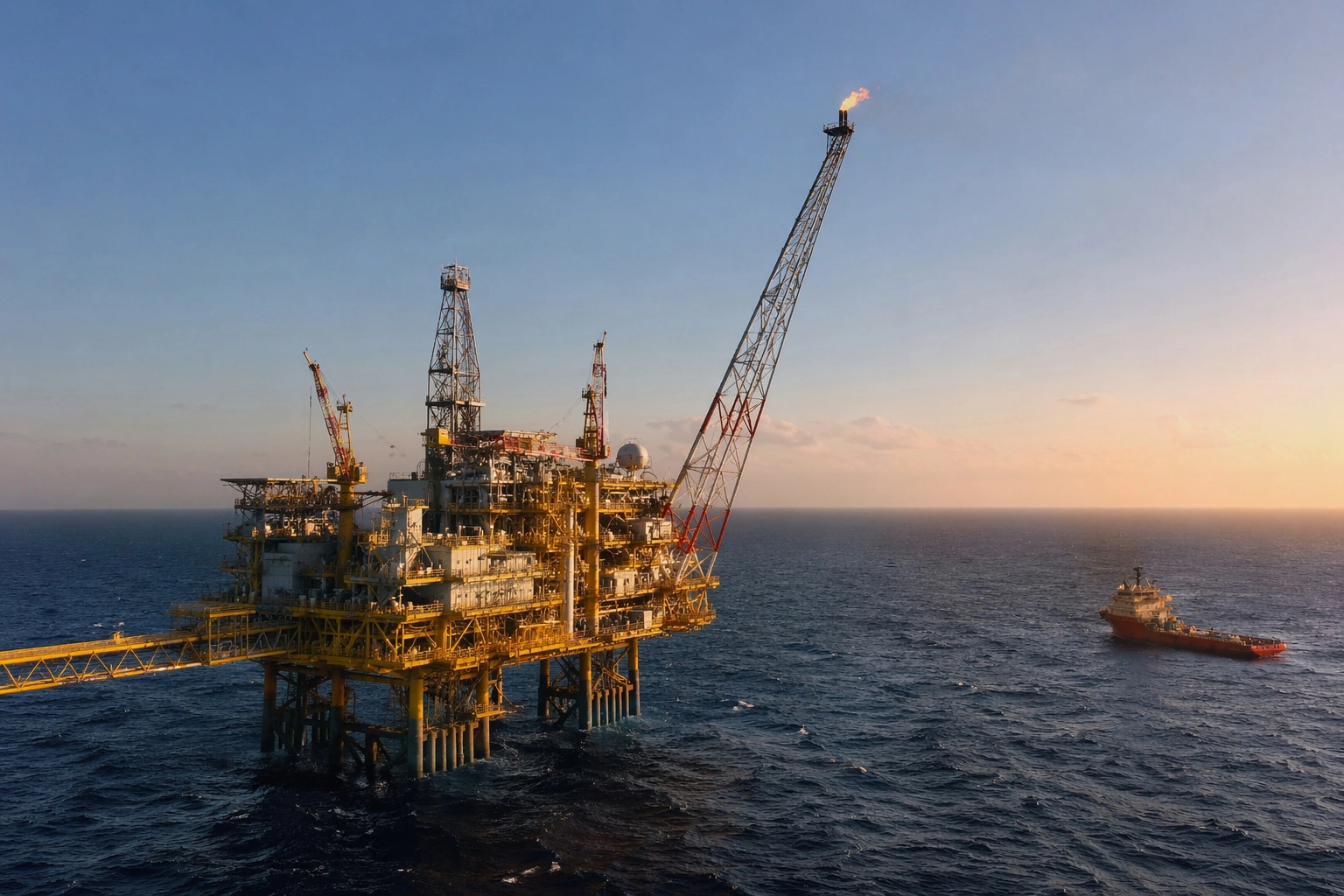
The real prize is still being built. The flagship GranMorgu project, led by France’s TotalEnergies, carries a price tag of about ten and a half billion dollars and is due to deliver Suriname’s first offshore oil in 2028.
There is a sober side too. Suriname’s drilling record has been mixed, with some wells abandoned, and timelines have slipped before, so the flurry of bids is a signal of confidence rather than a guarantee of riches.
Whether this momentum translates into actual drilling rigs and commercial discoveries remains an open question. The bids are a necessary first step, but the real test will come when companies commit capital to exploratory wells and those wells either confirm the geology or force a rethink.
Frequently Asked Questions
What is the Suriname offshore Open-Door Offering?
It is a rolling licensing round run by state oil firm Staatsolie, covering about 60 percent of Suriname’s offshore acreage. Companies can nominate any open block at any time, which opens a ninety-day window for rivals to file competing bids before Staatsolie negotiates a contract.
Why does Suriname matter for oil?
Suriname shares the same geology as neighbouring Guyana, one of the world’s hottest oil frontiers, where output has passed 900,000 barrels a day. Its first offshore field, the TotalEnergies-led GranMorgu, is due to start production in 2028.
Who is drilling offshore Suriname?
About half of Suriname’s offshore acreage is under contract across seventeen blocks. The holders include Chevron, TotalEnergies, Petronas, QatarEnergy, Shell, PetroChina and APA, alongside state firm Staatsolie.
















 English (US) ·
  French (CA) ·
  French (FR) ·