

PROTECT YOURSELF with Orgo-Life® QUANTUM TECHNOLOGY
Orgo-Life the new way to the future Advertising by Adpathway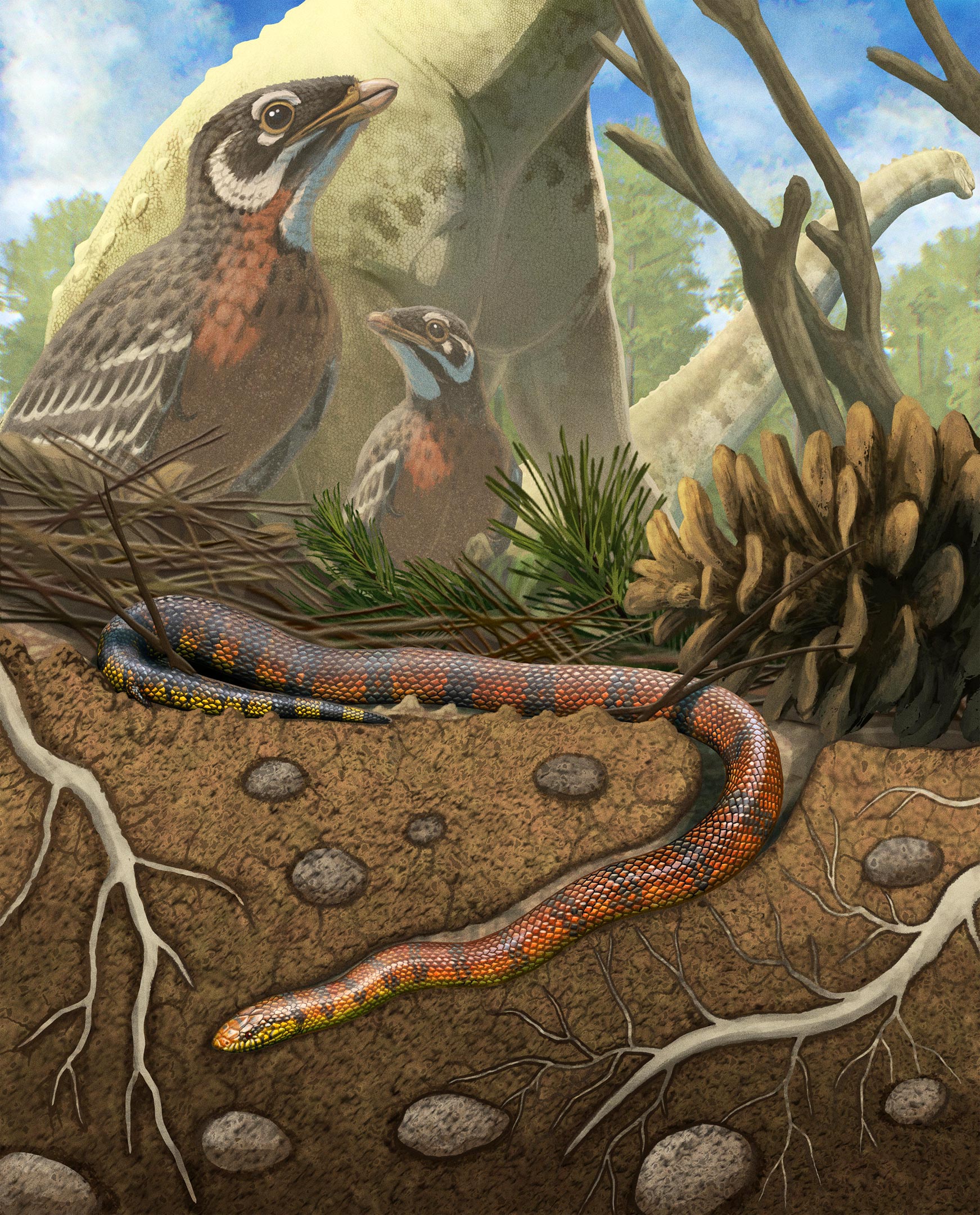 Life reconstruction of the burrowing stem snake Tametara mirim against a background of sauropod dinosaurs and the enantiornithean bird Navaornis from the same locality in the Adamantina Formation, Late Cretaceous of Brazil. Credit: Gabriel Ugueto
Exceptionally preserved Brazilian fossil reveals early snakes explored several habitats.
More than 4,000 snake species live today, yet the evolutionary path that produced their elongated, limbless bodies remains difficult to reconstruct. Snakes are highly modified lizards, but their limited fossil record has left one of evolutionary biology’s central questions unresolved.
Scientists have long debated whether the earliest snake bodies evolved for burrowing underground or moving through water. Research published in Nature challenges this either-or explanation, indicating that early snakes occupied several environments and developed different sensory adaptations.
“Our findings show that early snakes had already achieved remarkable ecological and morphological diversity by the Late Cretaceous, around 80 million years ago,” says lead author Tiago Simões, Assistant Professor at Princeton University.
Fossil preserves an early snake brain
At the center of the investigation is Tametara mirim, a newly described snake species from Late Cretaceous deposits in southeastern Brazil dating to around 80 million years ago. Its skeleton ranks among the most completely preserved fossil snakes found anywhere.
Researchers used computed tomography and cinematic 3D rendering to digitally reconstruct the specimen. The resulting model exposed fine details of its skull, vertebrae, and brain endocast, an impression of the space once occupied by the brain.
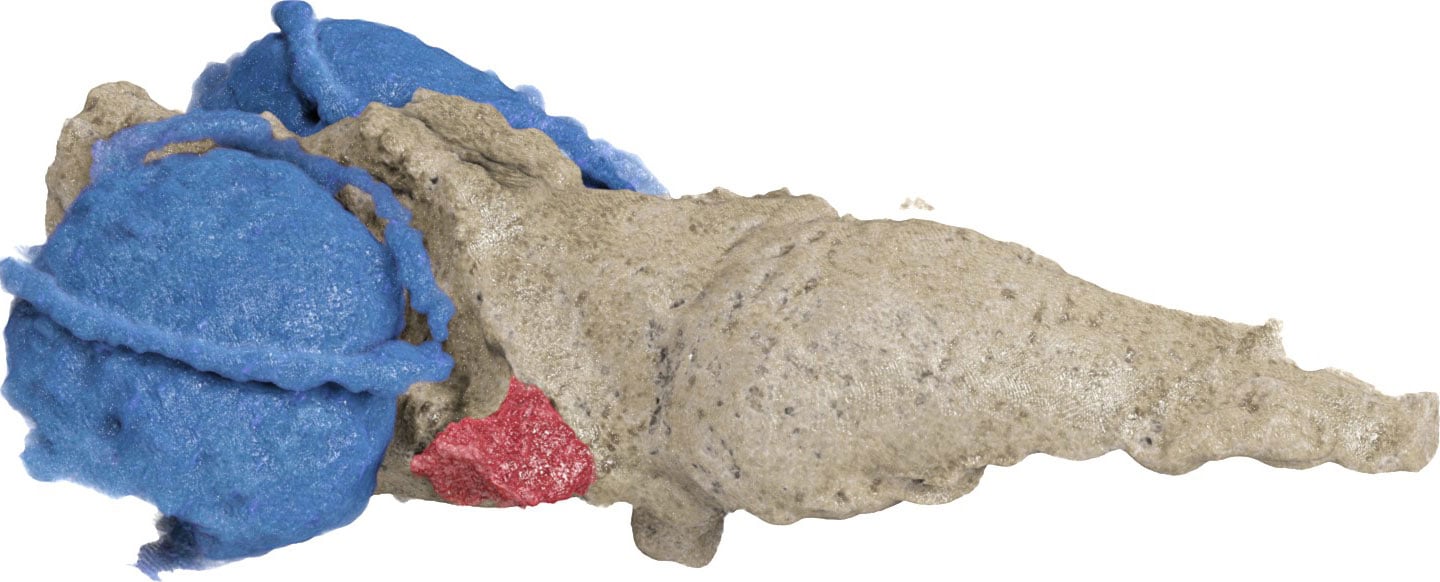 Researchers at the University of Helsinki reconstructed the snake fossil using computed tomography and cinematic 3D rendering, revealing details of the skull, vertebrae, and brain endocast. Credit: Simone Macrì
Simone Macrì, a postdoctoral researcher, and Nicolas Di-Poï, Research Director, both at the University of Helsinki’s HiLIFE Helsinki Institute of Life Science, led the digital reconstruction and comparative study of the brain. Their analysis connected the snake’s early neuroanatomy with its sensory abilities, habitat, and ecological history.
Early snakes explored multiple habitats
To determine how Tametara lived, the researchers compared it with Dinilysia patagonica, another fossil snake discovered in Argentina.
“The two had strikingly different brain shapes, both from each other and from most other snakes studied. Brain shape and bone microstructure pointed to the same conclusion: Tametara was adapted to burrowing, Dinilysia to life on the ground. Together with evidence from marine sediments, the findings reveal several shifts between burrowing, terrestrial and marine lifestyles in early snake evolution. Different lineages explored different habitats much earlier than previously thought,” concludes Research Director Nicolas Di-Poï.
“The brain tells a much richer story than the skeleton alone. By combining computed tomography-based brain reconstructions with data from living snakes, we could show that early snakes were not simply progressing toward one modern condition but experimenting with different sensory and ecological strategies. This means that early snakes did not follow a single evolutionary pathway,” says researcher Simone Macrì.
Reference: “Exceptional brain and ecological diversity in the earliest snakes” by Tiago R. Simões, Gabriela Sobral, Simone Macrì, Roy Ebel, Thiago S. Fachini, Agustín G. Martinelli, William R. Nava, Giovanna M. X. Paixão, Luis M. Chiappe, Nicolas Di-Poï and Annie S. Hsiou, 22 July 2026, Nature.
DOI: 10.1038/s41586-026-10809-9
Never miss a breakthrough: Join the SciTechDaily newsletter.
Follow us on Google and Google News.










 English (US) ·
  French (CA) ·
  French (FR) ·