

PROTECT YOURSELF with Orgo-Life® QUANTUM TECHNOLOGY
Orgo-Life the new way to the future Advertising by Adpathway Trees may rely on more than light and gravity to control their posture. New experiments reveal a hidden feedback system in woody tissue that helps poplars detect and correct their own curvature. Credit: Shutterstock
Young poplar trees can sense bends in their stems and straighten them by changing where they grow wood that pulls like a muscle.
Young poplar trees can straighten a bent stem even without light or gravity to guide them. In an experiment that removed those directional cues, the trees corrected their curves over several weeks, relying on their ability to sense their own shape.
Researchers from INRAE and the University Clermont Auvergne traced that adjustment to tension wood, a specialized type of wood that contracts and pulls on a stem, acting somewhat like a muscle. Their study, published in New Phytologist, shows that trees can change where they produce this wood to correct a bend.
Growing upward is not enough
Until now, tension wood was thought to form only on the upper side of a leaning stem, pulling it upward. It can be seen, for example, at the base of trees growing on mountain slopes. But a stem that bends upward may still be curved. Straightening it requires the tree to respond to the bend itself, as well as its orientation.
The ability to sense the position of one’s own body parts is called proprioception. Long considered exclusive to animals, it was also demonstrated in plants in 2012 by a research team involving INRAE. That work helped explain how plants control their posture, but the biological mechanism that translates the perception of a bend into a correction remained unknown.
 Forest in Alps. Credit: INRAE/Hervé Cochard
Straightening stems by switching the pull
To investigate that mechanism, the researchers first laid young poplars horizontally. Tension wood formed on the upper side of their stems, pulling their tops upward toward a vertical position. After about ten days, the stems had developed enough curvature for the team to test whether the trees could straighten themselves without the usual environmental guidance.
The researchers transferred the trees to a specially designed device with a horizontal platform that rotated around its own axis inside a sphere illuminated from every direction. The setup prevented the trees from using gravity or the direction of incoming light to guide their posture, leaving their perception of their own curvature.
Over the following weeks, the stems gradually became straight. Examining the newly formed wood revealed that tension wood had stopped forming on the side that had drawn the stems upward once the device was activated. Wood identical in every respect instead formed on the opposite side. This new growth appeared to act as an opposing muscle, progressively drawing the bend out of each stem.
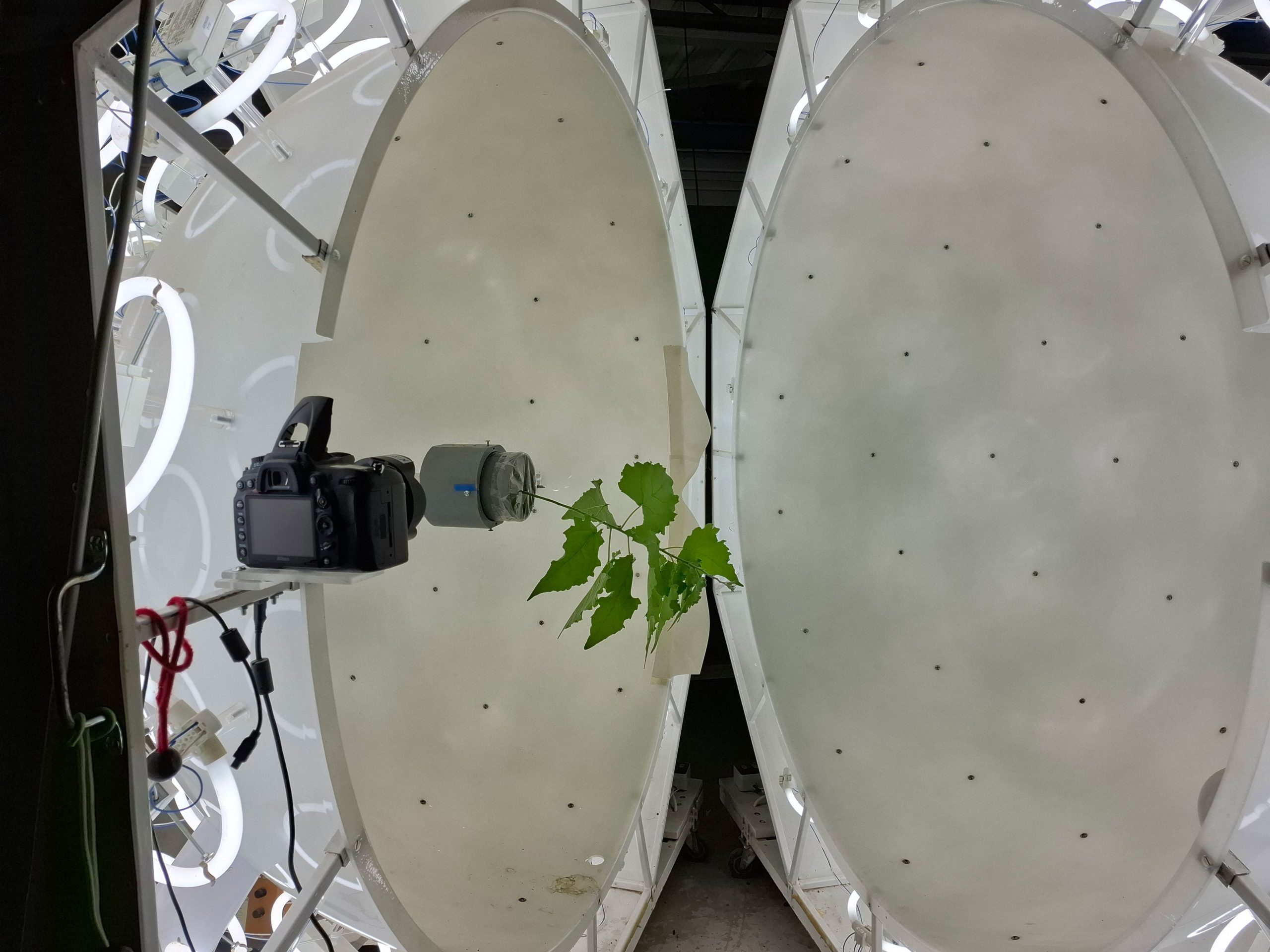 Clinostat : specially designed experimental set-up to study trees’ proprioception. Credit: INRAE/Bruno Moulia
Producing tension wood involves several successive stages regulated at the cellular level. The findings show that proprioception helps govern this complex process, allowing tension wood to serve opposing functions rather than simply pulling a stem upward.
“Revealing the remarkable capabilities of trees requires a great deal of ingenuity. In this project, we achieved it by bringing together researchers from different disciplines, with complementary skills and perspectives. This requires time and perseverance, but these interdisciplinary discoveries show that the effort is worthwhile,” said Félix Hartman, INRAE research engineer.
Staying straight without straining the wood
Under natural conditions, trees combine information about their shape with signals from light and gravity to achieve or maintain an appropriate posture. This coordination helps them respond when storms or landslides alter their position, contributing to their resilience in the context of climate change.
“What we have uncovered is a genuine sensorimotor loop operating in the woody parts of trees! Poor coordination in the successive activation of tension wood results in excessive internal tension, which can affect wood quality. These findings therefore reshape more applied research aimed at improving wood quality… and at obtaining trees that are as straight and as relaxed as possible, whatever life throws at them!” said Bruno Moulia, INRAE research director.
Beyond forestry, the findings suggest new possibilities for selecting cultivated plants based on their proprioception. Favoring plants that maintain an upright posture could, for example, help reduce lodging in cereal crops, when stems bend or fall over.
Reference: “Proprioception drives tension wood formation for autotropic straightening and postural control in trees” by Alexandre Caulus, Félix P. Hartmann, Éric Badel, Stéphane Ploquin, Nicole Brunel-Michac, Julien Ruelle, Mélanie Decourteix and Bruno Moulia, 2 September 2026, New Phytologist.
DOI: 10.1111/nph.71238
This work was supported by the CNES (French National Centre for Space Studies) and the IRC-SAE (International Research Centre on Sustainable Agroecosystems), part of the I-SITE CAP20-25 programme.
Never miss a breakthrough: Join the SciTechDaily newsletter.
Follow us on Google and Google News.











 English (US) ·
  French (CA) ·
  French (FR) ·