

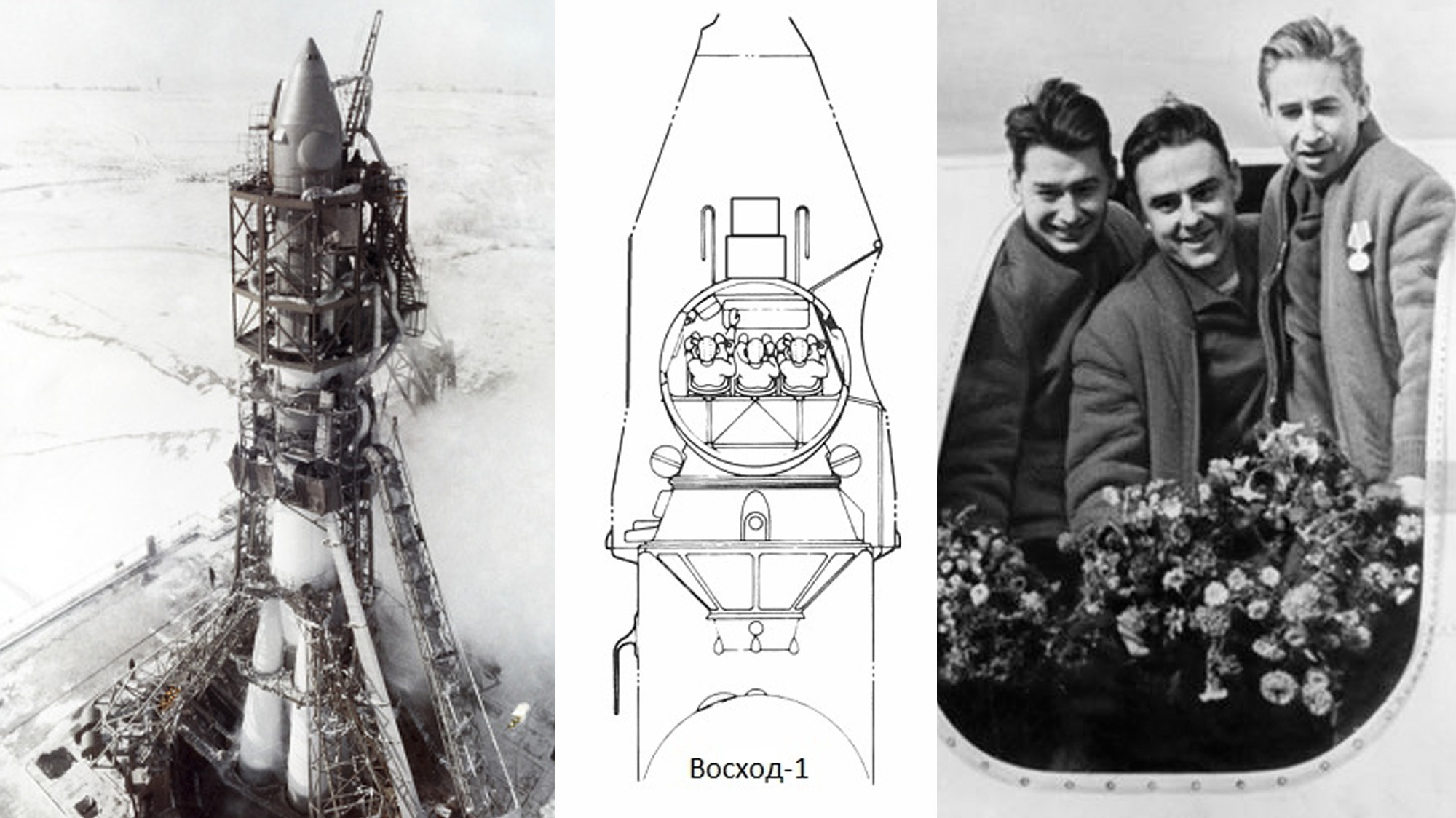
On Oct. 12, 1964, the Soviet Union launched Voskhod 1, a 24-hour crewed mission that achieved several "firsts" for human spaceflight. This was the first time that a spacecraft carried more than one person into orbit, with three cosmonauts packed inside the spacecraft.
Only two cosmonauts were originally supposed to fly on this mission, but Soviet politicians pressured the Russian space program to add one more. This left no room for spacesuits on board, so this also became the first spaceflight without spacesuits.
Two of the crewmembers, an engineer and a doctor, became the first civilians to go to space.
Why it mattered
Voskhod 1 served as yet another first for the Soviet Union during a space race kicked off by the launch of Sputnik 1 in 1957 and followed up by the first human spaceflight with Yuri Gagarin in 1961. And while the United States did follow up with its one human spaceflights, until Oct. 12, 1964, every mission had one person on board.
That changed with Voskhod 1, which crammed three man into a spacecraft not much larger than the Soviet Union's one-person Vostok spacecraft. At the time, NASA was develoing the two-person Gemini spacecraft, which prompted the Soviet Union's then leader to push for an edge.
"Soviet leader [Nikita] Khrushchev contacted Korolev and ordered him to convert the Vostok spacecraft into a vehicle capable of carrying not two, but three cosmonauts," according to space historian Asif Siddiqi, referring to Sergei Korolev, chief designer of the Soviet space program.
In order to fit a three people inside, the Voskhod 1 cosmonauts - commander Vladimir Komarov and his crew Konstantin Feoktistov and Boris Yegorov - did not wear spacesuits traditionally used for launch and landing, adding substantial risk to the flight. They also stayed inside their spacecraft when it landed, unlike Vostok crews like Gagarin, who parachuted out of them after reentry.
The Voskhod 1 mission lasted just over 24 hours, during which its crew performed experimented with the behavior of liquids and gases in microgravity and photographed the Earth.
NASA's first multi-crew mission, Gemini 3, would launch about six month later on March 23, 1965.
Want more space history? Check out our full On This Day In Space Story archive and watch our On This Day In Space videos on YouTube.
























 English (US) ·
  French (CA) ·
  French (FR) ·