

 50 minutes ago
6
50 minutes ago
6
PROTECT YOURSELF with Orgo-Life® QUANTUM TECHNOLOGY
Orgo-Life the new way to the future Advertising by AdpathwayChoosing a new software vendor involves more than comparing features and pricing. Businesses also need to understand how vendors collect, store, process, and protect sensitive information. Conducting a privacy risk assessment helps identify potential data security gaps, compliance issues, and third-party risks before signing a contract or integrating new software.
You can open Table of Contents show
By evaluating a vendor’s privacy policies, security measures, data handling practices, and regulatory compliance, organizations can make informed decisions and protect both customer information and business operations.
What Is a Privacy Risk Assessment and Why Do You Need One?
A privacy risk assessment is a structured review of how a software vendor will collect, use, store, share, and dispose of personal data on your organization’s behalf. It exists to identify privacy risk, security risk, and compliance risk before a vendor gets access to your systems or your customers’ information.
Without this step, organizations onboard SaaS tools based on sales demos and feature lists alone. That approach ignores the real question: what happens to the data once it leaves your control? A privacy risk assessment answers that by forcing a documented review of data flows, access controls, and legal obligations tied to the vendor relationship.
There are a few reasons this matters more in 2026 than it did even a few years ago:
- Regulatory enforcement under GDPR, CCPA, and newer U.S. state privacy laws has intensified, and regulators increasingly hold the hiring organization responsible for vendor failures.
- SaaS sprawl means the average business now runs dozens of cloud software tools, each one a potential data exposure point.
- Many organizations now require a formal data protection assessment, or a full DPIA, whenever they engage a new processor or renew a contract involving personal data, with the review focused on the specific data processing activity and the vendor together.
Overview of the Risks: What Can Go Wrong With a New Software Vendor
The core privacy risks with any new software vendor fall into five buckets: unauthorized data access, weak security controls, non-compliance with privacy law, unclear sub-processor relationships, and poor breach response. Each category can create legal, financial, and operational damage on its own, and most real incidents involve more than one at the same time.
Common privacy risks to watch for with new software include:
- Excessive data collection. Vendors that collect more personal data than their service actually requires increase your organization’s exposure.
- Weak access controls. Vendors with loose internal permissions let more employees touch sensitive data than necessary.
- Unclear data residency. Data stored or processed in jurisdictions with weaker privacy protections can violate GDPR transfer rules.
- Hidden sub-processors. A vendor may rely on other third parties you never agreed to, multiplying your third-party risk.
- Poor incident response. Vendors without a tested breach plan tend to notify customers late, making regulatory penalties worse.
Security teams should treat vendor risk and cyber risk as overlapping, not separate, categories. A vendor with weak information security is also a privacy risk, because a breach of security almost always means a breach of personal data too.
Regulatory and Compliance Implications of Vendor Risk
Regulatory compliance obligations attach to how personal data is handled, not to who technically caused a problem, which means your organization usually stays on the hook for a vendor’s privacy failures. GDPR, CCPA, HIPAA, and PCI DSS each define specific vendor obligations your assessment needs to confirm before signing a contract.
- GDPR requires data processing agreements with any vendor acting as a processor, plus proof of adequate security measures and lawful international data transfers.
- CCPA (and its amendments) requires vendors handling California consumer data to meet “service provider” contract terms restricting how that data can be used.
- HIPAA requires a signed Business Associate Agreement for any vendor touching protected health information, along with specific security safeguards.
- PCI DSS requires vendors processing payment card data to maintain certified security controls and pass regular compliance validation.
How Do You Check If a Vendor Is Compliant With GDPR and CCPA?
Checking GDPR and CCPA compliance means requesting the vendor’s data processing agreement, privacy policy, and evidence of data subject rights handling, then confirming those documents match actual practice. Ask the vendor directly how it handles access requests, deletion requests, and data transfer mechanisms like standard contractual clauses.
A quick compliance checklist for this part of the assessment:
- Request a signed data processing agreement (DPA) specific to GDPR, not a generic terms-of-service document.
- Confirm the vendor has a documented legal basis for processing and a defined data retention period.
- Ask how the vendor fulfills consumer rights requests under CCPA within the required response window.
- Verify international data transfer mechanisms if the vendor stores data outside your jurisdiction.
- Check for a designated privacy contact or data protection officer, especially for high-risk vendors.
Any vendor that cannot produce these documents on request should be treated as a higher-risk vendor until proven otherwise.
How Vendor Risk Impacts IT, Security, Procurement, and Legal Teams
Vendor risk does not stay contained inside one department. A single new software vendor can create work and exposure for IT, security, procurement, and legal teams simultaneously, which is why the assessment process works best as a shared, documented workflow rather than one team’s side project.
- IT teams manage integration, access provisioning, and technical compatibility, and they need to know what data the vendor will touch before granting system access.
- Security teams evaluate the vendor’s security controls, encryption practices, and incident response readiness.
- Procurement teams manage contract negotiation, pricing, and vendor relationship continuity, and they need risk findings before finalizing terms.
- Legal teams draft and review data processing agreements, liability clauses, and regulatory language tied to privacy obligations.
When these teams work from the same vendor risk assessment instead of separate reviews, organizations catch more problems and close deals faster, because nobody is waiting on duplicate information requests.
Which Key Risk Categories Should You Assess for a New Vendor?
A complete privacy risk assessment should cover six risk categories: data handling practices, security controls, regulatory compliance, financial and operational stability, contractual protections, and sub-processor relationships. Skipping any one of these leaves a gap that can turn into a real incident later.
| Data handling | Data types, volume, retention, deletion practices | Privacy officer |
| Security controls | Encryption, access management, patching, ISO 27001 status | Security teams |
| Regulatory compliance | GDPR, CCPA, HIPAA, PCI DSS applicability | Legal and compliance |
| Financial stability | Revenue health, funding status, business continuity plans | Procurement |
| Contract terms | SLAs, liability caps, termination and data return clauses | Legal |
| Sub-processors | Fourth-party vendors, data sharing chains | Privacy officer and security teams |
Step-By-Step: How to Conduct a Privacy Risk Assessment for a New Software Vendor
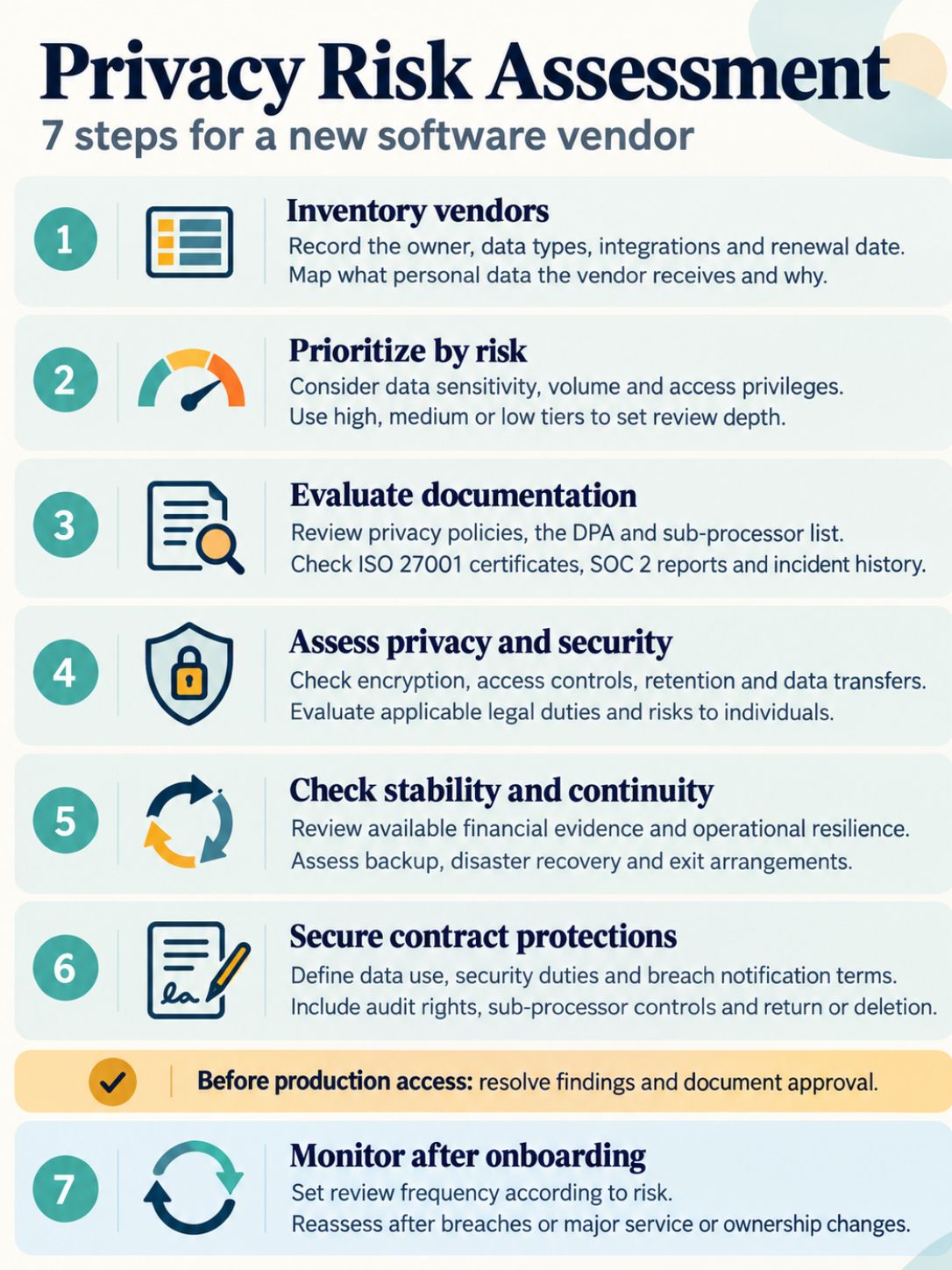
The step-by-step process for a privacy risk assessment follows seven stages: inventory the vendor, categorize its risk level, collect documentation, run security and compliance checks, assess financial stability, lock in contract protections, and monitor continuously after onboarding. Each vendor should move through all seven stages before gaining production access to any system containing personal data.
Step 1: Inventory All SaaS Vendors
Start by building a complete inventory of every SaaS vendor your organization uses or plans to use, including the new vendor under review. Many organizations discover during this step that they already have five or six tools doing the same job, each one an unnecessary risk surface.
Document for each vendor: the business owner, the data types involved, the integration points, and the renewal date. Without this baseline, you cannot prioritize your assessment workload or spot duplicate risk exposure across tools.
Step 2: Categorize and Prioritize Vendors
Categorize each vendor by data sensitivity and access level, then prioritize the deepest reviews for high-risk vendors first. A vendor processing employee health data deserves far more scrutiny than a vendor providing a free scheduling widget with no personal data access.
A simple three-tier model works for most organizations:
- High risk: Vendors with access to sensitive, regulated, or large-scale personal data.
- Medium risk: Vendors with limited personal data access or indirect system integration.
- Low risk: Vendors with no personal data access and minimal system connectivity.
Step 3: Collect and Evaluate Risk Documentation
Request the vendor’s privacy policy, security documentation, certifications, and prior audit or incident history, then evaluate whether the documentation actually matches the vendor’s real practices. This step is where vendor due diligence either builds trust or raises red flags.
Key documents to request:
- Privacy policy and data processing agreement
- Security certifications (ISO 27001, SOC 2, or similar)
- Breach history and incident response plan
- Sub-processor list
Step 4: Conduct Security and Compliance Assessments
Run a focused security and compliance assessment that checks encryption, access controls, and regulatory alignment against GDPR, CCPA, HIPAA, or PCI DSS as applicable. This is the technical core of the vendor risk assessment process.
Ask specifically how the vendor encrypts data in transit and at rest, how access permissions are scoped internally, how often systems are patched, and whether pseudonymization or de-identification is used where feasible. A vendor that cannot answer these clearly is a vendor you should not onboard without further escalation.
Step 5: Assess Vendor Financial and Operational Stability
Evaluate whether the vendor is financially stable enough to support a long-term relationship and whether it has a credible business continuity plan if systems go down. A vendor that goes out of business or suffers extended downtime creates operational risk even if its privacy practices were otherwise solid.
Check public financial filings where available, ask about funding rounds or acquisition plans, and request the vendor’s business continuity and disaster recovery documentation.
Step 6: Review and Store Contracts and SLAs
Review the vendor contract and service level agreements (SLAs) to confirm they include data protection clauses, breach notification timelines, audit rights, and clear terms for data return or deletion at termination. Store the finalized contract and SLAs somewhere your legal and compliance teams can retrieve quickly.
Confirm the contract specifies:
- Data protection obligations and sub-processing restrictions
- Security responsibilities and breach notification deadlines
- Audit and cooperation rights
- Data deletion or return terms at contract termination
Step 7: Continuously Monitor Vendors Post-Onboarding
Continuous monitoring after onboarding is what keeps a one-time privacy risk assessment accurate over time, since vendor security posture, ownership, and compliance status can all change. Set a review cadence based on risk tier: annual reviews for high-risk vendors, and reviews every two to three years for medium-risk vendors, with immediate reassessment triggered by any reported breach or major service change.
What Questions Should You Ask a Software Vendor About Data Handling?
The questions that matter most cover what data the vendor collects, where it is stored, who can access it, how long it is retained, and what happens to it if the contract ends. These questions should be part of every vendor questionnaire, regardless of vendor size.
A practical data-handling questionnaire includes:
- What specific personal data fields does your platform collect or process?
- Where is data stored, and does it ever leave that jurisdiction?
- Who inside your organization can access customer data, and how is that access controlled?
- How long is data retained, and how is it deleted at the end of that period?
- Do you use sub-processors, and can we review that list?
- What is your documented breach notification timeline?
- Do you support data subject access and deletion requests, and within what timeframe?
How Much Does It Cost to Conduct a Privacy Risk Assessment?
Cost depends heavily on whether the assessment is done manually in-house, with purchased risk assessment software, or outsourced to a consultant or law firm, and ranges from a few hours of internal staff time for a low-risk vendor to several thousand dollars for a high-risk vendor requiring legal review and specialized security testing. There is no single fixed price because the scope scales with vendor risk tier.
Rough cost drivers to consider:
- Internal staff time: The largest cost for most organizations, especially for high-risk vendors needing legal and security review.
- Software licensing: Risk assessment software and GRC platforms typically charge based on vendor volume and automation features.
- Outside counsel or consultants: Often brought in only for high-risk vendors handling regulated data like health or payment information.
How Often Should You Reassess a Vendor’s Privacy Practices?
Reassessment frequency should match vendor risk tier: high-risk vendors typically need an annual review, medium-risk vendors every two to three years, and all vendors need an immediate reassessment after any reported breach, ownership change, or major product update. A one-time assessment at onboarding is not enough on its own.
Triggers that should force an off-cycle reassessment include:
- A publicly disclosed data breach or security incident involving the vendor
- A change in the vendor’s ownership, leadership, or business structure
- A new feature or integration that expands the vendor’s data access
- A change in applicable privacy law or regulatory guidance
What Do You Do If a Vendor Fails Your Privacy Risk Assessment?
If a vendor fails a privacy risk assessment, the options are to require remediation before onboarding, negotiate stronger contract protections to offset the gap, or reject the vendor entirely and find an alternative. The right choice depends on how severe the finding is and how replaceable the vendor’s service is.
A practical escalation path:
- Minor gaps (missing documentation, incomplete answers): request corrections and a resubmission within a set deadline.
- Moderate gaps (weak but improvable controls): require specific remediation steps and stronger contract language before signing.
- Severe gaps (no breach plan, no compliance with required regulations, refusal to provide documentation): reject the vendor and document the decision for audit purposes.
Should You Get a Lawyer or Consultant to Help With Privacy Assessments?
Bringing in a lawyer or privacy consultant makes sense for high-risk vendors handling regulated data, complex cross-border transfers, or large-scale personal data processing, but most low- and medium-risk vendor reviews can be handled internally using templates and questionnaires. Legal review adds the most value around contract language and regulatory interpretation.
Consider outside legal or consulting help when:
- The vendor will process health, financial, or children’s data at scale
- Cross-border data transfers involve jurisdictions with unclear or conflicting privacy law
- The contract negotiation involves significant liability or indemnification terms
- Your internal team lacks experience interpreting GDPR, HIPAA, or PCI DSS obligations
How Do You Document and Track Privacy Risk Assessment Results?
Document every privacy risk assessment in a centralized, searchable system that records the vendor’s risk tier, findings, remediation status, and reassessment date, rather than scattering results across emails and spreadsheets. Consistent documentation is what makes the risk assessment process defensible during an audit or regulatory inquiry.
At minimum, your tracking system should capture:
- Vendor name, risk tier, and data types involved
- Assessment date, findings, and remediation status
- Contract terms and renewal dates
- Next scheduled reassessment date
What Happens If You Skip the Privacy Risk Assessment Before Onboarding a Vendor?
Skipping a privacy risk assessment means your organization takes on unknown data, security, and compliance risk with no documented basis for the decision, which becomes a serious liability if the vendor later causes a breach or regulatory violation. Regulators and courts increasingly expect organizations to show they performed reasonable due diligence on vendors handling personal data.
Practical consequences of skipping this step include:
- No contractual protection if the vendor mishandles data
- No evidence of due diligence during a regulatory investigation
- Higher odds of discovering unauthorized sub-processors or weak security after the fact
- Difficulty proving compliance with GDPR, CCPA, HIPAA, or PCI DSS obligations tied to vendor oversight
Best Practices for Ongoing SaaS Vendor Risk Management
Effective vendor risk management is an ongoing program, not a one-time gate at onboarding, and it works best when privacy, security, legal, and procurement teams follow the same documented process for every vendor. Organizations ready to mature their program should focus on consistency and automation over ad hoc reviews.
- Maintain a single, current inventory of all SaaS vendors and their risk tiers.
- Standardize questionnaires so every vendor answers the same core privacy and security questions.
- Tie reassessment frequency to risk tier, not a blanket annual calendar.
- Centralize documentation so legal, security, and compliance teams aren’t duplicating requests.
- Automate renewal and reassessment alerts wherever possible to avoid gaps.
Final Thoughts
A privacy risk assessment is not paperwork for its own sake. It is the documented proof that your organization looked at a vendor’s data practices, security controls, and compliance status before handing over access to personal data. Skipping it does not remove the risk, it just removes your visibility into that risk until something goes wrong.
Ready to put this into practice: start by inventorying every SaaS vendor you currently use, tier them by risk, and run the seven-step process outlined above on any new vendor before granting access. If your vendor list has grown past what a spreadsheet can handle, look at dedicated risk assessment software or a GRC platform like Mitratech to keep the assessment process consistent, auditable, and tied to continuous monitoring rather than a one-time check.
Frequently Asked Questions
1. What is a software vendor privacy risk assessment?
A software vendor privacy risk assessment is a process of evaluating how a software provider collects, stores, processes, shares, and protects sensitive or personal data.
2. Why is a privacy risk assessment important when choosing a new software vendor?
It helps businesses identify potential data breaches, privacy violations, compliance issues, and third-party risks before adopting new software.
3. How do you conduct a privacy risk assessment for a software vendor?
Start by identifying the data the vendor will access, reviewing its privacy policy, evaluating security controls, checking regulatory compliance, assessing third-party integrations, and documenting potential risks.
4. What should you check when evaluating a software vendor’s privacy practices?
Review its data collection policies, encryption methods, access controls, data retention rules, breach notification procedures, and data deletion practices.
5. Which regulations should businesses consider during a vendor privacy assessment?
Depending on the data and location, businesses may need to consider regulations such as the GDPR, CCPA/CPRA, HIPAA, or other applicable data protection laws.























 English (US) ·
  French (CA) ·
  French (FR) ·