

PROTECT YOURSELF with Orgo-Life® QUANTUM TECHNOLOGY
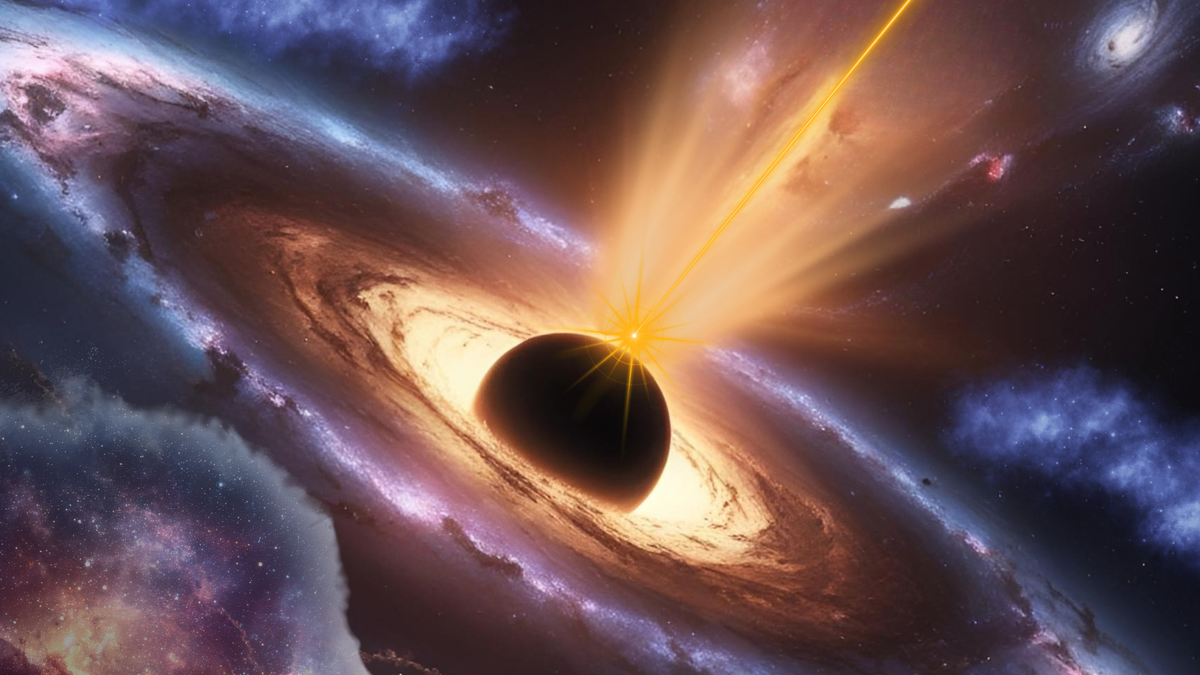
Orgo-Life the new way to the future Advertising by AdpathwaySources and scientific references: Near-infrared spectroscopy of TON 618 and the widely cited estimate of approximately 66 billion solar masses, based on its Hβ emission-line width and optical luminosity: Shemmer et al. (2004), Near-Infrared Spectroscopy of High-Redshift Active Galactic Nuclei. I. A Metallicity–Accretion Rate Relationship. The Astrophysical Journal. https://doi.org/10.1086/423607 A later quasar analysis listing an Hβ-based mass estimate of approximately 41 billion solar masses for TON 618, illustrating the dependence of the inferred mass on the adopted calibration: Ge et al. (2019), The Blueshift of C IV Broad Emission Line in QSOs. The Astronomical Journal. https://doi.org/10.3847/1538-3881/ab0956 How astronomers estimate distant black hole masses from emission-line widths and luminosity, including the calibration and uncertainties of these methods: Vestergaard & Peterson (2006), Determining Central Black Hole Masses in Distant Active Galaxies and Quasars. II. Improved Optical and UV Scaling Relationships. The Astrophysical Journal. https://doi.org/10.1086/500572 The formation and growth of massive black hole seeds in the early Universe, including accretion, radiation feedback, direct-collapse scenarios, and mergers: Inayoshi, Visbal & Haiman (2020), The Assembly of the First Massive Black Holes. Annual Review of Astronomy and Astrophysics. https://doi.org/10.1146/annurev-astro-120419-014455 A theoretical limit on growth through luminous gas accretion, approximately 50 billion solar masses for typical assumptions and up to 270 billion in extreme cases, with further growth through mergers and possible detection through gravitational lensing: King (2016), How Big Can a Black Hole Grow? Monthly Notices of the Royal Astronomical Society: Letters. https://doi.org/10.1093/mnrasl/slv186 An estimate of the Milky Way’s total stellar mass of approximately 61 billion solar masses, providing the basis for comparing TON 618’s estimated mass with the combined mass of our galaxy’s stars: Licquia & Newman (2015), Improved Estimates of the Milky Way’s Stellar Mass and Star Formation Rate from Hierarchical Bayesian Meta-Analysis. The Astrophysical Journal. https://doi.org/10.1088/0004-637X/806/1/96




















 English (US) ·
  French (CA) ·
  French (FR) ·