

 7 hours ago
4
7 hours ago
4
PROTECT YOURSELF with Orgo-Life® QUANTUM TECHNOLOGY
Orgo-Life the new way to the future Advertising by AdpathwayUnder the longstanding policy of “strategic ambiguity,” the U.S. government has refused to say ahead of time whether or not it would send American forces to help defend Taiwan against an attack from China. Some analysts say the Trump administration has rendered this policy ineffective by generating doubt that U.S. forces would intervene.
To cite just one example, the title of a September 14 analysis by columnist James Crabtree in Foreign Policy proclaimed that “Trump is killing ‘strategic ambiguity’ over Taiwan.” Crabtree argued that based on “signals from Washington,” the United States is “inching more toward a position of nonintervention.” Similarly, geopolitical risk analyst Shahn Louis said “the era” of strategic ambiguity “is over.” Michael Schiffer, a former U.S. deputy assistant secretary of defense for East Asia, argued that “strategic ambiguity is no longer a sustainable or effective policy.”
Multiple opinion polls show the belief among Taiwan’s people that the United States would ride to the rescue has decreased since 2025. The reasons for this loss of credibility are not hard to find.
Trump has repeatedly made four points about Taiwan, all of which call into question a robust U.S. response to military action by Beijing. The first is that Taiwan is vastly smaller and less important than China. Second, he says Taiwan is indefensible – too close to China and far from the United States. Third, Trump thinks Taiwan free-rides on U.S. defense. Finally, he complains about Taiwan allegedly stealing America’s semiconductor industry. Shortly before he took office for the second time, Trump said he would respond to a Chinese invasion of Taiwan with economic sanctions.
On top of this, Trump avoids antagonizing Beijing over the Taiwan issue, presumably to clear the way for a China-U.S. bilateral economic deal. During his keynote speech at the 2026 Shangri-La Dialogue, U.S. Defense Secretary Pete Hegseth did not mention Taiwan, a change from his speech the previous year. The unclassified version of the 2026 U.S. National Defense Strategy also does not mention Taiwan by name.
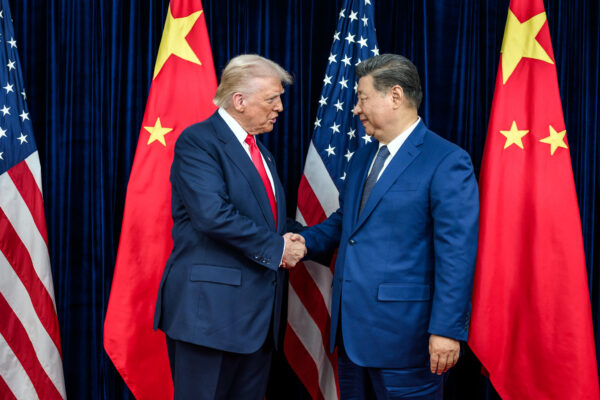
After his May 2026 meeting with Xi Jinping, Trump criticized the Taiwan government for allegedly flirting with independence due to the presumption of U.S. support. “[W]e’re not looking to have somebody say, ‘Let’s go independent because the United States is backing us,’” he told Fox News.
For good measure, Trump announced that he was delaying a large arms sale to Taiwan already approved by Congress, calling such sales a “very good negotiating chip” in talks with China. He also dismissed the Six Assurances, part of U.S. policy toward Taiwan since the Reagan era.
The idea that strategic ambiguity has lost its usefulness, however, is wrong. Despite particular statements by Trump that are adverse to Taiwan, U.S. policy remains broadly supportive of Taipei.
The Pentagon’s 2026 National Defense Strategy said the United States will “erect” and “sustain a strong denial defense along the First Island Chain.” Even a cursory look at a map indicates that aspiration is meaningless without a U.S. intent to prevent China from absorbing Taiwan.
The large arms sale is delayed, but not canceled. This latest package of armaments is all business, not symbolic. It includes weapons systems appropriate for the scenario of an attempted amphibious invasion by the People’s Liberation Army (PLA): HIMARS rockets, ATACMS missiles, ALTIUS loitering munition drones, Javelin and TOW anti-tank missiles, and mobile howitzers.
U.S. military transits through the Taiwan Strait continue, albeit about half as often as during Trump’s first term.
U.S. security cooperation with the Philippines and Japan, highly relevant to deterring China from moving aggressively against Taiwan, has deepened during the second Trump administration.
The United States got access to, and set aside funding to develop infrastructure in, additional base sites in the northern Philippines, close to the Taiwan Strait. The annual Balikatan military exercises were larger than ever before in 2025 and 2026 and brought in Japan and Australia. U.S. forces deployed NMESIS and Typhon missile systems to the Philippines. The stridency of China’s complaints about these deployments indicate they present problems for Chinese planners.
Washington’s plan to upgrade U.S. Forces Japan to a joint force combat headquarters has proceeded under Trump’s second administration. U.S. and Japanese armed forces increased their interoperability in 2025 and 2026 through more integrated command-and-control structures, more complex joint exercises, and more sharing of data. The United States started supplying Tomahawk cruise missiles to Japan. Washington and Tokyo are engaged in serious discussions about Japan producing warships or components for the U.S. Navy to help it close the gap with China’s production.
Strategic ambiguity still holds because what look like indications of U.S. abandonment of Taiwan are relatively superficial, while substantive investment in capabilities that could deter China continues apace.
The stances of the Joe Biden presidency and the second Trump administration are different. Biden said on four occasions that the United States would militarily intervene in a cross-strait war, placing him close to an unambiguous pre-commitment to intervention. Trump is closer to the other end, a pre-commitment to non-intervention.
Both, however, represent forms of strategic ambiguity. One president seemed committed and the other reluctant, but who knows what either of them would actually decide to do at crunch time. Beijing still cannot confidently assume a Trump-led United States would not intervene in a Taiwan scenario despite Trump seemingly indicating reticence to do so.
Chinese analysts consider Trump to be unpredictable. They cannot be sure he will act in a way consistent with his past statements. The Chinese remember how quickly Trump turned on them in 2020. In January, he said “our relationship with China now might be the best it’s been in a long, long time.” Later in the year, largely over the COVID-19 pandemic, Trump regularly berated China with statements such as “I’m very angry at China” and “The world is now suffering as a result of the malfeasance of the Chinese government.”
There are, nevertheless, reasons to doubt the American commitment to defend Taiwan, and these reasons go beyond the current U.S. presidential administration.
First, the demographic trend in the United States is increasingly anti-war. Gen Z Americans, born 1997-2012, are significantly less fearful of China attaining a stronger global position and less likely to see China as an adversary. The succession of unpopular wars against Afghanistan, Iraq and Iran further strengthens the aversion of Americans toward getting embroiled in foreign conflicts.
Second, the costs and risks of maintaining U.S. strategic pre-eminence on the western Pacific Rim against the determination of China to achieve regional supremacy are rising. The United States already dominates the Western Hemisphere. The rationale for dominating the Asia-Pacific, as well, is that doing so makes war less likely and opens the door for U.S. commerce. This rationale is less persuasive, however, if China supports international trade and if opposing China’s aspirations for “rejuvenation” makes war more rather than less likely.
Military analyst Jennifer Kavanaugh’s September 10 proposal for a “Second Island Chain strategy” attracted much attention. Kavanaugh, a member of the “restrainer” camp in U.S. foreign policy, argued that to reduce the risk of war with China while still protecting the most vital U.S. interests, Washington should end its alliances with Japan, South Korea, Australia, and the Philippines, pull most of its military forces out of the region, and announce that it will not intervene to protect Taiwan in a cross-strait war. Expect arguments such as this to grow in volume and frequency.
Finally, the U.S. defense industrial base is currently unable to compete with China’s productivity. This weakness is not easily fixed, even with an increased defense budget. As the modernization of its armed forces have made China a near-peer adversary of the United States, China’s advantage in manufacturing capacity becomes potentially decisive in a theoretical China-U.S. war.
Recent wargaming suggests both China and the U.S. would suffer huge losses in a conflict. Even where the U.S. “wins,” China is better placed to quickly rebuild and rearm its forces, giving Beijing hope that it would prevail in a second round. If American leaders conclude the math leaves them without a path to victory, they will reconsider whether an intervention is feasible.
But for now, Beijing would be reckless not to assume that both the United States and Japan would militarily oppose an attempt to conquer Taiwan. And Xi is not reckless.



![Beautiful Studio Ghibli coin/card cases recreate scenes and props from anime classics [Photos]](https://soranews24.com/wp-content/uploads/sites/3/2026/09/60.jpg?w=1000&h=525&crop=1)















 English (US) ·
  French (CA) ·
  French (FR) ·