

PROTECT YOURSELF with Orgo-Life® QUANTUM TECHNOLOGY
Orgo-Life the new way to the future Advertising by Adpathway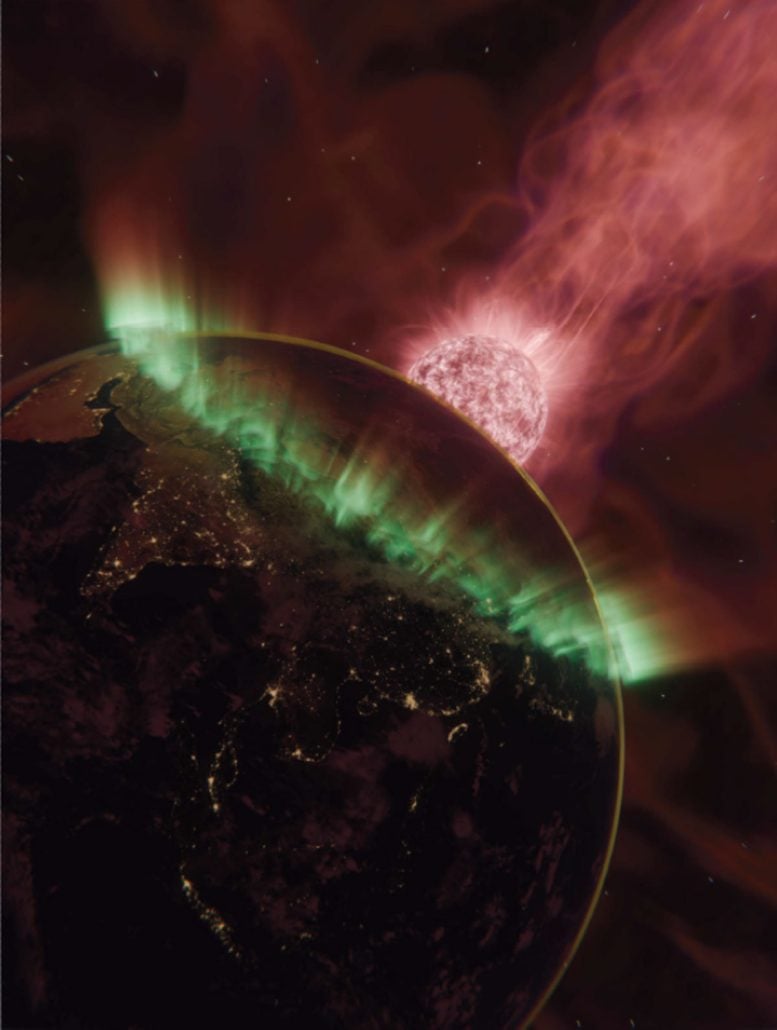 Illustration of solar wind streaming from a fuming sun drives auroras bright enough to be seen far from the poles, a dazzling signature of an extreme geomagnetic storm. Credit: Nithin Sivadas, NASA Goddard Space Flight Center
Earth may be far more vulnerable to powerful solar storms than scientists realized, with extreme events potentially hitting modern technology twice as hard as previous models predicted.
Earth’s magnetic shield may not have the safety limit scientists once thought it did. New research suggests that the most powerful solar storms could disturb the planet’s upper atmosphere up to twice as severely as traditional estimates predict.
The finding challenges a decades-old assumption about how Earth responds when it is struck by unusually intense solar wind. Rather than reaching a maximum and leveling off, the planet’s geomagnetic response may continue growing as conditions become more extreme.
That could have serious consequences for a world increasingly dependent on satellites, GPS, radio communications, aviation, and interconnected power grids.
The study, published in Nature, was led by Dr. Nithin Sivadas of NASA’s Goddard Space Flight Center and included Dr. Maria Walach of Lancaster University. It examined why measurements have long appeared to show a ceiling on the strength of geomagnetic activity.
How Space Weather Threatens Technology
Space weather begins with activity on the Sun. The solar wind, a continuous flow of electrically charged particles, moves outward through the solar system and interacts with Earth’s magnetic field. Solar eruptions can greatly intensify this flow, sending disturbances toward the planet.
When those particles reach Earth, they can transfer energy into the magnetosphere and generate powerful electric currents in the upper atmosphere. The same process can produce brilliant auroras, but during extreme events it can also interfere with satellites, disrupt navigation and communication signals, increase radiation exposure for astronauts and pilots, and induce damaging currents in power networks.
Dr. Walach said, “Our planet’s magnetic field does a really great job of protecting us against many space weather effects, and so they often just show up as glitches or beautiful auroras. There are, however, extreme cases where satellites unexpectedly fall back to Earth, or we lose communication and GPS signals.”
The Magnetic Shield’s Supposed Limit
Scientists previously believed that Earth had a built-in limit on how strongly it could respond. Measurements indicated that atmospheric currents rose as the solar wind intensified, but eventually stopped increasing at the same rate. Researchers developed several physical explanations for this apparent saturation, including theories in which the magnetosphere restricted the amount of energy entering the upper atmosphere.
The new study proposes a very different explanation. The supposed ceiling may be a statistical illusion created by uncertainty in the measurements themselves.
Solar wind conditions are usually recorded by spacecraft near the first Lagrange point, or L1, roughly 1 million miles (1.6 million kilometers) closer to the Sun than Earth. From there, the spacecraft can provide advance warning of incoming space weather. However, the solar wind continues to move and change before it reaches the planet.
That distance creates uncertainty about both the timing and strength of the solar wind that actually strikes Earth. A particularly extreme measurement at L1 may not perfectly represent conditions at the magnetosphere several minutes later.
Regression to the Mean
This becomes especially important when researchers analyze rare events. Exceptionally high measurements are more likely to include unusually large errors. The true conditions associated with them will often be closer to the average, a statistical tendency known as regression to the mean.
As a result, an extreme solar wind measurement at L1 may be compared with a less extreme response at Earth. When many such observations are combined, the mismatch can make it appear that Earth has stopped responding proportionally, even when no physical limit has been reached.
The researchers tested that possibility using more than 1 million measurements collected by NASA spacecraft orbiting much closer to Earth. They also used statistical methods to account for uncertainty in the timing and intensity of the solar wind.
Once those uncertainties were corrected, the apparent saturation largely disappeared. Earth’s geomagnetic response remained closely proportional to the strength of the solar wind across the observed range. The analysis indicates that the effects of the most extreme storms could be about twice as large as earlier models suggested.
Preparing for Rare Extreme Storms
The findings do not show that Earth’s response will keep increasing under every possible condition. The strongest solar storms are extremely rare, so scientists have little direct evidence of how the planet would react to an event that may occur only once every few hundred or thousand years.
However, the study finds no convincing statistical evidence for the protective ceiling that has been incorporated into many theories and models. That means models that assume Earth’s response eventually levels off may underestimate the risks from the most powerful solar storms.
Dr. Walach said, “If there is no upper limit to our planet’s response to the solar wind, modeling for extreme cases needs to take this into account, and we should be vigilant of space weather effects. Fortunately, these very extreme cases are rare, but this also means we have limited data to work with, and only time will tell what happens at the very extreme one-in-a-thousand-year kind of event.”
Dr. Sivadas said, “We usually assume the truth may be around its measurement. But probability theory says it leans one way. That’s why space weather risks appear underestimated.”
Reference: “Regression to the mean can explain saturation of geomagnetic storms” by Nithin Sivadas, David Sibeck, Varsha Subramanyan, Maria-Theresia Walach, Dogacan Su Ozturk, Banafsheh Ferdousi and Bayane Michotte de Welle, 15 July 2026, Nature.
DOI: 10.1038/s41586-026-10757-4
Never miss a breakthrough: Join the SciTechDaily newsletter.
Follow us on Google and Google News.








 English (US) ·
  French (CA) ·
  French (FR) ·