

 1 month ago
26
1 month ago
26
PROTECT YOURSELF with Orgo-Life® QUANTUM TECHNOLOGY
Orgo-Life the new way to the future Advertising by AdpathwayDiplomacy
Key Facts
—The summit. The 51st meeting of CARICOM heads of government ran in Gros Islet, Saint Lucia, from July 5 to 8.
—The row. Trinidad and Tobago’s prime minister challenged the process used to reappoint the bloc’s secretary-general, a dispute running since February.
—The fix. Leaders agreed to seek an advisory opinion from the Caribbean Court of Justice under Article 212 of the founding treaty.
—The catch. An advisory opinion is not binding. It interprets Community law rather than deciding liability.
—The asymmetry. All fifteen members accept the court’s original jurisdiction. Only five accept it as their final court of appeal, and Trinidad is not among them.
—The rest. Leaders finalised frameworks for a regional ferry and widened free movement, which four member states have accepted.
The CARICOM summit Saint Lucia hosted this week resolved a dispute that had shadowed the bloc since February. It did so by asking a court for an answer nobody is obliged to follow.
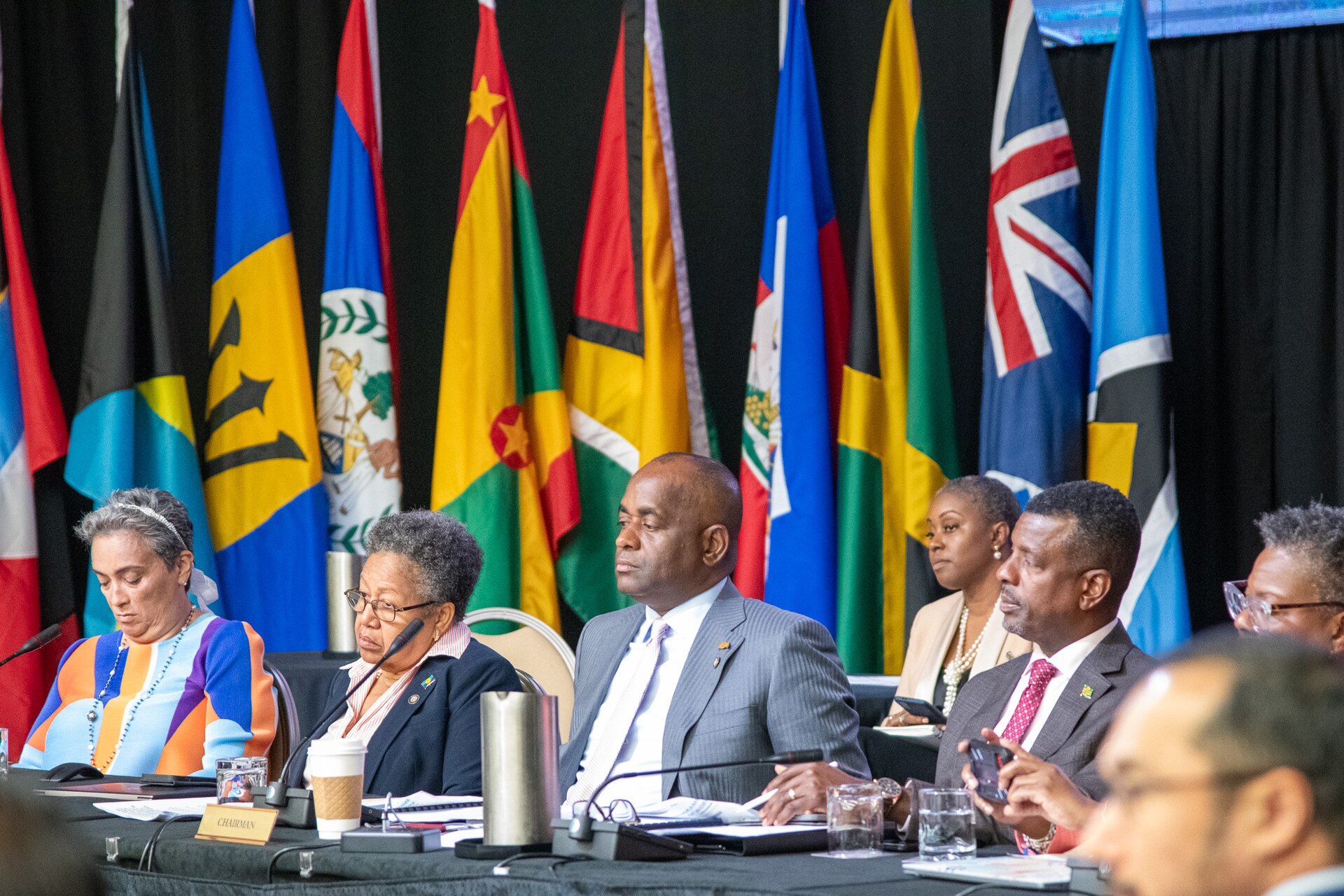
Kamla Persad-Bissessar, prime minister of Trinidad and Tobago, spent months contesting the procedure by which the Caribbean Community reappointed its secretary-general. She said her country was not part of the exercise and that her foreign minister had been shut out.
The reappointment had happened at a leaders-only retreat during the previous summit, which she left early. She then missed an emergency meeting called afterwards.
What the CARICOM summit Saint Lucia actually decided
The community agreed to commence proceedings for an advisory opinion from the Caribbean Court of Justice. Article 212 of the revised founding treaty gives that court exclusive jurisdiction to interpret the treaty when asked.
Read the mechanism carefully. An advisory opinion determines neither guilt nor liability, and it does not bind the parties who requested it.
What it produces is an authoritative reading of Community law. Whether that settles anything depends entirely on whether the parties choose to be settled.
Persad-Bissessar could have gone to the court directly, the Trinidadian political scientist Indira Rampersad noted, because her country remains subject to its original jurisdiction. She chose the multilateral route through the bloc instead, which Rampersad called laudable.
The court Trinidad trusts, and the one it does not
All fifteen member states participate in the Caribbean Court of Justice under what is called its original jurisdiction, which covers treaty interpretation between states.
Only five have adopted it as their final court of appeal: Barbados, Belize, Dominica, Guyana and Saint Lucia. The rest, Trinidad and Tobago and Jamaica included, still send their last appeals to the Privy Council in London.
So a Caribbean regional dispute now goes to a Caribbean regional court, at the request of a country that reserves its own final word for a court in the former imperial capital. Both things can be defensible; together they describe the state of integration.
Trinidad is the largest economy in the bloc and contributes more than a fifth of its budget. That is why a procedural quarrel about a personnel decision carried the weight it did.
The bloc has fifteen member states and seven associate members, bound by a treaty signed in 1973. Its largest contributor withholding cooperation is not a footnote but a structural risk.
Why one analyst calls the CARICOM summit Saint Lucia a success
Peter Wickham, a Barbadian pollster who directs a regional research firm and is quoted across the Caribbean press, called the meeting a productive exercise in mature diplomacy. The compromise, he said, lets Trinidad claim a win and lets the bloc claim one too.
He argued the opinion helps build jurisprudence within the concept of CARICOM, satisfying both the complainant and those who suspected something was not right. He also conceded, unprompted, that it is not binding.
The same analyst spent April warning that the row was damaging regional unity and bringing an important issue into disrepute. He said then that a leader who absents herself from a meeting cannot later contest its decisions.
Asked now what pleased him most, he named none of the policies. It was that Persad-Bissessar attended in person and stayed for the whole thing.
Had she attended the previous meeting, he added, the issue would never have arisen. Attendance is a real signal of intent, and it is also a low bar for declaring an institution strengthened.
What the leaders took home
Two substantive items emerged. Operational frameworks were finalised to fast-track a regional cargo and passenger ferry, aimed at cutting shipping costs and diversifying food supply chains.
A framework is not a vessel. No ship, no financing and no sailing date accompanied the announcement.
The single market’s free movement provisions were widened to more categories of worker, with four member states accepting under a three-year transition that began last October, Belize, Barbados and Dominica among them. Wickham’s answer to those fearing a migration surge is instructive, since uptake has been very slow and he presents that as proof that uncontrolled free movement is a myth.
That is a candid defence of a policy by pointing at how little it is used. The outgoing chairman framed the bloc’s position more hopefully, saying the question is no longer whether CARICOM survives but how to strengthen it for the next generation.
Is the court’s opinion binding?
It is not. An advisory opinion under Article 212 of the revised Treaty of Chaguaramas provides an authoritative interpretation of Community law rather than determining guilt or liability, and the analysts welcoming the outcome say so openly.
What was the dispute about?
Trinidad and Tobago objected to the process by which CARICOM reappointed its secretary-general at a leaders-only retreat during the previous summit, arguing its foreign minister was excluded and proper procedure was not followed. The prime minister had left that summit early and did not attend a subsequent emergency meeting.
Does free movement now apply across the Caribbean?
No, it applies where states have accepted it. Leaders agreed to expand the categories of workers eligible under the single market, and four member countries have accepted the expansion under a transition window of three years, while uptake of existing provisions has been slow.


















 English (US) ·
  French (CA) ·
  French (FR) ·