

 1 month ago
71
1 month ago
71
PROTECT YOURSELF with Orgo-Life® QUANTUM TECHNOLOGY
Orgo-Life the new way to the future Advertising by AdpathwayKey Facts
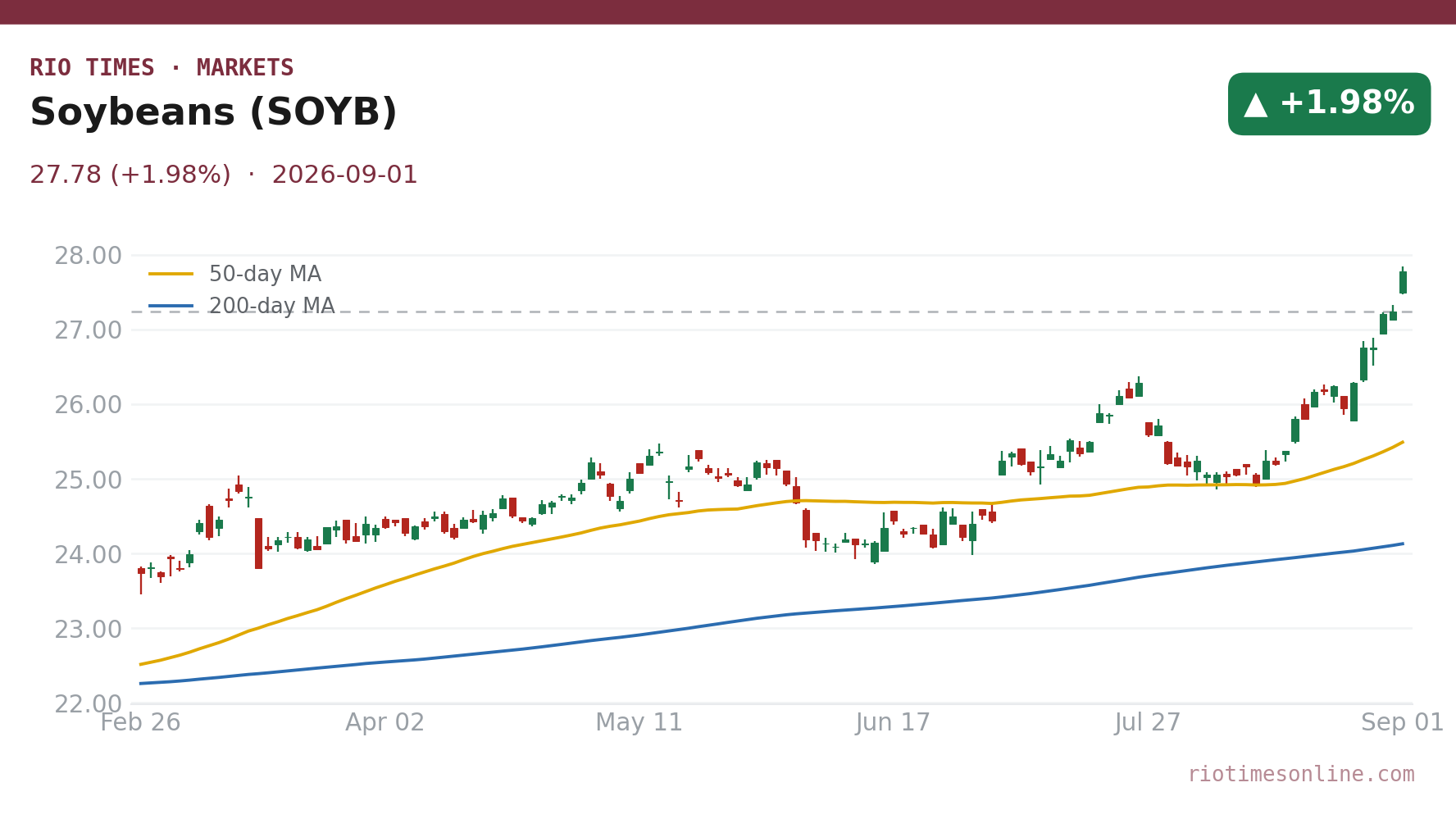
- The soybean-tracking fund SOYB settled at US$27.78 a 1.98% rise on Tuesday, September 1, 2026, the strongest move among the three grain proxies.
- The corn-tracking fund CORN settled at US$20.29 up 1.15% as the market weighed better global supply expectations against firm oilseed prices.
- The wheat-tracking fund WEAT closed at US$28.00 a 0.68% gain, keeping it near multi-year highs as Black Sea export worries persisted.
- Chinese buying was the clearest driver for soybeans with multiple US export sales reported for 2026/27 delivery during August, extending a rally to the highest levels since late 2023.
- Brazil and Argentina remain the export engine and tariffs continue to make Brazil the preferred origin for Chinese soybean purchases over US Gulf cargoes.
- A stronger US dollar works against American grain because it makes Brazilian and Argentine offers cheaper in global markets, a dynamic tracked by dollar-denominated futures.
Today’s Focus
Grain markets extended their firm tone on Tuesday, September 1, 2026, with soybeans again leading the way. The soybean-tracking fund SOYB settled at US$27.78, up 1.98%, reflecting continued Chinese buying and concerns over US crop conditions.
Corn was steady rather than explosive. The corn-tracking fund CORN gained 1.15% to US$20.29, as better global supply prospects capped the rally even while strong oilseed prices influenced planting decisions.
Wheat held near multi-year highs, with the wheat-tracking fund WEAT up 0.68% to US$28.00. Russia’s Black Sea attacks kept a floor under prices, though the day’s move was more modest than soybeans.
For Latin America, the message is one of relative advantage. Brazilian and Argentine exporters remain well positioned because tariffs and currency moves keep Chinese demand flowing toward South American origins rather than US ports.
What matters today. Chinese appetite for soybeans and Black Sea disruptions are still setting the tone, but the real and peso will decide how much of that premium lands in Brazil and Argentina.

One-stop reference
Company Intelligence
Every listed company in Latin America — financials, ownership and structure for 1,450+ companies across 26 exchanges, in one place.
01 The session in one read
All three grain proxies closed higher on Tuesday, September 1, 2026, but soybeans did the heavy lifting. The soybean-tracking fund SOYB rose 1.98% to US$27.78, the clearest sign that Chinese demand and crop worries are still the market’s main engine.
Corn and wheat were positive but quieter. The corn tracker CORN added 1.15% to US$20.29, while the wheat tracker WEAT gained 0.68% to US$28.00, holding near the multi-year highs set in late August.
Assessment — Soybeans charge ahead; corn waits MEDIUM
The grain complex is being pulled by two different engines: protein demand from China and supply risk from the Black Sea. Soybeans have the stronger story, with buying interest and crop worries pushing the tracking fund up 1.98% on Tuesday. Corn is more cautious because the world simply has more of it, while wheat remains hostage to headlines from Russia’s attacks on export infrastructure. The variable to watch is whether China’s August buying turns into September contracts, because any slowdown would quickly unwind the soybean premium that has lifted the whole complex.
02 The board
The price board tells a story of rotation within grains. SOYB at US$27.78 was the standout, up almost two percent on the day, while CORN at US$20.29 and WEAT at US$28.00 posted smaller but still positive gains.
The spread between soybean and corn performance matters for South American farmers. When soybeans outpace corn, it can tilt planting decisions in Brazil and Argentina toward oilseeds, which echoes into next season’s export mix.
| Soybeans (SOYB) | US$27.78 | +1.98% |
| Corn (CORN) | US$20.29 | +1.15% |
| Wheat (WEAT) | US$28.00 | +0.68% |
Source: RT close, 2026-09-01. Where a commodity has no spot feed, an exchange-traded tracker or leading producer is shown as a labelled proxy.
Live Market IntelligenceThe live market boardInside: market breadth, the sector heatmap, currencies & rates, the Latin America scoreboard and the full instrument board.Rio Times · Live Market Intelligence
Latin America — Cross-Market Board
Regional
Sep 2, 2026 · 05:47
Ibovespa · benchmark
179,722.48 +1.30%
L 167,142day rangeH 168,310
+21.85% over 12 months
Market breadth · 5 names
60% advancing
3 ▲ advancing2 declining ▼
Currencies, rates & key inputs
Latin America scoreboard
IndexLastTodayStrength
IbovespaBrazil 179,722.48 +1.30%
S&P/BMV IPCMexico 65,314.78 -0.18%
S&P IPSAChile 11,315.26 -1.14%
S&P MERVALArgentina 3,049,455 +0.51%
MSCI COLCAPColombia 2,470.26 +1.86%
BVL S&P PerúPeru 59,450.29 +0.11%
Full instrument board
| IBOV | 179,722.48 | +1.30% | +21.85% | 177,418.78 | 168,310 | 167,142 | — |
| IPSA | 11,315.26 | -1.14% | — | 11,445.90 | 11,210 | 10,984 | 1,513,213,483 |
| IPC MEX | 65,314.78 | -0.18% | +12.17% | 65,430.32 | 66,121 | 65,405 | 108,886,187 |
| MERVAL | 3,049,455 | +0.51% | +30.51% | 3,022,485 | 3,042,365 | 2,991,150 | — |
| COLCAP | 2,470.26 | +1.86% | — | 9.04 | 9.05 | 9.02 | 4,133 |
| BVL PERÚ | 59,450.29 | +0.11% | — | — | — | — | — |
| USD/BRL | 5.16 | +0.01% | -5.13% | 5.16 | 5.18 | 5.14 | — |
| EUR/BRL | 5.95 | +1.01% | -5.83% | 5.89 | 5.98 | 5.94 | — |
| USD/MXN | 17.06 | -0.24% | -8.58% | 17.10 | 17.08 | 17.01 | — |
| USD/CLP | 913.98 | +0.04% | -5.67% | 913.65 | 915.11 | 906.68 | — |
| USD/COP | 3,140 | +0.03% | -22.04% | 3,139 | 3,141 | 3,105 | — |
| USD/PEN | 3.36 | -0.66% | -4.82% | 3.38 | 3.38 | 3.35 | — |
| USD/ARS | 1,493 | +0.10% | +12.96% | 1,491 | 1,494 | 1,480 | — |
| USD/UYU | 40.27 | +1.24% | +1.80% | 39.77 | 40.27 | 40.23 | — |
| USD/PYG | 5,939 | +1.68% | -19.54% | 5,841 | 5,939 | 5,925 | — |
| USD/BOB | 11.64 | -0.76% | +72.04% | 11.73 | 11.72 | 11.64 | — |
| USD/DOP | 58.34 | +1.25% | -3.44% | 57.62 | 58.34 | 58.04 | — |
| USD/CRC | 445.92 | +0.89% | -9.71% | 441.97 | 448.50 | 445.92 | — |
Largest moves today
COLCAP 2,470.26 +1.86%
USD/PYG 5,939 +1.68%
IBOV 179,722.48 +1.30%
USD/DOP 58.34 +1.25%
USD/UYU 40.27 +1.24%
IPSA 11,315.26 -1.14%
EUR/BRL 5.95 +1.01%
USD/CRC 445.92 +0.89%
The session read
The Ibovespa rose 1.30%, with breadth positive — 3 of 5 names higher. COLCAP led, while IPSA lagged.
03 What moved it
Chinese buying remains the dominant force in soybeans. Market reports describe multiple US export sales for 2026/27 delivery booked during August, enough to push soybean futures to their highest since late 2023 and keep the SOYB tracker firm.
Wheat’s support is geopolitical. Russia’s continued attacks on Black Sea export routes have kept Chicago wheat near levels not seen in more than three years, even though the urgency cooled slightly on Tuesday.
Corn is the laggard because supply looks adequate. Analysts note relatively better global corn production expectations compared with soybeans, even as the firm oilseed complex and the soybean-corn price ratio continue to shape planting plans in South America.
04 The Latin American read
Brazil and Argentina together ship the bulk of globally traded soybeans, making them the export engine that competes directly with US Gulf cargoes. Tariffs continue to limit larger Chinese purchases of American soybeans, and that keeps Brazil as the preferred origin for Chinese buyers.
Argentine cargoes remain attractive on price, and both countries benefit when the US dollar strengthens. A firmer dollar makes American grain more expensive relative to Brazilian and Argentine offers, reinforcing the competitive position of South American exporters.
05 The names to watch
Investors tracking this complex through exchange-traded products should watch how SOYB, CORN and WEAT diverge. SOYB’s 1.98% move on Tuesday shows the market is still rewarding exposure to the China demand story.
For Latin America specifically, the currency link is the name to watch behind the names. The real and the peso determine whether Brazilian and Argentine farmers capture more of the current grain premium or see it eroded by local currency strength.
06 The outlook
The outlook depends on whether Chinese buying continues into September and whether Black Sea disruptions escalate or fade. Soybeans have the clearest bullish path, but corn’s supply cushion and wheat’s headline dependency make this a three-speed market. For Brazil and Argentina, the opportunity is straightforward: keep exports flowing while the US remains partly sidelined by tariffs and a strong dollar.
07 What to watch
- China’s soybean purchases: Whether August’s US export sales turn into firm September contracts will set the direction for SOYB and for Brazilian export premiums.
- Black Sea shipping news: Any new Russian attacks on Ukrainian grain ports would push WEAT higher, while a negotiated corridor could unwind the wheat risk premium quickly.
- Brazilian real and Argentine peso: A weaker local currency makes South American soybeans and corn more competitive, directly influencing the trade flow that underpins CORN and SOYB.
- South American planting decisions: The soybean-corn price ratio will shape how many hectares go to each crop, setting up next season’s export supply from the world’s key engine.
Frequently Asked Questions
Why did soybeans rise more than corn or wheat?
Chinese buying continued into late August, with multiple US export sales booked for 2026/27 delivery, while US crop condition worries added support.
What do SOYB, CORN and WEAT actually track?
These are exchange-traded funds that track soybean, corn and wheat prices respectively, not the raw commodities themselves.
Why does the US dollar matter for Brazilian grain exports?
A stronger dollar makes US grain more expensive for foreign buyers, favouring cheaper offers from Brazil and Argentina.
What is keeping wheat near multi-year highs?
Russia’s continued attacks on Black Sea export routes have kept a supply-risk premium in the wheat market.
Market data: RT
This article was produced by The Rio Times’ automated newsroom system. How we use AI · Report an error
LatAm Markets: Live Signals → — real-time movers, turnover leaders and FX across Latin America.
The Rio Times · Power Map
See who really holds power in Latin America
Click to open the Power Map →





















 English (US) ·
  French (CA) ·
  French (FR) ·