

 1 month ago
59
1 month ago
59
PROTECT YOURSELF with Orgo-Life® QUANTUM TECHNOLOGY
Orgo-Life the new way to the future Advertising by Adpathway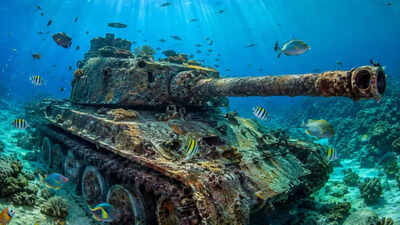
Almost 10 years after the tanks went under, researchers from Ramkhamhaeng University in Bangkok did some diving to see what had grown up around the man-made reef sites.
Battle tank is made for war. It is built to cross tough terrain, take a beating and dominate a battlefield. But what if the battlefield disappears and there is no place for the tank to go? Some retired tanks have found an unexpectedly useful second life, under the sea in southern Thailand.
According to an online repor by Aljazeera, in August 2010 Thailand’s army sank 25 old Chinese-made battle tanks into the Gulf of Thailand off Narathiwat province. 273 old railroad cars and 198 scrapped garbage trucks went under the water to serve as an artificial reef and create new fishing grounds. The strange undersea haul was part of an effort to help fishing communities whose catches have plummeted after decades of overfishing.
And then, over the next few years, something astonishing happened: the cast-off military hardware began to attract marine life.As per the report, it all began with a problem common to fishing communities around the world. Local fishermen in southern Thailand had complained of dwindling catches and finally appealed to Queen Sirikit for help. The response included an unusual thought, why not not just dump old equipment, but put it to work under the waves? The tanks were particularly well designed for the purpose, since they had already become obsolete.
According to Bangkok Post reporting, Thailand bought them second-hand from China in 1987 at a discounted price and they were decommissioned in 2004. They were essentially steel not used by the army. But for the fishing industry, they could be something else entirely. The 2010 sinking, Al Jazeera reported, left the tanks next to hundreds of old railroad cars and scrapped garbage trucks. Collectively, the structures would supply the hard surfaces and shelter that a sandy seafloor cannot.
What did they put in the tanks?
Almost 10 years after the tanks went under, researchers from Ramkhamhaeng University in Bangkok did some diving to see what had grown up around the man-made reef sites. Their study “First Insight on the Fish Species Composition at Two Artificial Reef Areas, Narathiwat Province, Thailand” listed 53 fish species of 21 families that live around the tanks and the nearby sunken railroad wagons. Snappers were the most diverse group with seven species recorded.
Then four species each of damselfish and wrasses. Also, the scientists found an interesting difference between the structures. The closed-in tanks held much larger schools of fish than the more open railroad wagons. Species recorded included commercially important fish such as snappers and the critically endangered humphead parrotfish. What had once been military hardware now offered shelter and feeding grounds and habitat for an underwater community.
Why does a steel tank act like a reef?
A reef does not necessarily have to look like coral to a fish. It’s the structure that’s important for what it provides. The flat, sandy seafloor provides relatively little for many reef-associated species. Vertical surfaces, crevices and sheltered spaces are created by a submerged tank, train car or other solid structure. As time goes by, algae, barnacles and other organisms colonize those surfaces. These tiny beasts then become food for smaller fish.
The smaller fish attract bigger predators An abandoned piece of infrastructure can gradually become the basis for an entire food web. That is the simple idea behind artificial reefs. According to the report, this is not a practice unique to Thailand. Countries such as Japan, the United States and India have tried to create habitat and improve fishing grounds by using artificial structures built from boats, railroad materials, concrete and other durable materials.
Figures suggest artificial reefs can pay off
The Narathiwat project seems to support local assertions that artificial reefs can improve fishing opportunities, but no independent study has quantified the increase in catches specifically around the Narathiwat tank reefs. But there is some interesting evidence elsewhere in the research. H. Mohamad Kasim and colleagues from India’s Central Marine Fisheries Research Institute published a study on the economic performance of artificial reefs along the Tamil Nadu coast in southern India in the Indian Journal of Fisheries in 2013.
They found that fish catches per unit of fishing effort were 34% higher in reef areas compared to open fishing zones. Gillnet fisherman had a net income nearly three times greater near the artificial reefs. The scientists also discovered that the cost of building the reefs could be recouped in around two and a half months. But those results don't show that Thailand's tanks produced the same economic benefits. But they show why artificial reefs have become of interest as a tool to help fishing communities.
Artificial reefs are not a magic bullet
But there is an important question behind the success stories. Are artificial reefs really increasing fish populations, or are they simply aggregating fish from elsewhere? The argument is not conclusively settled among scientists. An artificial reef that merely concentrates fish from a large area into a convenient location can look like a great success at first glance. Fishermen would catch more fish around the reef, but the overall population might not have grown.
And that concentration could cause a new problem: overfishing. A popular artificial reef can be an easy target for fishermen and may deplete the very population it is intended to support. This is why successful artificial-reef programs often have fishing regulations such as catch limits or other restrictions to allow fish populations to reproduce. The performance of the reef can also depend on many environmental factors like depth, strength and direction of currents, materials used to build the reef and shape of the reef itself.
Those variables might help explain why some artificial reefs become thriving ecosystems while others yield more modest results.
A broader reef-building experiment
The tanks were not an isolated experiment. By 2008, Thailand's broader artificial-reef program in the region had already expanded to include donated railroad materials and concrete pipes supplied by government departments, including the state railway and highways authorities. The 2010 sinking of the tanks simply became its most striking and widely reported chapter. There is something almost poetic about the transformation.
Objects designed to occupy battlefields were placed on the seabed and given an entirely different purpose.
















 English (US) ·
  French (CA) ·
  French (FR) ·