

 7 hours ago
3
PROTECT YOURSELF with Orgo-Life® QUANTUM TECHNOLOGY
Orgo-Life the new way to the future Advertising by Adpathway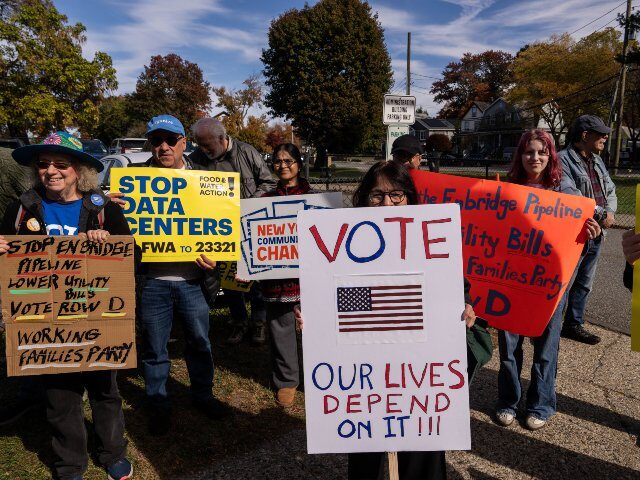 Adam Gray/Bloomberg
Political advertising about data centers has swung sharply negative on Facebook and Instagram leading up to the midterm elections, according to a new analysis from Pew Research Center.
Pew analysts examined 20,751 ads about social issues, elections or politics that mentioned data centers and ran on Facebook or Instagram in the United States between January 1 and October 24. The tone of those ads flipped over the course of the year. In January, 42 percent of political ads mentioning data centers were supportive and 31 percent were critical, with the rest taking no clear position. By October, only three percent were clearly in favor, while 57 percent expressed opposition.
Spending followed the shift in tone. Advertisers spent almost $12 million on political ads mentioning data centers between July 27 and October 24, a 90-day window Pew used for a second, more detailed look covering 13,956 ads.
That spending breaks down in a telling way. About 61 percent went toward ads that did not promote a specific candidate, the kind typically funded by advocacy groups; 56 percent of those ads opposed data centers, while just 13 percent supported them. The remaining 39 percent backed specific candidates. Among those campaign ads, 72 percent promoted Democratic candidates and 15 percent promoted Republican candidates, with the rest tied to independents or candidates whose party affiliation could not be determined. Pro-data center messaging barely showed up in campaign advertising at all, appearing in less than one percent of candidate ads, and most campaign ads critical of data centers came from both parties. Democratic candidates were more likely than Republicans to run ads about data centers in the first place, though when candidates from either party addressed the subject, they were about equally critical.
A handful of themes keep recurring. Corporate involvement in data center development came up in 30 percent of all the ads analyzed, followed by energy use (24 percent), environmental effects (17 percent) and water usage (15 percent). But the emphasis splits sharply depending on which side the ad is on. Nearly half of anti-data center ads, 47 percent, raised concerns about corporate interests, whether tech companies or utility providers, roughly double the 22 percent rate in pro-data center ads. Anti-data center ads were also more likely to mention water usage (22 percent versus 26 percent for pro ads) and environmental effects (26 percent versus 13 percent), and slightly more likely to mention taxes (21 percent versus 18 percent). Energy usage and costs showed a narrower gap: 35 percent for anti-data center ads versus 42 percent for pro ads. Jobs were the one theme pro-data center ads leaned on far more than their critics: 25 percent of pro ads mentioned employment impact compared with just 3 percent of anti-data center ads.
States with more competitive House, Senate or gubernatorial races tended to see more spending on these ads, and spending was higher on average in states with more operational or planned data center facilities. Pew counted an ad as targeted to a state if 90 percent or more of its audience was located there, and the spending figures reflect the midpoint of ranges reported through the Meta Ad Library API, rounded to the nearest $1,000.
Major players in AI are jockeying for position in the AI race, including attempts to control potential government regulation of the technology. Breitbart News social media director Wynton Hall has written his New York Times bestseller Code Red: The Left, the Right, China, and the Race to Control AI to serve as the definitive guide on how the MAGA movement can create positions on AI that benefit humanity without handing control of our nation to the leftists of Silicon Valley or allowing the Chinese to take over the world.
Hall predicted the current tone of the AI debate in February, when he laid out the left’s plan to weaponize AI concerns before the midterms, a political playbook he wrote has three components:
- Convince Americans that mass AI job loss is inevitable.
- Channel that fear and ennui into galvanizing support for Universal Basic Income (UBI) redistribution in the long-term.
- Co-opt populist concerns over AI data centers driving up electricity and water bills for everyday Americans in the short-term.
Read more at Pew Research here.
Lucas Nolan is a reporter for Breitbart News covering issues of AI, free speech, and online censorship.




















 English (US) ·
 French (CA) ·
 French (FR) ·