

 1 month ago
52
1 month ago
52
PROTECT YOURSELF with Orgo-Life® QUANTUM TECHNOLOGY
Orgo-Life the new way to the future Advertising by Adpathway- The Wits Donald Gordon Medical Centre has become the first in Africa to introduce a state-of-the-art liver perfusion machine, which preserves and resuscitates donor livers before transplantation.
- The technology could expand the donor pool, lower complications and hospital stays, and allow daytime surgeries with rested teams.
- Clinicians aim to cut waiting-list deaths and will track outcomes over 12-18 months as perfusion-assisted transplants are set to begin soon.
A R2.7 million liver perfusion machine introduced at Wits Donald Gordon Medical Centre is expected to change the way liver transplants are performed in South Africa, with specialists saying the technology could help save more lives in a country grappling with severe organ shortages.
On Thursday, the medical centre unveiled the technology, becoming the first transplant centre in Africa to implement liver perfusion for liver transplantation.
The machine keeps donor livers functioning outside the body by pumping oxygenated blood and preservation fluid through the organ, allowing transplant teams to assess, monitor and improve its condition before transplantation.
For a country where donor organs remain scarce, and patients often die while waiting for a transplant, clinicians believe the technology could significantly increase the number of usable livers while reducing complications after surgery.
“There are incredibly long patient waiting lists and transplantation in the country is largely dependent on the availability of deceased donor organs, which remain a very limited resource because of low donation rates,” said Professor Jerome Loveland, head of solid organ transplantation at Donald Gordon.
READ | Husband and wife donate organs that save the same man’s life – 16 years apart
Loveland described the introduction of the machine as the latest milestone for a programme that has already performed more than 1 000 liver transplants and achieved outcomes comparable to leading international centres.
“Sadly, there is an ever-increasing trend of deceased donor organs being relatively poor in quality. That predisposes patients to liver dysfunction after transplantation, increased complications and longer hospital stays. The implementation of this machine perfusion programme is the next landmark innovation being introduced by our unit,” Loveland said.
According to the Donald Gordon centre, more than 4 000 people nationally are waiting for solid organ transplants and at the centre alone, nearly 600 patients are waiting for kidney transplants and more than 30 are awaiting liver transplants.
Lowest donor rates in the world
The Donald Gordon centre stated that South Africa’s donor rate remains among the lowest in the world, with fewer than two deceased donors per million people compared with more than 40 donors per million in some countries.
According to transplant surgeon Dr Sharan Rambarran, the country’s shortage of donor organs has forced transplant teams to become increasingly innovative.
“Because donor organs are so scarce, our unit has had to innovate. We have accepted higher-risk organs and performed ABO-incompatible liver transplants because we simply do not have the luxury of abundant donor organs,” Rambarran said.
Traditionally, donor livers are preserved on ice before transplantation.
Rambarran said the method has changed little since the earliest days of transplant medicine and provides limited information about the organ’s condition.
Rambarran said:
This machine pumps oxygenated blood and specialised perfusion fluid through the liver while keeping it cool. In doing so, it helps resuscitate and recover the organ before transplantation.
“Essentially, what this machine does is convert a damaged, oxygen-deprived donor organ into one that we can confidently and safely transplant.”
International studies have already shown that machine-perfused livers perform better than comparable organs preserved using traditional methods, while also reducing post-operative complications and shortening hospital stays.
Better planning for fresher surgeons
Rambarran said the technology also offers practical advantages, allowing surgical teams greater flexibility in scheduling procedures.
“Rather than beginning a six- to eight-hour operation in the middle of the night, we can preserve the organ and perform the transplant with a fresh surgical team in the morning. International data consistently shows that fresh surgeons achieve better outcomes than tired surgeons operating through the night,” Rambarran said.
The machine was funded through a partnership involving Surgeons for Little Lives and corporate sponsor Weelee.
Although the R2.7 million price tag may appear substantial, Loveland argued the long-term benefits far outweigh the cost.
“People often see that figure and think it’s expensive, but if you transplant just one child who would otherwise have died, and that child goes on to be educated, work and contribute to society, the value becomes immeasurable,” Loveland said.
One liver can save two lives
For transplant hepatologist Dr Bilal Bobat, the machine represents an opportunity to honour both donor families and patients waiting for life-saving organs.
“The donor families who donate these organs do so with good hearts and good intentions, and we are very aware that we are the custodians of those organs,” Bobat said.
“This machine gives an organ time to recover. It allows us to resuscitate a liver so that, if it reaches the right quality, we can even split one liver between a paediatric patient and an adult patient. One liver can save two lives.”
Bobat said the technology could help reduce both waiting-list deaths and post-surgery complications.
“We’re hoping that our waitlist mortality, meaning patients who die waiting for a transplant, can be reduced. We’re also hoping that post-operative complications can be reduced with this machine,” Bobat said.
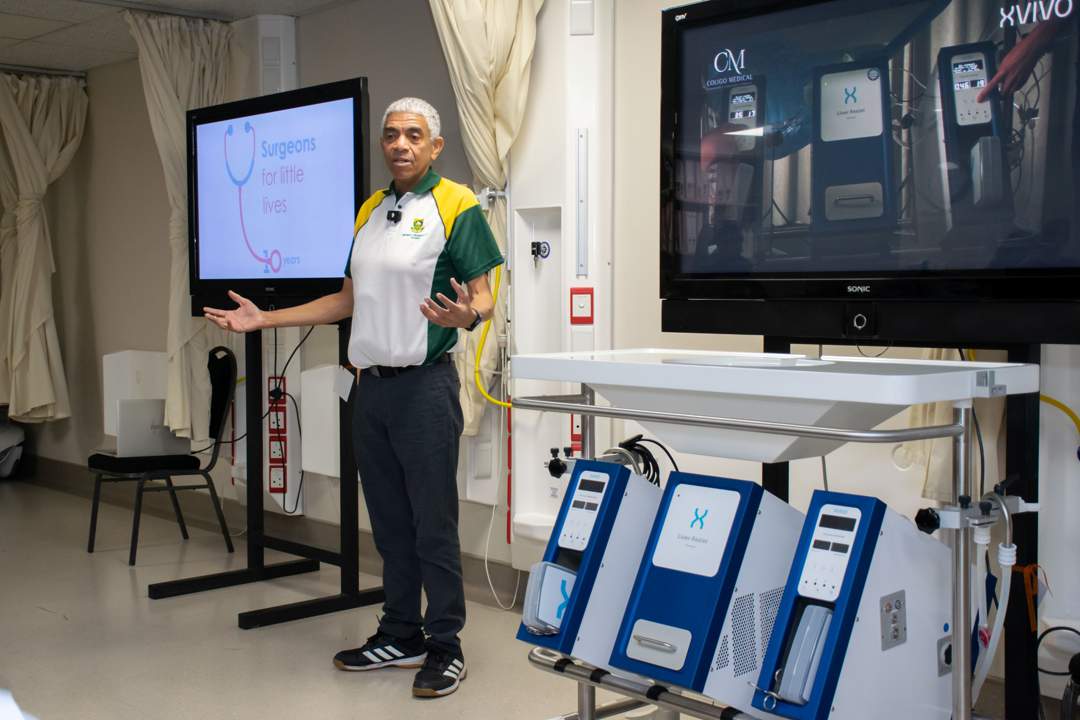
Winston Baatjies, a liver transplant recipient, whose story is a reminder of why organ donation matters.
The potential impact is perhaps best illustrated by the story of liver transplant recipient Winston Baatjies.
“In 2018, I was dying. There’s no shortcut about that,” Baatjies said.
Diagnosed with liver disease caused by sarcoidosis, he was placed on the transplant waiting list on 12 December 2018 and received a donor liver just three days later.
“I would never have seen my son graduate if I didn’t have a transplant. I would never have been able to represent my country, and I would never have been able to look forward to retirement,” Baatjies said.
Speaking to News24, his son, Cameron Baatjies, described the years his family gained because a donor organ became available in time.
He said:
The transplant has given us more opportunities to live as a family, and with this machine, it will give more families that opportunity.
Cameron added that since 2018, his dad has been able to see him graduate, complete his honours degree, and witness him get his first credit in his film and television career.
“He has even seen me buy a house, and hopefully he’ll see me have kids one day, all because of the transplant.”
While the machine has not yet been used and the hospital is still awaiting some disposable components required for operation, transplant teams expect the first perfusion-assisted transplant to take place soon.
The true measure of success, Loveland said, will come in the next 12 to 18 months as clinicians gather data on whether the technology improves outcomes, expands the donor pool, and helps more South Africans survive the wait for a life-saving liver transplant.
If you have a hopeful story to tell, email [email protected].






















 English (US) ·
  French (CA) ·
  French (FR) ·