

PROTECT YOURSELF with Orgo-Life® QUANTUM TECHNOLOGY
Orgo-Life the new way to the future Advertising by Adpathway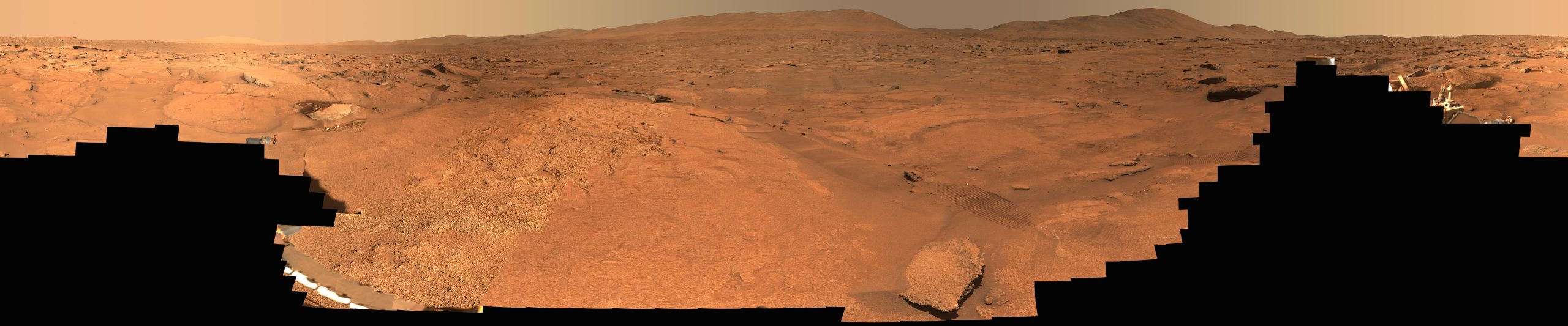 The Perseverance rover captured the data used in this panorama of the “Margin Unit,” a geologic area that hugs the inner edge of Jezero Crater’s rim, between October 8 and October 16, 2023. Credit: NASA/JPL-Caltech/MSSS
A new study suggests that Jezero Crater’s mysterious “Margin Unit” records a surprisingly complicated history involving ancient lakes, groundwater, and heated fluids moving through the Martian subsurface.
When NASA’s Perseverance rover arrived at the inner rim of Mars’ Jezero Crater in September 2023, scientists expected to encounter sedimentary rock. The region, known as the “Margin Unit,” lies along the edge of an ancient lake, where layers of sand might have accumulated over thousands of years.
On Earth, sedimentary rocks made from materials such as clay and silt can preserve evidence of past microbial life particularly well. Scientists were also interested in strong carbonate signatures that Mars orbiters had detected from above. On Earth, carbonate minerals often develop in shallow lakes and oceans, including environments that can support life.
Instead, Perseverance encountered igneous rocks.
Igneous rock can form from magma deep underground or through volcanic activity at the surface. Because crystals within these rocks preserve information about the conditions in which they formed, they can provide unusually detailed records of ancient geologic events.
In Jezero Crater, those rocks turned out to contain an unexpectedly rich record of water on early Mars. Researchers found evidence that the rocks had interacted with water on at least three separate occasions. Each episode changed their chemistry and physical appearance in a different way.
The findings were published in the journal Communications Earth & Environment.
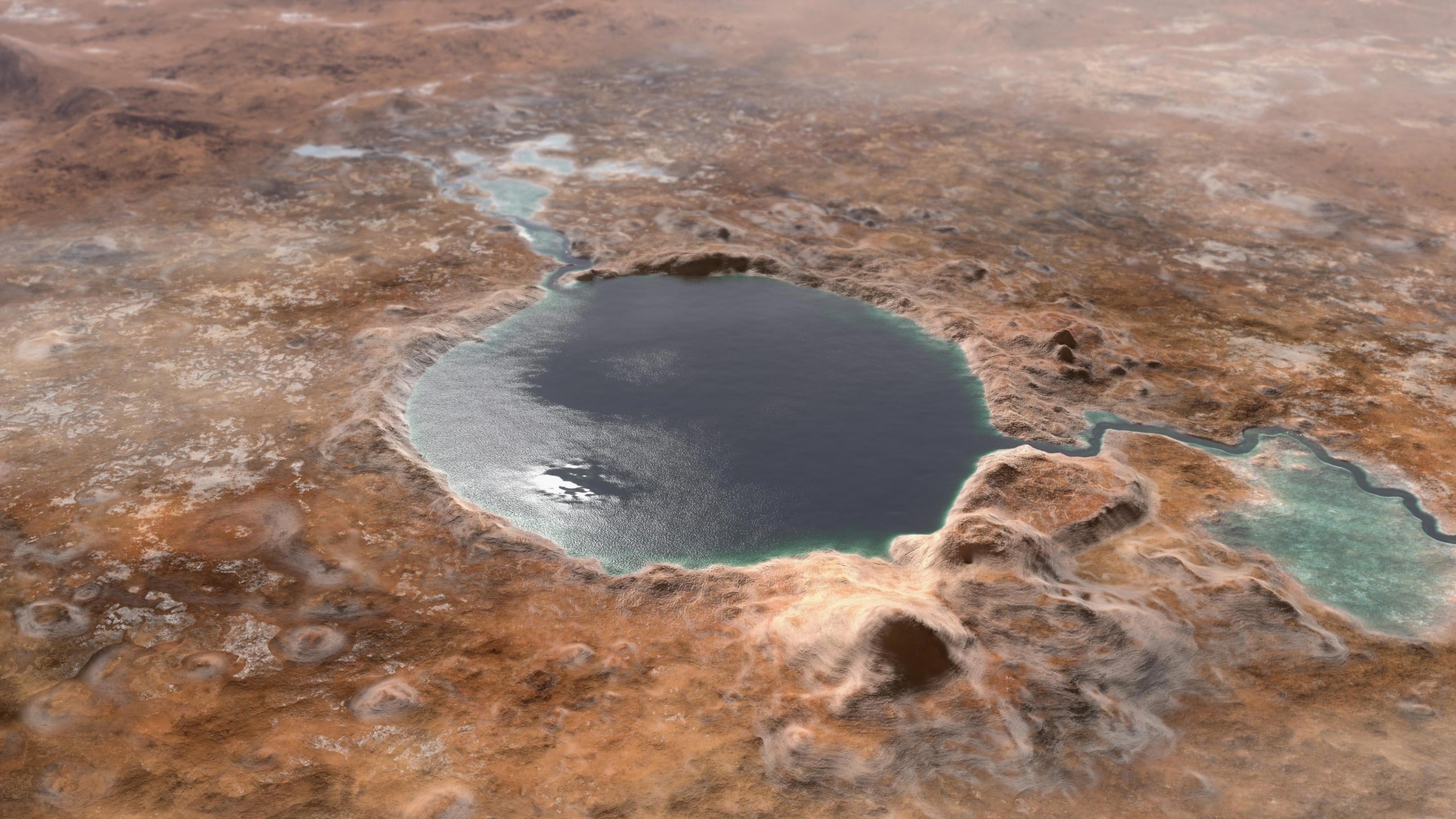 Perseverance has found that Jezero Crater was shaped by at least three different episodes of water activity, revealing a surprisingly complex chapter in Mars’ ancient past. Credit: NASA/JPL-Caltech
SuperCam Reveals Mars’ Hidden Chemistry
Much of the evidence came from SuperCam, an instrument mounted high on Perseverance’s mast. SuperCam helps scientists identify minerals by examining the light reflected from Martian rocks.
When researchers select a promising target, SuperCam can also fire a laser at it from as far as 21 feet (6.5 meters) away. The laser briefly turns a small amount of the rock into plasma. By analyzing the spectrum of that plasma, scientists can determine the rock’s chemical composition.
Using this technique, Perseverance has studied more than 185 bedrock targets throughout the Margin Unit.
“Before we arrived at the Margin Unit, the main hypothesis — derived from orbital observations — was that the carbonate seen from orbit formed from interaction with the lake that existed in Jezero Crater,” said Candice Bedford, a research scientist at Purdue University in West Lafayette, Indiana, and the study’s lead author. “But now we know that this location became a sort of crossroads for aqueous systems. The Margin Unit findings are important because Jezero Crater sits inside one of the largest exposures of carbonate on Mars, so what we learn here reaches well beyond this crater.”
 This image of Mars’ Jezero Crater is overlaid with mineral data detected from orbit. The green color represents carbonates – minerals that form in watery environments with conditions that might be favorable for preserving signs of ancient life. Credit: NASA/JPL-Caltech/MSSS/JHU-APL
Ancient Magma Cooled Beneath the Surface
Perseverance investigated the Margin Unit across approximately 870 feet (265 meters) of elevation. At the higher elevations, the rover encountered coarse, crystalline rock containing the mineral olivine. These rocks showed very little evidence of past contact with water.
Olivine contains magnesium and iron. Researchers concluded that this portion of the Margin Unit formed from a body of magma deep underground. The magma cooled slowly, giving the mineral grains enough time to grow relatively large.
The rocks were eventually exposed at the surface after overlying material eroded away.
Farther downhill, closer to the ancient lakebed, the rocks looked very different. There, olivine grains had been fractured, with silica appearing between them, indicating that water had altered the original rock.
Carbonate and silica are especially interesting in the search for signs of ancient life. On Earth, reactions between water and olivine can release hydrogen, which some microbes can use as an energy source. Those reactions can also produce carbonate and silica, minerals capable of preserving traces left behind by microorganisms.
Three Separate Episodes of Water
Researchers can reconstruct the order in which water altered the Margin Unit, although they cannot yet determine exactly when each episode occurred.
The first event involved groundwater rich in carbon dioxide. That water reacted with olivine and produced carbonate within fractures in the bedrock at lower elevations.
As erosion gradually removed the softer surrounding rock, the harder carbonate-filled fractures remained behind, creating raised ridges that Perseverance can observe today.
A second episode of water may have been connected to the lake that once filled Jezero Crater.
“Some of the Margin Unit rocks also contain silica,” said Eleni Ravanis, a planetary scientist at the University of Hawaii at Manoa and a coauthor of the study. “Turning olivine into carbonate can leave silica behind, and we see more of that silica in rocks that sat below the water line.”
Hot Water Flowed Through the Rocks Later
A third and later episode produced mineral veins at one location in the eastern Margin Unit. These veins measure about 10 inches (25 centimeters) thick and contain minerals including calcium sulfate and fluorite.
Fluorite provides an especially important clue. On Earth, it commonly forms when hot water circulates through volcanic rocks.
Its presence therefore suggests that heated underground water moved through this part of Jezero Crater after the earlier groundwater and lake-related events had already altered the rocks.
Together, the observations show that the Margin Unit was influenced by several different water systems over time rather than by a single ancient lake event.
“If there is one thing I have learned after 10 years working with Mars rovers, it is that Mars constantly throws surprises at you,” said Bedford. “It is very rare that things are as we expect them to be from orbital data. I hope this work helps reshape how scientists view the history of water in Jezero Crater and across Mars. Ultimately, I hope it helps planetary scientists reconstruct the changing climate and habitability of early Mars.”
Reference: “Lake- and groundwater-associated alteration of the olivine-rich Margin unit in Jezero crater, Mars” by Candice C. Bedford, Eleni Ravanis, Roger C. Wiens, Elise Clavé, Julene Aramendia, Juan Manuel Madariaga, Eleanor Moreland, Stephanie Connell, Alexander Jones, Briony Horgan, Olivier Forni, Bradley Garczynski, Susanne Schröder, Kenneth Williford, Linda Kah, Kathryn Stack, Lucia Mandon, Agnés Cousin, Pierre Beck, Erwin Dehouck, Clément Royer and Adrian Brown, 21 September 2026, Communications Earth & Environment.
DOI: 10.1038/s43247-026-03997-9
Never miss a breakthrough: Join the SciTechDaily newsletter.
Follow us on Google and Google News.






















 English (US) ·
  French (CA) ·
  French (FR) ·