

PROTECT YOURSELF with Orgo-Life® QUANTUM TECHNOLOGY
Orgo-Life the new way to the future Advertising by Adpathway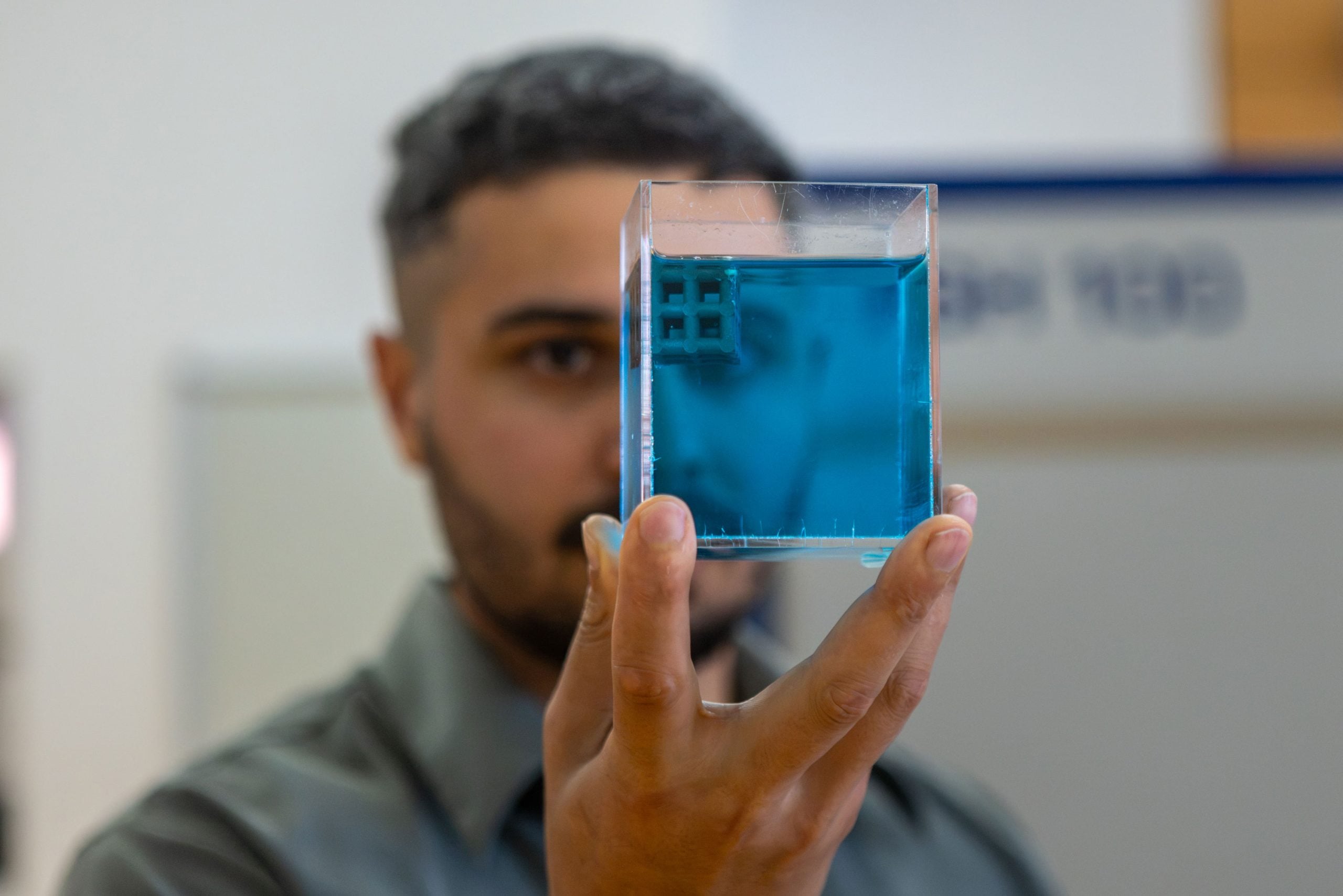 Dr. Jordan Noronha holding a sample of the floating titanium. Credit: Sara Tan, RMIT
Australian engineers have developed a strong, lightweight titanium material that remains afloat even after severe damage, offering a potential new option for marine infrastructure.
Buoys, floating sensors, and other marine structures depend on sealed spaces to keep water out and stay afloat. A serious crack can flood those spaces and send the entire structure underwater. Engineers, therefore, need materials that can survive harsh marine conditions without sacrificing strength, low weight, or buoyancy. Stainless steel and high-density plastic are widely used for this equipment, but neither solves the problem of keeping a damaged structure afloat.
Metallic lattice structures appear well suited to that challenge because their intricate frameworks can be extremely light while retaining considerable strength. Their open architecture, however, creates a fundamental problem in water. Liquid can move freely through the interconnected spaces, eliminating the flotation advantage that their low overall density might seem to provide.
“Although metallic lattices can be incredibly light – with densities less than one-tenth the density of water – their open, interconnected spaces allow water to enter, causing them to sink,” said Dr. Jordan Noronha, lead researcher from RMIT University’s Centre for Additive Manufacturing.
“This has made these strong, lightweight structures unsuitable for marine infrastructure – until now.”
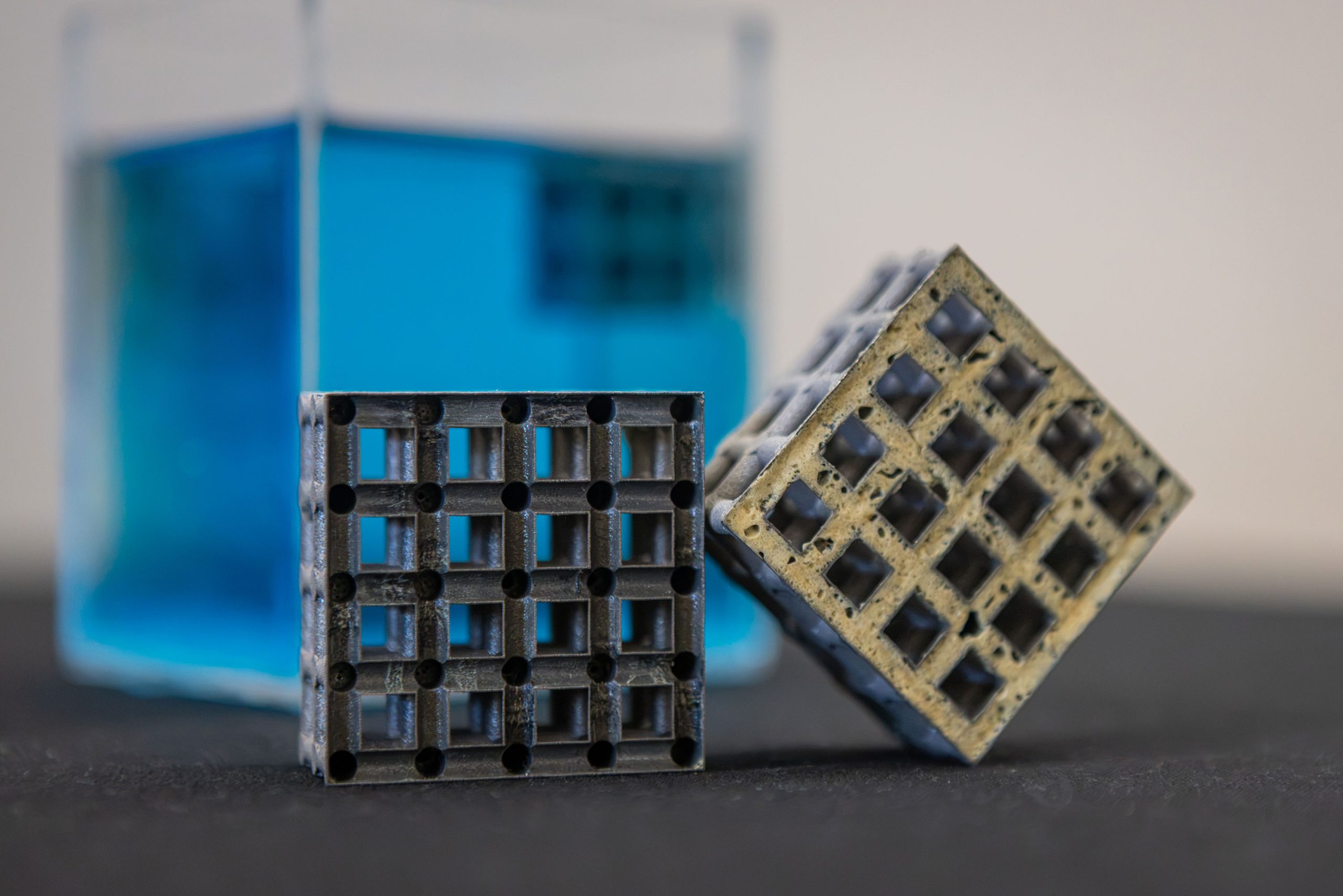 Cross sections of the titanium lattice cube showing before and after being filled with polyurethane foam for buoyancy. Credit: Sara Tan, RMIT
Foam-filled struts preserve buoyancy
Researchers led by RMIT University addressed that weakness by 3D printing a titanium lattice composed of hollow, interconnected struts and filling those struts with polyurethane foam. The spaces surrounding the struts remain open, so water can pass through the lattice itself rather than being blocked by a sealed outer shell.
“By filling only the hollow titanium struts with polyurethane foam, we created a structure that allows water to flow through it while remaining buoyant even after significant cracking and damage,” Noronha said.
Samples remained afloat in freshwater for more than two months, providing sustained evidence of their buoyancy. According to the researchers, the work represents the first reported demonstration of a floating metal-hybrid lattice metamaterial.
A new rule for predicting flotation
Predicting whether an open structure like this will float required the team to rethink how its density should be calculated. Conventional calculations count all the open space inside a lattice, even though that space can fill with water and therefore contributes nothing to keeping the structure above the surface.
The researchers instead developed a measure called “skeletal density,” which counts only the portions of the structure that exclude water. In their design, those portions are the titanium walls and the sealed, foam-filled channels inside them.
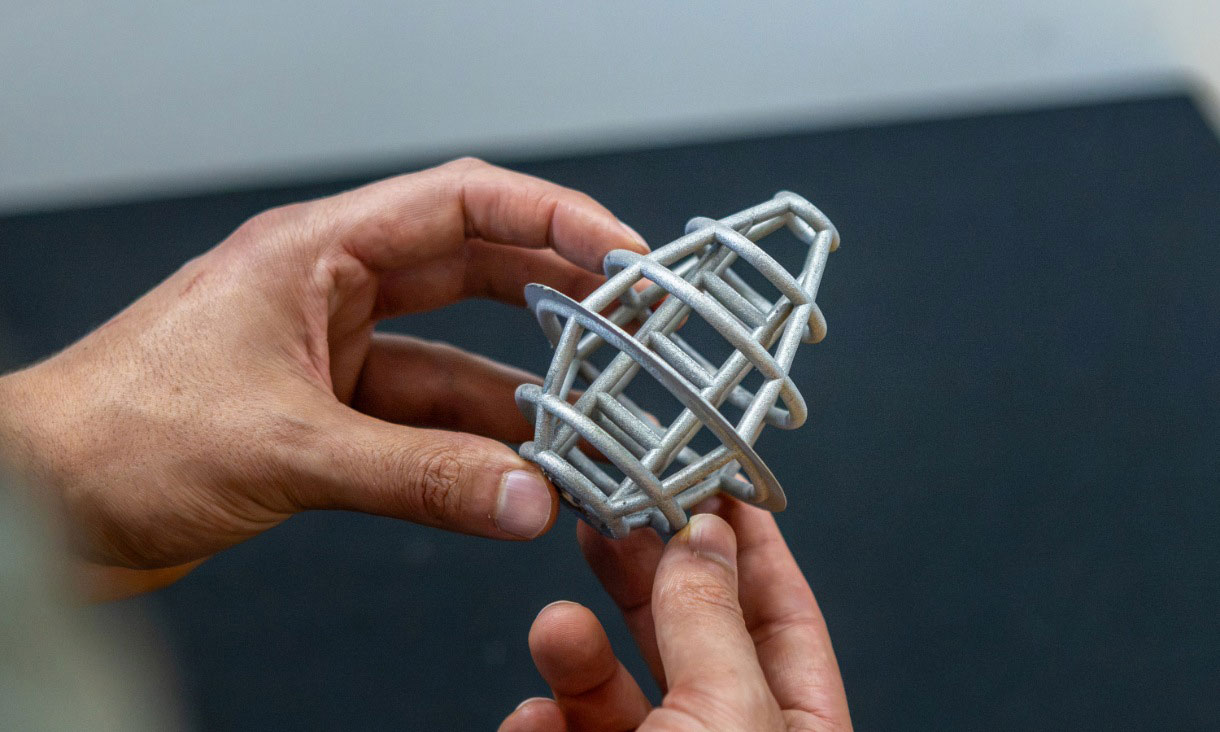 The 3D-printed buoy used in testing. Credit: Sara Tan, RMIT
“This gives engineers a simple design rule: if the skeletal density is lower than that of the surrounding liquid, the structure will float—even when water flows through all its external openings,” Noronha said.
Strength and flotation survive damage
The titanium lattice also carried substantially greater loads than materials already used in marine applications. When the researchers compared materials at the same overall density, their structure was 70% stronger than stainless steel or high-density polyethylene.
Exposure to seawater produced relatively little deterioration during short-term testing. After two weeks submerged in natural seawater collected from Melbourne’s Port Phillip Bay, the lattice had lost just 0.15% of its mass, while its strength declined by less than 1%.
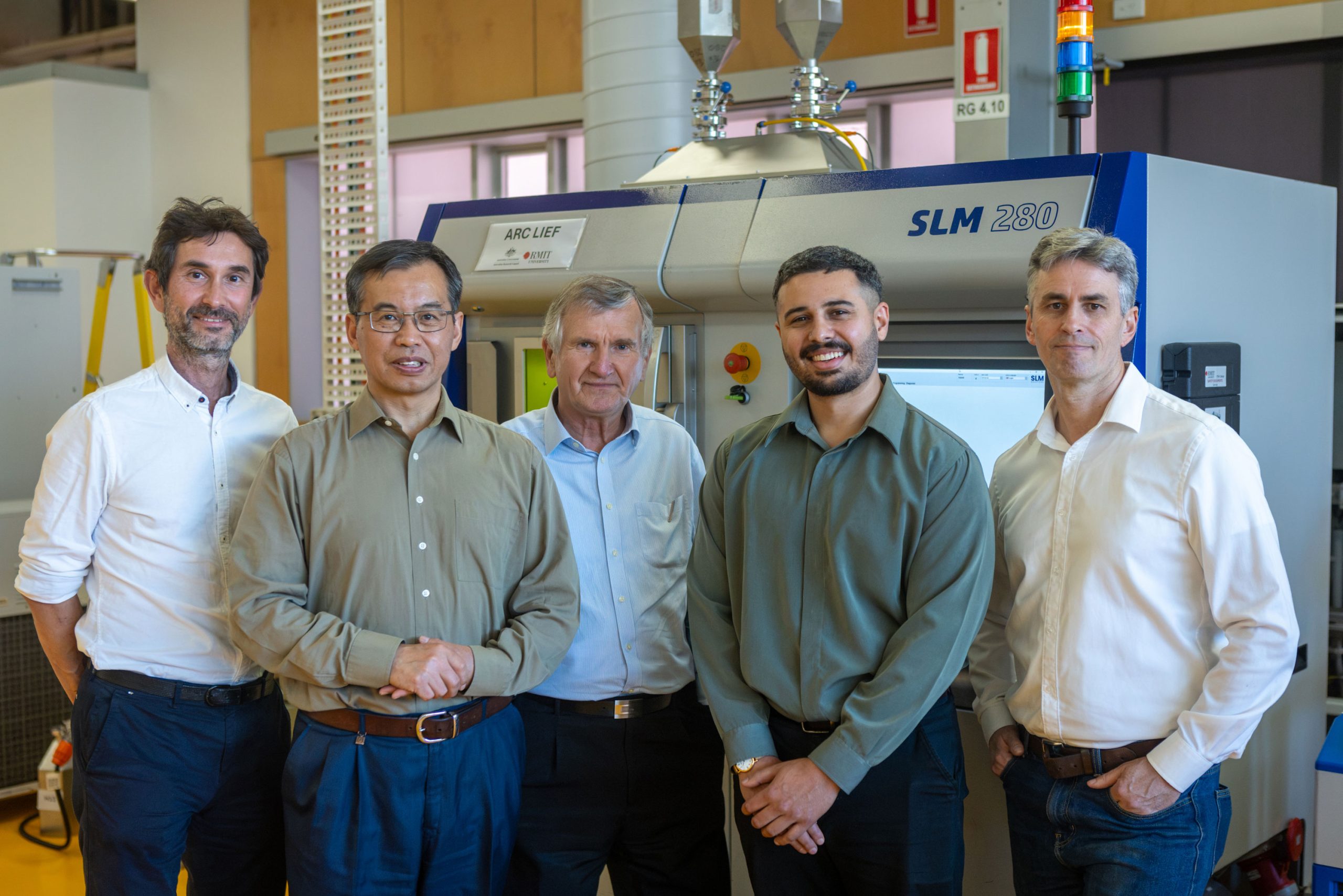 The project team: Associate Professor Andrey Molotnikov, Distinguished Professor Ma Qian, Distinguished Professor Milan Brandt, Dr. Jordan Noronha and Professor Martin Leary at RMIT’s Centre for Additive Manufacturing. Credit: Sara Tan, RMIT
Cracks and structural failures did not immediately compromise flotation either. The hybrid lattice continued to float after significant damage that included cracking, failures at important connection points, and the fracture of an entire lattice layer. It sank only after being severely crushed and compacted.
“Tiny, sealed cells in the foam trap gas and prevent water from flooding the hollow struts,” Noronha said.
“In this way the foam acts as a distributed barrier that helps the structure remain afloat after damage – unlike conventional hollow marine structures, which can rapidly fill with water after cracking.”
The team built a 3D-printed marine buoy to demonstrate how that combination of open structure and distributed flotation could work in practice. In a turbulent seawater tank, the buoy remained stable as it was rotated as much as 45 degrees, without a sealed casing, protective coating, or additional flotation system.
Longer marine tests come next
Project leader Distinguished Professor Ma Qian said the researchers now plan to scale up their demonstration components and examine how the material performs over longer periods under realistic marine and deep-sea conditions.
Its internal structure can also be altered for uses beyond flotation. “By changing the material inside the titanium framework, we could tailor a similar structure for energy absorption, thermal management, vibration control and other applications,” Qian said.
Reference: “Breaking the Surface: Buoyant Metal–Polymer Open–Cell Hybrid Lattice Metamaterials” by Jordan Noronha, Joey Tallon, Raad Omar, Jason Dash, Andrey Molotnikov, Martin Leary, Milan Brandt and Ma Qian, 28 August 2026, Advanced Materials.
DOI: 10.1002/adma.74641
This project was funded by the Australian Research Council (ARC) through DP250103847 and LE230100147, and through the RMIT School of Engineering (SENG) Crazy Idea Initiative.
Never miss a breakthrough: Join the SciTechDaily newsletter.
Follow us on Google and Google News.




















 English (US) ·
  French (CA) ·
  French (FR) ·