

 1 month ago
4
PROTECT YOURSELF with Orgo-Life® QUANTUM TECHNOLOGY
Orgo-Life the new way to the future Advertising by AdpathwayLeaders set ambitious goals to better the world by 2030. They've made little progress
In 2015, global leaders set ambitious goals to reduce inequality, end hunger and boost education. More than a decade later, the world is nowhere near achieving much of what was promised.
Transcript
STEVE INSKEEP, HOST:
World leaders agreed in 2015 to set a series of goals to improve everything from clean water to world peace. They hope to meet those goals by 2030. As United Nations leaders meet this week in New York, reporter Kamala Thiagarajan checked in on how they're doing. Welcome.
KAMALA THIAGARAJAN: Hi, Steve.
INSKEEP: Are any of these goals going to be met?
THIAGARAJAN: I would say very few, if any. You know, and that's because the world is nowhere close to achieving what leaders set out to do in 2015. Representatives from all over the world signed off on these goals like gender equality, clean water and sanitation, peace, justice, strong institutions, and these goals were broken down into many measurable targets. Just 15% of these targets are on track. Roughly half are making marginal progress, but others are stagnant. They're not going anywhere. And some of these goals - we're even worse off than we were in 2015.
INSKEEP: Wow. So are we making any progress as a planet?
THIAGARAJAN: Some of the health goals are actually seeing some positive trends. So experts I talked to told me that child mortality rates are going down, fewer babies are dying and life expectancy is increasing. Paul Spiegel, the director of the John Hopkins Center for Humanitarian Health in Baltimore, says that the goals worked where money, technology, political will all lined up. For instance, he says that since 2015, a lot more people have access to safe drinking water. Electricity reaches 92% of the world. Seventy-four percent of the world is connected to the internet.
INSKEEP: OK. So electricity, internet access - things like that are good. Which ones are not so good?
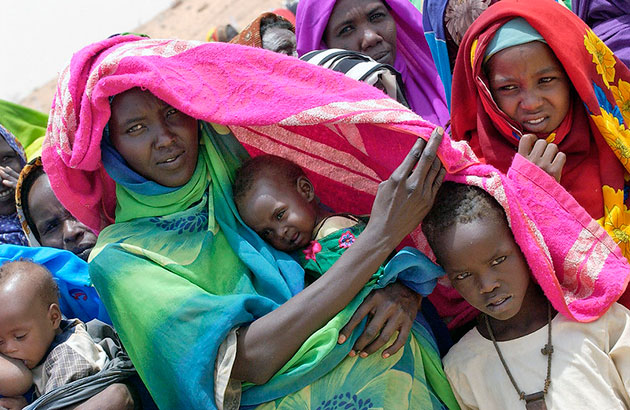
THIAGARAJAN: Hunger, especially due to crises. So more people are not getting enough to eat, and the number of refugees relative to the global population has more than doubled since 2015. And on the environmental front, species are going extinct, and there's a lot of hazardous waste as the world's appetite for electronics and related goods soars. So Andrew Shepherd from the Institute of Development Studies in the U.K. says policymakers really need to be better at anticipating these crises and responding to emergencies.
INSKEEP: What else do experts say governments should have been doing?
THIAGARAJAN: Experts want to see governments build resilient institutions that actually help people, such as giving people more easier access to loans, for instance, to get them through the hard times. So also, experts say, focusing on climate and environment is key. Investing more in climate resilience, for instance, and increasing disease surveillance, community infrastructure, strengthening food, agriculture, social systems - all of this will help.
INSKEEP: You know, it must have seemed like a nice idea in 2015 to set goals like world peace. But were these goals overall just unrealistic?
THIAGARAJAN: That's a question that experts continue to debate. I talked to Charles Kenny, who's with a Washington, D.C., think tank called the Center for Global Development. He says the goals are not impossible to achieve, but it would take dramatic policy change from participating countries.
And I think you're right. And, I mean, it's hard to imagine that kind of global cooperation today because we live in a world where there's so much unresolved conflict and a lot of bad sentiment. So it's a very different world from 2015. But what experts remind us is that, like, governments just have to prioritize these goals in order for them to succeed, and they're not unachievable. It's also important to note that even if a country is not achieving a goal, they still may be making progress on it. So they say that there's still reason for hope.
INSKEEP: That's Kamala Thiagarajan, and you can read more of her reporting at npr.org.
(SOUNDBITE OF MUSIC)
Copyright © 2026 NPR. All rights reserved. Visit our website terms of use and permissions pages at www.npr.org for further information.
Accuracy and availability of NPR transcripts may vary. Transcript text may be revised to correct errors or match updates to audio. Audio on npr.org may be edited after its original broadcast or publication. The authoritative record of NPR’s programming is the audio record.











 English (US) ·
 French (CA) ·
 French (FR) ·