

 1 day ago
4
1 day ago
4
PROTECT YOURSELF with Orgo-Life® QUANTUM TECHNOLOGY
Orgo-Life the new way to the future Advertising by AdpathwayNot all mountain bikes feel the same on the trail. Some respond instantly, inspiring confidence with every turn, while others can feel vague or sluggish, even in identical conditions. A key factor behind this is lateral frame stiffness.
In this article, I’ll break down where lateral stiffness on a mountain bike comes from, why some bikes feel “alive” while others feel “dead”, how frame materials and design shape the ride, and how to find a bike with more or less lateral rigidity.
Let’s dive in!
How Lateral Frame Stiffness Shapes Bike Handling

When you lean the bike, snap it from side to side, or hit an obstacle at an angle, lateral forces act sideways across the bike (perpendicular to your direction of travel). Those forces pass through every structure between the ground and the rider: the tyres first, then the wheels, through the fork and frame, and finally into the cockpit.
Excessive flex can reduce steering accuracy, mute trail feedback, and in extreme cases even allow the tyre to contact the frame’s chainstays under load. On the other hand, an overly stiff frame can feel harsh, amplify trail chatter, and diminish ride feel.
So, what’s the optimal amount of lateral stiffness for a mountain bike frame?
Unfortunately, there isn’t a single ideal stiffness value. The forces acting on a bike vary enormously between riders because terrain, body weight, speed, and riding style all influence how much load is fed into the frame and components.
Heavier or more aggressive riders (who generate higher peak forces) will generally benefit from stiffer frames. Lighter riders, or those with smoother inputs, may find that a more compliant frame delivers better control and comfort.
Measuring the Lateral Stiffness of Different Bike Components
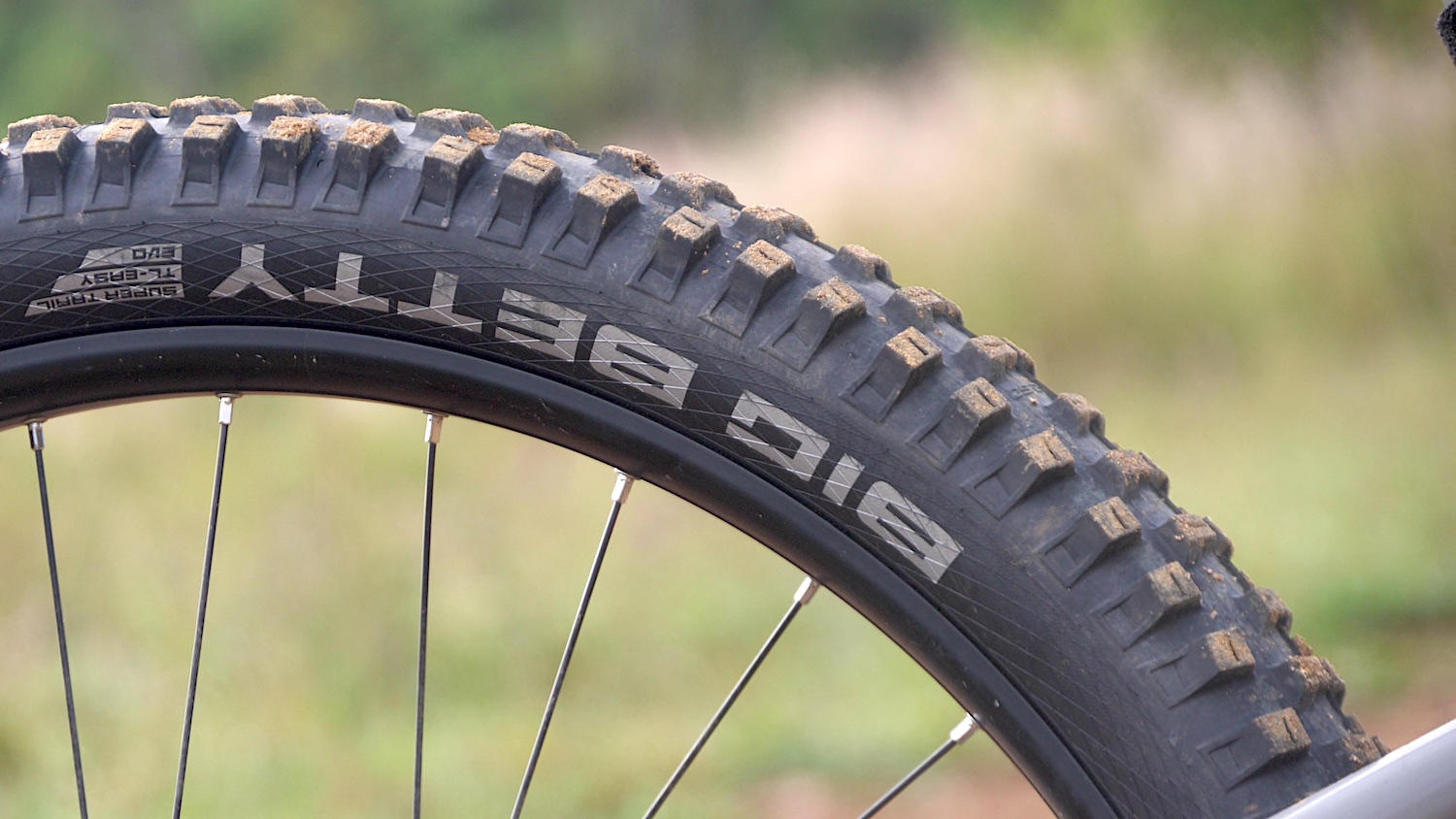
It’s easy to assume the tyres would be the least laterally stiff component. After all, mountain bikes have low-pressure tyres, and vertical tyre compliance has a major influence on ride comfort.
But according to laboratory testing by BIKE Magazin, tyres remain relatively stable under lateral loads.
The stiffest component laterally is the wheels, thanks largely to their wide spoke bracing angles and rim width. Tyres rank second, followed by suspension forks – which, in most cases, are stiffer laterally than the front centre of a frame.
To put numbers on it: wheels are roughly 2.5x stiffer laterally than tyres, 5x stiffer than forks, and about 7x stiffer than frames.
And when looking closer at the frame, there’s a clear split between the front and rear centres. The front centre – from the frame’s bottom bracket to the front wheel axle – consistently measures as the least laterally stiff section, typically 3 to 4 times less stiff than the rear centre.
This is important because the front centre stiffness plays a very large role in ride feel.
Why the Frame Dominates Ride Feel
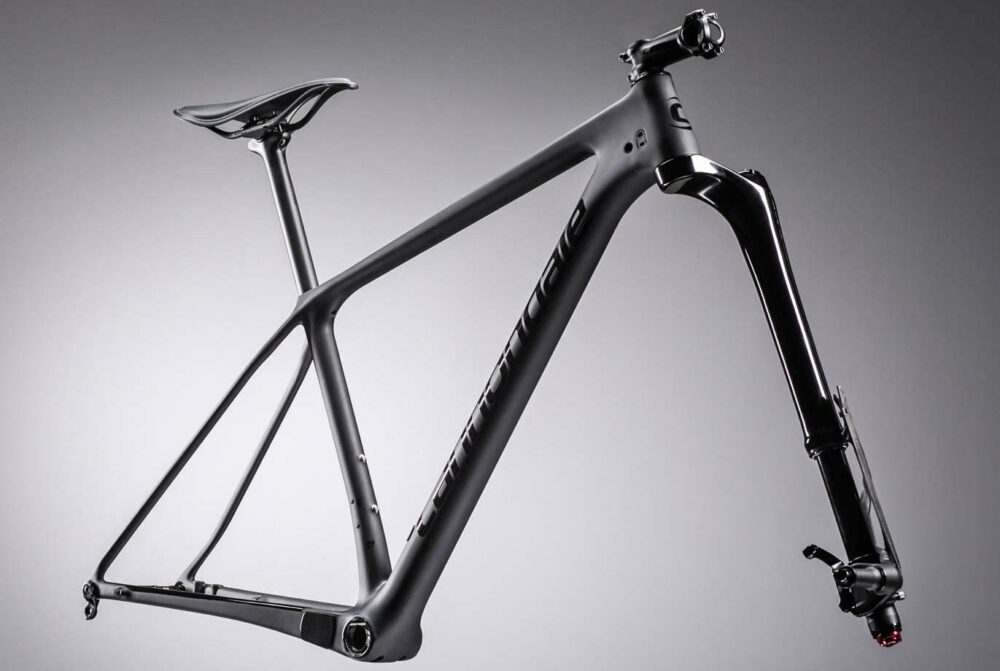
From a mechanical standpoint, the tyres, wheels, fork, and frame behave like a series of springs connecting the rider to the ground. In such a system, overall stiffness is determined by the softest spring.
That softest spring in this case is the front centre. It’s the section where the majority of lateral deflection occurs. As a result, much of a bike’s ride feel is dictated by the frame itself rather than the individual components bolted onto it.
Of course, this assumes all other variables (geometry, components, suspension, and setup) are identical between the bikes being compared.
In addition, because the system is constrained by its least stiff element, making any other component stiffer laterally results in only marginal gains. As we’ll see later, even large differences in wheel stiffness translate into surprisingly small changes in overall system stiffness.
Frame Materials and Lateral Stiffness
 This test rig gives us very useful information about different MTB frames. Image: BIKE Magazin
Bike designers can tune the lateral stiffness of any frame material to suit a bike’s intended purpose. They achieve this by adding material where needed or by altering tube shapes and profiles to control how the frame flexes.
For mountain bikes subjected to higher forces (such as downhill or enduro), frames are typically tuned to be stiffer. For bikes designed for lower-force disciplines, like cross-country, they are usually engineered to be less stiff.
Looking at average values, aluminium frames tend to be laterally stiffer than carbon frames. Across all bikes tested by BIKE Magazin, aluminium frames are about 14% stiffer at the front centre.
However, the stiffness differences between bike frames of the same material vary significantly. Between carbon frames, it’s not unusual to see variations of 50 to 100% in lateral frame stiffness. This means some carbon frames are literally twice as stiff as others, which has a dramatic effect on how a bike feels under a rider.
The stiffness variation is much smaller amongst aluminium frames, but it can still be anything from 18% through to 45%, with the biggest differences found in the longer travel mountain bikes.
I’ve compiled frame stiffness data from about 100 frames from BIKE Magazin into tables showing the lowest, highest, and average stiffness for the front and rear centres of both carbon and aluminium frames.
XC Hardtails
| Minimum Stiffness (N/mm) | Maximum Stiffness (N/mm) | Variation from Min to Max | Average Stiffness (N/mm) | |
| Carbon Frame | 4.4 | 6.1 | 39% | 5.2 |
| Aluminium Frame | 6.0 | 7.1 | 18% | 6.4 |
Among cross-country hardtails, aluminium frames feature front centres that are, on average, about 23% stiffer than carbon. This is a meaningful difference in terms of ride feel and will likely be perceived by riders.
That said, the stiffest carbon frame tested was similar in stiffness to the least stiff aluminium frame. In other words, material alone won’t determine ride feel – careful model selection is still essential if you’re chasing a specific feel.
When looking at the averages, I suspect smaller or lighter riders will find that carbon XC hardtails deliver a more responsive and lively character that best matches their weight and riding style.
Full Suspension Trail Bikes (130-150 mm)
| Minimum Stiffness (N/mm) | Maximum Stiffness (N/mm) | Variation from Min to Max | Average Stiffness (N/mm) | |
| Carbon Frame | 4.0 | 7.9 | 98% | 6.2 |
| Aluminium Frame | 6.0 | 8.1 | 35% | 6.7 |
On full-suspension trail bikes, the front centre of aluminium frames is only about 8% stiffer than carbon – a difference that’s unlikely to be noticeable on the trail. Because trail bikes are ridden harder than XC hardtails, the stiffness gap between materials tends to shrink on average.
That said, the range of stiffness among carbon frames is enormous, with some models twice as stiff as others. In practice, this means a broad array of carbon trail bikes are just as stiff as aluminium ones. Consequently, you’ll need to compare specific models rather than assuming that carbon automatically means a more compliant ride.
Full Suspension Enduro Bikes (150 mm+)
| Minimum Stiffness (N/mm) | Maximum Stiffness (N/mm) | Variation from Min to Max | Average Stiffness (N/mm) | |
| Carbon Frame | 3.8 | 7.5 | 97% | 5.9 |
| Aluminium Frame | 5.8 | 8.4 | 45% | 6.9 |
For full-suspension enduro bikes, aluminium front centres are roughly 17% stiffer than carbon on average – a difference some riders might notice.
But again, variation among carbon frames remains substantial, with some front centres twice as stiff as others (though most cluster around 6 N/mm). This once again underscores the need to compare specific models rather than assuming carbon automatically means a more compliant ride.
What About Steel Frames?

Steel frames have a long-standing reputation for being more laterally compliant than other materials. But does the data actually support that belief?
Unfortunately, very few steel frames have been measured using BIKE Magazin’s current test rig. At the moment, we have just one relevant data point: the Kona Unit. Its front triangle measured 7.4 N/mm, making it 42% stiffer than the average carbon hardtail frame, and 16% stiffer than the average aluminium frame. The Kona Unit’s front centre is actually the stiffest of any hardtail frame measured so far!
Of course, we can’t draw broad conclusions from a single example. But this result reinforces an important point: frame material alone tells us very little about how a bike will actually ride. That applies to steel frames too!
Now, what happens when you install stiffer wheels on a bike?
Wheels Affect Ride Feel Less Than You Think
 To read this graph, first choose a frame-and-fork stiffness value on the X-axis. From there, move vertically upward until you intersect the line representing your chosen wheel stiffness. Then trace horizontally to the Y-axis to find the combined stiffness of the frame-fork-wheel system.
Increasing wheel stiffness does increase the system’s overall lateral stiffness, but the effect is smaller than many riders expect.
As the graph above demonstrates, if a frame has a front-centre stiffness of 6 N/mm, doubling the wheel stiffness (from the least stiff to the stiffest option) boosts the combined frame–fork–wheel system stiffness by only about 6%. In absolute terms, that’s a change from 4.6 to 4.9 N/mm.
For most riders and real-world riding conditions, a difference that small is unlikely to be noticeable. So if you’re hoping a stiffer carbon wheelset will dramatically sharpen the cornering of a flexy mountain bike, physics suggests the improvement will be modest at best.
The opposite is also true: installing more compliant wheels on a stiff frame has surprisingly little impact on the total system stiffness.
That said, there is some evidence that polymer, string-like spokes can improve vibration damping. In one test, they reduced horizontal vibration energy by 16% compared to steel spokes. Riders often describe bikes with polymer-spoked wheels as feeling calmer and more composed over rough terrain, and reduced vibration transmission may help explain that impression.
Summary

Lateral stiffness plays a major role in how a mountain bike feels on the trail, and it’s the front centre that largely defines that ride character.
On average, aluminium frames measure slightly stiffer laterally than carbon frames. But the variation within each material category is often greater than the difference between them. Some carbon frames are nearly twice as stiff as others, making it clear that material choice alone doesn’t determine ride feel.
In practice, there’s substantial overlap between aluminium and carbon frames, highlighting the importance of measured lateral stiffness rather than relying on material assumptions.
If you truly want to know which frame delivers the stiffness characteristics that suit you best, you need data. Testing from BIKE Magazin (covering around 100 mountain bike frames) offers one of the most comprehensive looks at how bikes deform under load, helping you to make decisions based on measured performance rather than marketing claims.






















 English (US) ·
  French (CA) ·
  French (FR) ·