

 1 month ago
76
1 month ago
76
PROTECT YOURSELF with Orgo-Life® QUANTUM TECHNOLOGY
Orgo-Life the new way to the future Advertising by AdpathwayEnergy: Guyana
Key Facts
—What happened. Guyana’s oil output fell four months running, from 918,000 barrels a day in February to 869,000 in June.
—Why it matters. Guyana is now South America’s second-largest producer, behind Brazil.
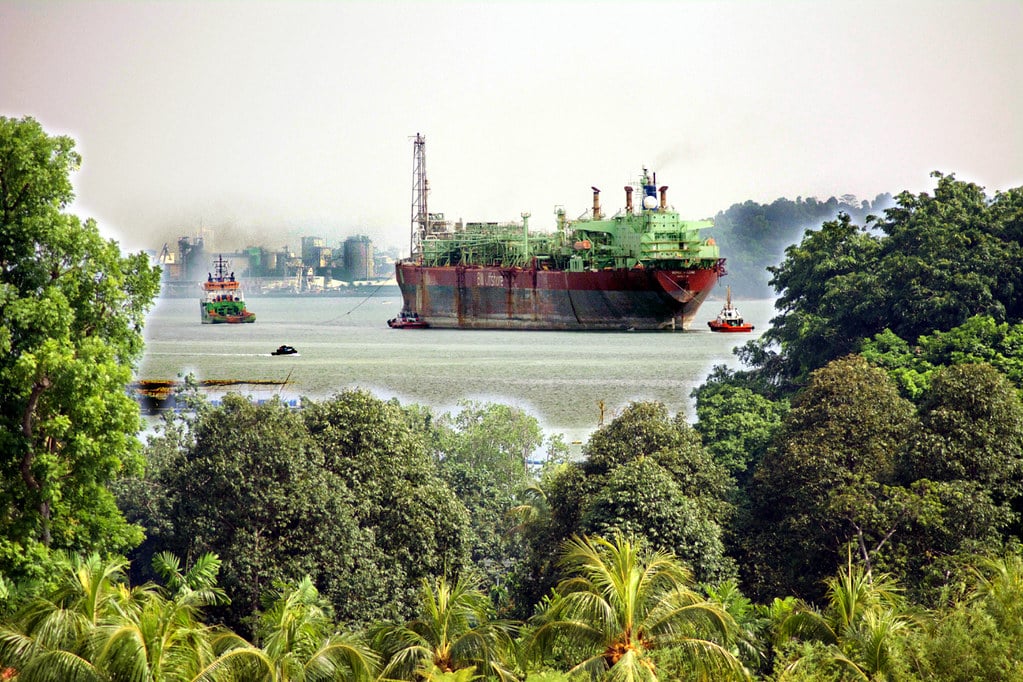
—The answer arrived. The Errea Wittu, a 250,000-barrel-a-day production ship, reached Guyana’s coast on 20 August.
—The catch: Arrival is not first oil. The government says September, ExxonMobil guides to the fourth quarter.
—The money. US$1.996 billion flowed into the sovereign wealth fund in the first half of 2026.
—What comes next. Uaru targets over 800 million recoverable barrels and should push Guyana past a million a day.
South America’s newest oil power has hit its first sustained production dip — a four-month slide that says less about decline than about timing: the ship built to carry Guyana past one million barrels a day has arrived.
One-stop reference
Company Intelligence
Every listed company in Latin America — financials, ownership and structure for 1,450+ companies across 26 exchanges, in one place.
Four Straight Months of Decline
The numbers trace a clear arc. After 915,000 b/d in January and a record 918,000 b/d in February, output eased to 910,000 in March and 903,000 in April — then slipped to 895,000 b/d in May and 869,000 b/d in June, according to government data reported by OilNOW on August 14, 2026.
The weakness sits mostly in one place: Liza 1, the development that started it all in December 2019. It produced 122,000 b/d in April, against a first-quarter average of 129,000 b/d, as natural decline sets in. The newer projects compensate — in April, Liza 2 delivered 259,000 b/d, Payara 261,000 and Yellowtail 262,000, all above their original nameplate capacities after optimization work.
Context matters: even with the slide, Guyana produced about 82.2 million barrels in the first quarter alone, averaging roughly 914,000 b/d, and remains South America’s second-largest oil producer behind Brazil.
One Billion Barrels and Counting
The dip landed in the same week as a milestone. Speaking at the launch of the 2027 Guyana Energy Conference on 14 August 2026, ExxonMobil Guyana president Alistair Routledge said the country may already have produced more than one billion barrels of oil since offshore production began less than seven years ago.
The scale behind that figure is staggering. The ExxonMobil-led consortium has committed more than US$60 billion to develop seven government-sanctioned projects in the 6.6-million-acre Stabroek Block, where discoveries to date are estimated at about 11 billion barrels of oil equivalent.
The Ship That Takes Guyana Past a Million
The answer to the dip is already at sea. The Errea Wittu, the vessel built for the US$12.7 billion Uaru development, was positioned off Guyana’s coast on 19 August and arrived the next morning. Guyana’s Ministry of Natural Resources welcomed it on 21 August.
Uaru, Guyana’s fifth project, is designed to add roughly 250,000 b/d and is scheduled to start up before the end of the year — lifting total capacity above one million barrels per day. Behind it, Whiptail follows in 2027 with another 250,000 b/d, and Hammerhead, the seventh sanctioned project, adds 150,000 b/d from 2029. ExxonMobil’s stated vision is 1.7 million b/d from eight developments by 2030.
What the Dip Means for Georgetown’s Coffers
For the government, lower volumes are cushioned by price and timing. Official Gazette notifications show US$1.996 billion was deposited into the Natural Resource Fund in the first half of 2026 — putting the country near the US$2.47 billion it earned in all of 2025. Finance Minister Ashni Singh told parliament on 27 July that the fund stood at just under US$4 billion at the end of May, and it reached US$4.35 billion by the end of July.
The operator split is unchanged: ExxonMobil runs the Stabroek Block with a 45% stake, Chevron holds 30% through its 2025 acquisition of Hess, and China’s CNOOC holds 25%. With cargoes going mainly to the Netherlands, Britain, Panama, Spain, Italy and the United States, Guyana’s barrels have become a strategic supply line for the Atlantic basin.
Frequently Asked Questions
How much oil does Guyana produce per day in 2026?
Output peaked at 918,000 barrels per day in February 2026, then declined for four straight months to 869,000 b/d in June, according to government data. First-quarter production averaged about 914,000 b/d across the four producing Stabroek Block projects.
When will Guyana’s oil production pass 1 million barrels per day?
When the Uaru project starts up. Its Errea Wittu production ship, designed for about 250,000 b/d, arrived off Guyana on 20 August; the government says production could begin in September, while ExxonMobil guides to the fourth quarter. Uaru would push national capacity above one million b/d, with Whiptail due to add more in 2027.
Who operates Guyana’s offshore oil fields?
ExxonMobil operates the Stabroek Block with a 45% working interest. Chevron holds 30% through its 2025 purchase of Hess, and China’s CNOOC holds the remaining 25%. All of Guyana’s current production comes from this single block.
Sources: OilNOW; OilNOW Oil Ledger; ExxonMobil.
This article was drafted with automated assistance and reviewed before publication. How we use AI · Report an error

















 English (US) ·
  French (CA) ·
  French (FR) ·