

 2 months ago
70
2 months ago
70
PROTECT YOURSELF with Orgo-Life® QUANTUM TECHNOLOGY
Orgo-Life the new way to the future Advertising by Adpathway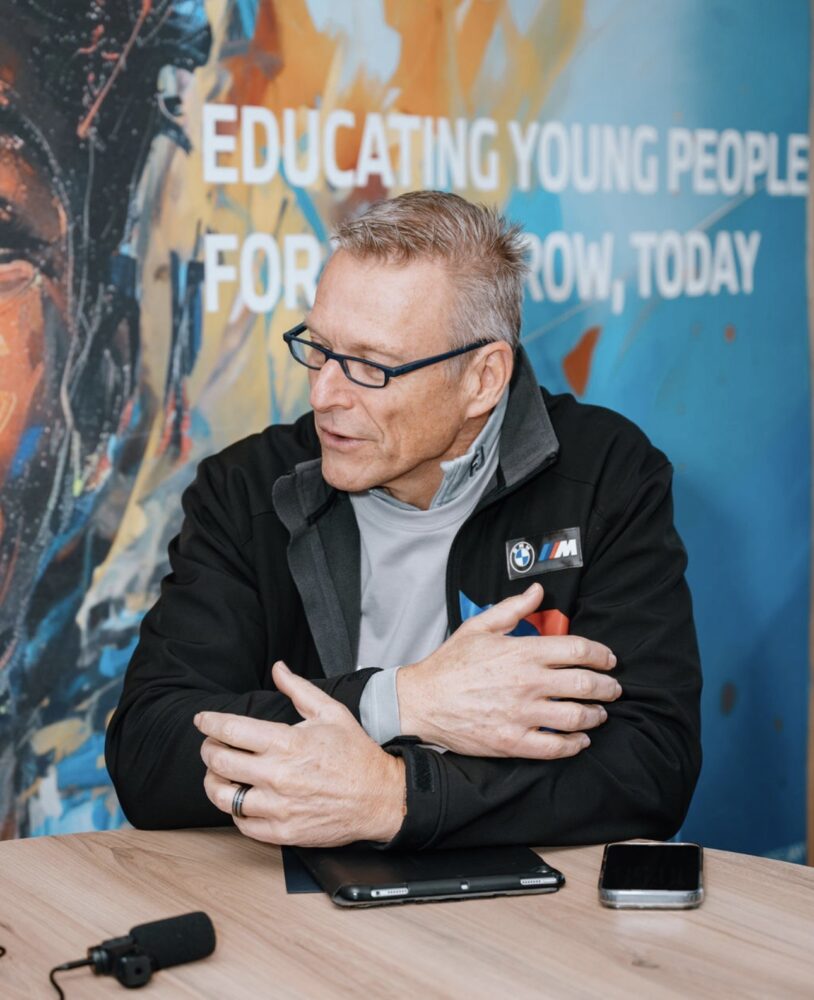
Peter van Binsbergen, Chief Executive Officer: BMW Group South Africa
South Africa has no shortage of graduates. It does, however, have a shortage of technicians, artisans, engineers, coders and other skilled workers.
That contradiction lies at the heart of what BMW South Africa chief executive Peter van Binsbergen sees as one of the country’s biggest economic challenges.
“There is a need for technical skills In SA and we need to educate people on what technical skills are needed in order to secure futures”” he said during an interview at Soshanguve School of Specialisation in Soshanguve, north of Pretoria.
“There’s no question about it.” At the same time, he added, many graduates continue to struggle to find work. “There’s actually plenty of people with degrees who can’t find jobs.”
His remarks speak to a tension that has long troubled South Africa’s labour market. Employers across sectors continue to report shortages of artisans, technicians, engineers, software developers and other specialised workers while youth unemployment remains among the highest in the world.
More than six out of every 10 South Africans between the ages of 15 and 24 are unemployed.
For van Binsbergen, addressing that challenge begins long before young people enter the labour market.
“The youth are the future of our country,” he said.
“If they’re unemployed, the question is what happens as they grow up, which direction do they grow in and what does it mean for the future of the country?”
Those concerns help explain why BMW has invested heavily in education initiatives around its Rosslyn manufacturing plant, including a long-running partnership with Soshanguve School of Specialisation.
The school, which focuses on engineering, mathematics, science and technical subjects, recently hosted the fifth STEM-focused Youth Day by BMW Group South Africa and UNICEF South Africa.
For van Binsbergen, the value of programmes such as these lies not only in teaching technical skills but in exposing young people to opportunities they may never otherwise encounter.
“You don’t know what you don’t know,” he said.
Many learners, particularly those from disadvantaged communities, have limited exposure to careers in engineering, software development, advanced manufacturing and technology. Career choices are often shaped by what young people see around them rather than by the full range of opportunities available in the economy.
Situated a short distance from BMW’s Rosslyn manufacturing plant, Soshanguve Engineering has built a reputation as one of Gauteng’s leading schools for specialised technical education. Learners move between robotics laboratories, automotive workshops, engineering spaces and conventional classrooms, combining academic learning with practical skills.
Van Binsbergen believes schools have an important role to play in helping young people discover where their interests lie.
“What they do at the school is really great,” he said. “When you leave school, you already have an idea of what you enjoy and can then take the next step in education or employment.”
For decades, technical education was often treated as a second-choice option for learners who were not considered academically inclined. Yet employers increasingly point to shortages of precisely the skills that technical and vocational institutions are designed to produce.
At schools such as Soshanguve Engineering, learners are exposed to robotics, engineering, automotive technology and coding alongside traditional academic subjects. They can pursue university studies, enter apprenticeships or continue through technical and vocational education programmes.
The pathways are different, but no less valuable.
“South Africa needs skilled people,” van Binsbergen said.
BMW’s investment in education forms part of what the company describes as a cradle-to-career approach. The model stretches from early childhood development through to secondary education, technical training, apprenticeships and workplace opportunities.
“We’re a technology company,” van Binsbergen said. “Whether it’s building cars, fixing cars, financial services or our IT hub, everything is technology driven.”
That reality is reshaping the kinds of skills businesses require.
Artificial intelligence, automation and digital technologies are becoming part of daily operations across industries. While much of the public debate has focused on whether technology will replace workers, van Binsbergen believes the more pressing question is whether workers are prepared to use the technology available to them.
“Artificial intelligence is not going to replace people,” he said. “But people using artificial intelligence will replace people who are not using artificial intelligence.”
The shift is already visible within BMW’s operations.
At the company’s Rosslyn plant, digital systems monitor production quality in real time using sensors, cameras and data analytics. Technology has changed the nature of work on the factory floor, but it has not removed the need for people.
Instead, it has increased demand for workers capable of analysing information, understanding systems and solving increasingly complex problems.
“You suddenly have all this data that needs to be analysed,” van Binsbergen said. “You need people who can understand the reports and understand what needs to change.”
The same applies within BMW’s IT operations, where artificial intelligence can assist software developers but cannot replace technical expertise or human judgement.
For young people entering the labour market, adaptability is becoming just as important as qualifications. Technology continues to evolve, creating demand for workers who can learn new systems, acquire new skills and work alongside increasingly sophisticated tools.
Yet when asked what distinguishes successful young people entering BMW through internships and youth employment programmes, van Binsbergen did not immediately mention technical expertise.
Instead, he returned to a quality that employers across sectors frequently cite but often struggle to define.
Attitude.
The most successful participants, he said, are often those who seek out opportunities, volunteer for responsibilities and demonstrate a willingness to learn.
“You can train skills,” he said. “But if you don’t have the right attitude, you can’t train that.”
BMW’s involvement extends beyond schools through apprenticeship programmes, internships and participation in the Youth Employment Service initiative. The intention is to create pathways into employment and to help young people translate classroom learning into workplace opportunities.
Van Binsbergen believes business has a responsibility to contribute to that process.
“Companies need to invest in their communities,” he said.
“If everybody did that in South Africa, it would really move things forward.”
For BMW, that investment is concentrated in communities surrounding Rosslyn and Soshanguve, where many of its employees live and where future generations of workers are growing up.
But he is careful not to present the company as a saviour.
Reflecting on schools such as Soshanguve Engineering, he said BMW’s role has been to support institutions that were already succeeding.
“We didn’t make them proud,” he said.
“The pride was already there.”
BMW’s contribution, he said, has been to strengthen existing programmes, create opportunities for learners to engage with emerging technologies and expose them to industries they may never otherwise encounter.
South Africa’s youth unemployment crisis will not be solved by a single company, programme or school. Nor will it be solved through economic growth alone.
The country’s skills gap remains a persistent challenge, particularly as industries become more technology-driven and employers search for increasingly specialised capabilities.
For van Binsbergen, helping young people see those possibilities is as important as teaching technical skills.
“You don’t know what you don’t know.”
At schools such as Soshanguve Engineering, the aim is to change that.















 English (US) ·
  French (CA) ·
  French (FR) ·