

PROTECT YOURSELF with Orgo-Life® QUANTUM TECHNOLOGY
Orgo-Life the new way to the future Advertising by Adpathway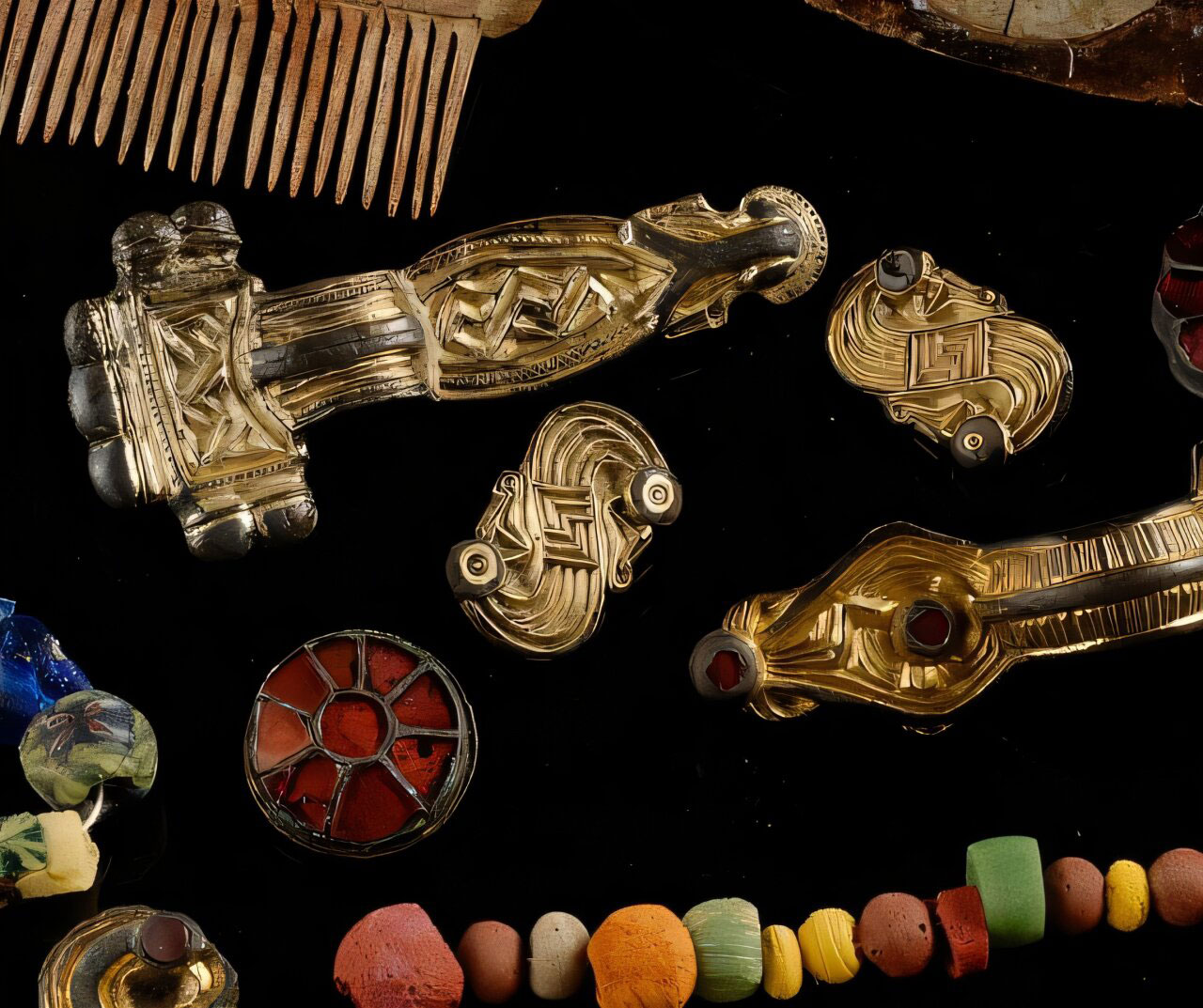 Collection of artifacts from the sixth-century cemetery at Szeleste, Hungary. Credit: Savaria Museum, Szombathely, Hungary
A study challenges the idea that Barbarians simply dominated Europe during the Early Middle Ages.
A new study from the HistoGenes project, whose co-PI includes Patrick Geary, Professor Emeritus in the School of Historical Studies, is helping scholars build a clearer picture of the early medieval people who lived in Western Europe after the fall of the Roman Empire and the societies they formed.
The findings, published in Science, come from combining ancient human DNA analysis with archaeological evidence. The international, multidisciplinary team, led by Yijie Tian (Stony Brook University) and István Koncz (Eötvös Loránd University, Hungary), sequenced genomes from more than 300 people who lived in the Little Hungarian Plain, a region in northwestern Hungary.
Ancestry shifted after Rome
During the Roman period, communities in this region were part of a dense network of infrastructure and cooperation. Their populations had mainly southern European genetic ancestry, along with notable genetic diversity from Asia and Africa that reflected the cosmopolitan character of the Roman Empire.
After Roman rule, however, sites in the region showed an increase in northern European genetic ancestry, pointing to major population movements into the area. By combining the genetic data with archaeological evidence, the researchers concluded that this influx of people with northern European ancestry likely reflected the historically documented but still debated expansion of the Lombard Kingdom from north of the Danube River into former Roman territories during the early sixth century.
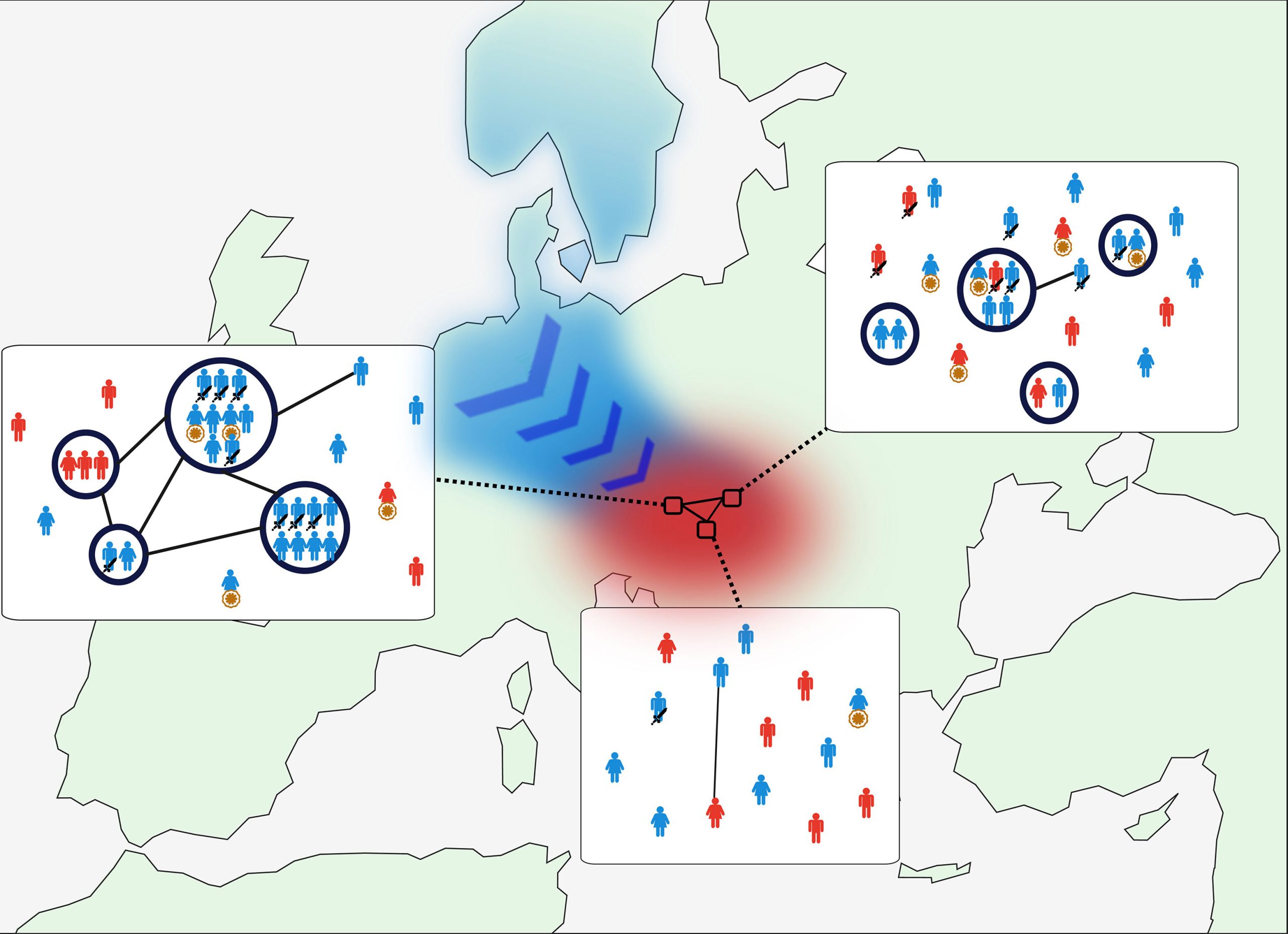 This schematic illustrates the formation of differing forms of sixth-century communities through the convergence of migrating Northern European (blue) and local Southern European (red) ancestry. By combining ancient DNA, isotopic data, and archaeological data, we are able to reconstruct the emergence of complex regional hierarchies in the post-Roman world. Credit: HistoGenes
They found that this was not one simple mass migration, but a pattern of complex and sustained movement, with genetic ties linking people in the Little Hungarian Plain to populations farther north. They also found that these new communities did more than create scattered rural settlements. They built a diverse, hierarchical society with ruling elites who shaped a new political order after Roman authority faded.
Migration was not simple conquest
The findings matter because historians still know relatively little about life in this region after the Roman period. This era is often linked to the migration of groups commonly called “Barbarians,” people from other parts of Europe and Asia who took control of much of Europe as the Roman Empire broke apart. Because these kingdoms left behind very few written records, historians and archaeologists have often had to rely on accounts shaped by the perspectives of the conquered Romans.
The HistoGenes team’s results complicate that view. In the Little Hungarian Plain, the migrating Lombards eventually became the dominant political force, but society was not formed by replacement alone. Instead, several kinds of community formation emerged through interactions between incoming groups with mainly northern European ancestry and local populations with mostly southern European ancestry, together producing a new and complex society.
Culture and ancestry diverged
Reflecting on the significance of the discoveries and the HistoGenes project more generally, Patrick Geary stated: “The project has revealed both gradual and localized forms of movement across short and long distances, as well as rapid, large-scale population shifts from Eastern Asia into the Carpathian Basin. It has also demonstrated that material culture and genetic ancestry do not necessarily coincide and has illuminated the diverse ways newcomers integrated into existing populations.”
Reference: “Unveiling the complexity of post-Roman polity formation in Pannonia using ancient DNA” by Yijie Tian, István Koncz, Norbert Faragó, Corina Knipper, Ronny Friedrich, Deven N. Vyas, Levente Samu, Olga Spekker, Tamás Szeniczey, Tamás Hajdu, Balázs Gusztáv Mende, Péter Tomka, Ildikó Katalin Pap, Dávid Czigány, Rita Radzeviciute, Luca Traverso, Guido Alberto Gnecchi-Ruscone, Paolo Francalacci, Bernd Schöne, Gábor Tóth, Anna Szécsényi-Nagy, Petrus le Roux, Kurt W. Alt, Zuzana Hofmanová, Walter Pohl, Johannes Krause, Tivadar Vida, Patrick J. Geary and Krishna R. Veeramah, 11 June 2026, Science.
DOI: 10.1126/science.aec2634
The HistoGenes project is funded by the European Research Council (ERC).
Never miss a breakthrough: Join the SciTechDaily newsletter.
Follow us on Google and Google News.















 English (US) ·
  French (CA) ·
  French (FR) ·