

 2 days ago
9
2 days ago
9
PROTECT YOURSELF with Orgo-Life® QUANTUM TECHNOLOGY
Orgo-Life the new way to the future Advertising by AdpathwayWith a raft of new Shimano drivetrain components and a much clearer understanding of Shimano CUES compatibility, the cycling community has uncovered 2× setups that offer wider gear ranges and lower climbing ratios than many riders realise.
This article is a curated list of unsanctioned drivetrains – combinations that Shimano doesn’t officially endorse, but which have been tested thoroughly enough to be genuinely excellent options for your next bike.
I’ll be breaking down why 2× still matters, and how GRX, CUES, and even third-party components can work together reliably to build drivetrains that outperform what’s already on your bike.
Let’s get into it!
The Advantages of a 2X Drivetrain
 This Shimano GRX drivetrain has significantly lower gear ratios than standard. Image: Reddit/HZCH
One of the main advantages of a 2X drivetrain is that it provides smaller steps between gears compared to a 1X setup.
Each time you shift, your pedalling cadence changes. Ideally, your cadence would remain constant as you speed up or slow down, but that’s not possible on a bike with gears. The next best solution is to minimise the difference between each gear, allowing you to stay in your optimal pedalling range for longer. Bikes with 2X drivetrains typically use a smaller rear cassette, which reduces the jump between gears.
2X drivetrains are also generally more efficient. With a straighter chain line in most gear combinations, less energy is lost to friction. On average, 1X drivetrains are about 1% less efficient than 2X, and in the three highest gears, the difference can be 1.5 to 2.5%. You can see the full test HERE.
Finally, a 2X drivetrain provides a wider overall gear range, letting you maintain your preferred cadence across a broader range of speeds.
Gear range example: Modern Shimano 1X drivetrains typically have a 510% gear range, meaning the largest gear is 5.1 times bigger than the smallest. In contrast, a Shimano 2X drivetrain with a wide-range cassette can reach 627%, or 6.27 times the smallest gear. Assuming both setups use the same low climbing gear, this means that if you pedal at 120 RPM in the top gear, the 1X setup would reach around 55 km/h, while the 2X setup would hit 68 km/h – a significant difference.
GRX & CUES Compatibility Guide
Cable Pull Compatibility

Shimano CUES rear derailleurs use MTB-style cable pull, which is functionally equivalent to Shimano Dynasys and very close to Microshift Sword and Advent.
Because of this, CUES rear derailleurs do not work correctly with standard Shimano road or gravel shifters (eg GRX or 105) unless you use a cable-pull adapter such as a Wolftooth Tanpan or J-Tek Shiftmate.
As a result, Shimano CUES drop-bar shifters are really intended to be paired with CUES rear derailleurs if you want correct indexing without adapters or hacks.
Chain & Cassette Compatibility
Within Shimano’s ecosystem, there are two distinct chain and cassette standards:
LinkGlide (LG)
Hyperglide (HG)
LinkGlide uses thick, square-profile teeth with wider spacing and is designed for maximum durability. Shimano claims up to three times the lifespan of Hyperglide, which makes it ideal for high-mileage touring and commuting. The trade-off is that shifting is slower and more deliberate, and cassette options are limited to 11-39, 11-43, and 11-45T.
Shimano CUES 9 and 10-speed systems are designed exclusively around LinkGlide, and must be used with LinkGlide chains and cassettes.
Hyperglide, by contrast, uses Shimano’s traditional ramped tooth profiles for lighter, faster, and smoother shifts. This is what you’ll find on GRX and most road groupsets.
Shimano CUES 11-speed is unique in that it can be used with either LinkGlide or Hyperglide, since all Shimano 11-speed cassettes share the same spacing.
Front Derailleur, Crankset and Shifter Compatibility
 The all mountain CUES derailleur design is different to the City & Touring model.
Shimano offers two distinct CUES front derailleur families: City & Touring and All Mountain.
The City & Touring derailleurs are designed for front chainrings ranging from 46 to 22 teeth, supporting up to a 16-tooth difference between chainrings. These derailleurs are fully compatible with CUES drop-bar shifters, making them ideal for touring setups where wide-range gearing and smooth front shifts are important.
On the other hand, the All Mountain front derailleurs are designed for slightly smaller chainrings, from 40 to 22 teeth, with up to a 14-tooth difference.
The All Mountain derailleurs are not directly compatible with CUES drop-bar shifters because they require more cable pull than a road shifter can provide. While there is a workaround for this, it should be considered a hack rather than native compatibility. I’ll explain the workaround later in this resource.
GRX & CUES Compatibility Testing
Every drivetrain listed here has been physically tested – either by bike manufacturers, well-trusted independent sources, or by me personally.
A special thanks to Russ from PathLessPedaled, who has put many of these drivetrain combinations through real-world testing. You can find his in-depth drivetrain experiments on his YouTube channel.
For the gear-inch calculations that follow, I’ve assumed a bike running 700C × 47 mm tyres, and unless otherwise noted, a Shimano GRX 46–30T crankset. Smaller front chainrings are readily available, which can push the climbing gears even lower if required.
Tiagra GRX Wide (2X10)

- Gear Range: 585%
- Lowest Gear: 20.1″
- Highest Gear: 118″
The Tiagra GRX Wide setup is probably my favourite option because it offers the best shift performance, thanks to the higher-quality GRX components, and it’s quite affordable too. No cable-pull adapters or unusual modifications are needed – everything works together out of the box.
This drivetrain still uses the Tiagra 4700 shifters from the previous setup, but here they’re paired with GRX 800 components instead of CUES. GRX 800 parts are built to a higher standard: they’re more durable, stronger, resistant to misalignment, and deliver smoother, more precise shifting.
We’re still using Hyperglide chains and cassettes for ultra-smooth shifting, and the Tiagra levers are available in small-hand sizes for better ergonomics.
Although this setup combines 10-speed shifters, chain, and cassette with 11-speed derailleurs, don’t worry – the cable-pull ratios line up perfectly, so shifting is flawless.are
Key components:
- Rear derailleur: RD-RX810 – US $145 on Performance Bike
- Shifters: Shimano Tiagra ST-4700 (10-speed) – US $240 on Performance Bike
- Cassette: Shimano CS-M4100 (11-42T) – US $33 on Performance Bike
- Front derailleur: FD-RX810 – US $65 on Performance Bike
- Total: US $483 (mechanical brakes)
Tiagra CUES Ultra Wide (2X10)

- Gear Range: 641%
- Lowest Gear: 18.4″
- Highest Gear: 118″
This drivetrain uses a cable-pull ratio adapter to pair 10-speed shifters with a Shimano CUES rear derailleur. Although the rear derailleur is technically an 11-speed model, it works reliably with Tiagra 4700 shifters and 10-speed Shimano Hyperglide components.
The key benefit of this setup is cassette capacity: the derailleur can manage an 11-46T cassette, delivering extremely low climbing gears. Care is required in small-small combinations (eg. 30×11) due to capacity limits.
Additional advantages include the smooth, precise shifting of Hyperglide and the fact that Tiagra 4700 levers are available in a small-hand version, which is a major ergonomic benefit for some riders.
Please note: the Wolftooth Tanpan must be the 11-speed version, as Tiagra’s cable-pull ratio differs from most other Shimano 10-speed road shifters.
Key components:
- Rear derailleur: Shimano RD-U8020 – US $85 on Performance Bike
- Shifters: Shimano Tiagra ST-4700 (10-speed) – US $240 on Performance Bike
- Cassette: Shimano CS-M4100 (11-46T) – US 45 on Performance Bike
- Front derailleur: FD-U6030 – US $44 on Performance Bike
- Cable-pull adapter: Wolftooth Tanpan (11-speed) – US $44 on Wolf Tooth
- Total: US $458 (mechanical brakes)
CUES Sword Wide (2X10)

- Gear Range: 585%
- Lowest Gear: 20.1″
- Highest Gear: 118″
Another intriguing option introduces a new brand: Microshift. The Microshift Sword drop bar shifters have a cable pull very close to Shimano CUES, which means they work well with CUES rear derailleurs without any modifications.
The main benefit is that the Microshift Sword shifters are more affordable, in fact, you’ll save over $100 compare to the previous drivetrains. You can also continue using Hyperglide chains and cassettes for smooth, reliable shifting.
This setup works well with an 11 to 42T cassette, but make sure you use a Microshift front derailleur, as the CUES front derailleur is not compatible with Microshift Sword shifters.
Key components:
- Rear derailleur: Shimano RD-U8020 – US $85 on Performance Bike
- Shifters: Microshift SB-G7000 – US $189 on Performance Bike
- Cassette: Shimano CS-M4100 (11-42T) – US $33 on Performance Bike
- Front derailleur: Microshift FD-G7020 – US $28 on Performance Bike
- Total: US $335 (mechanical brakes)
Sword Advent Wide (2X10)

- Gear Range: 585%
- Lowest Gear: 20.1″
- Highest Gear: 118″
The final 10-speed drivetrain option is almost entirely Microshift, which means it’s the most affordable option here! This setup pairs a 9-speed Microshift Advent rear derailleur with Sword drop bar shifters and 10-speed Shimano Hyperglide components.
The main advantages are affordability and derailleur options. The Advent derailleur comes in a clutch version, which provides superior chain retention over rough terrain; the ratchet-and-pawl clutch is also easy to adjust and repair. There’s also a non-clutch Advent option for road riding, which can deliver even smoother shifting.
As with many other options, you will get to run Hyperglide chains and cassettes for smooth shifting, and make sure to fit the matching Microshift Sword front derailleur.
Key components:
- Rear derailleur: Microshift RD-M619L – US $64 on Performance Bike
- Shifters: Microshift SB-G7000 – US $189 on Performance Bike
- Cassette: Shimano CS-M4100 (11-42T) – US $33 on Performance Bike
- Front derailleur: Microshift FD-G7020 – US $28 on Performance Bike
- Total: US $314 (mechanical brakes)
CUES Ultra Wide (2X11)

- Gear Range: 627%
- Lowest Gear: 18.8″
- Highest Gear: 118″
Our first 11-speed setup exclusively uses Shimano CUES components, meaning it runs LinkGlide cassettes and chains throughout.
Of all the options listed, this is the most durable drivetrain. LinkGlide components wear significantly more slowly than Hyperglide equivalents, especially under load. Longevity can be extended even further by running a wax-based chain lubricant – you can find the best wax chain lubes HERE.
The RD-U8020 rear derailleur is required, as its geometry is optimised for very large cassettes and delivers noticeably better shift performance than lower-tier CUES derailleurs.
Key components:
- Rear derailleur: Shimano RD-U8020 – US $85 on Performance Bike
- Shifters: ST-U6030 (comes with hydraulic brakes) – US $630 on Performance Bike
- Cassette: CS-LG400 (11-45T) – US $89 on Peformance Bike
- Front derailleur: FD-U6030 – US $44 on Performance Bike
- Total: US $848 (hydraulic brakes)
CUES Insane Wide (2X11)

- Gear Range: 669%
- Lowest Gear: 13.8″
- Highest Gear: 92.3″
This is a complete Shimano CUES 2× mountain bike drivetrain paired with CUES drop bar shifters. The result is an incredibly low climbing gear and an impressively wide gear range (I used a 36-22T crankset for these calculations rather than 46-30T). Since everything is 11-speed, you can run either Linkglide or Hyperglide chains and cassettes.
The main challenge is matching the CUES front shifter to the front derailleur. The wider crankset often requires a CUES side-swing MTB front derailleur with front cable routing, which demands more cable pull than the drop bar shifter can supply. To fix this, you’ll need to use an inline barrel adjuster (BBB BCB-96 is recommended) fitted to the front of the front derailleur to achieve the correct tension.
Please note: CUES 2x MTB cranksets have a wider crankset (q-factor) than the gravel versions, which some people don’t like as much. Personally, the extra width doesn’t bother me.
Key components:
- Rear derailleur: Shimano RD-U8020 – US $85 on Performance Bike
- Shifters: ST-U6030 (comes with hydraulic brakes) – US $630 on Performance Bike
- Cassette: CS-LG400 (11-45T) – US $89 on Performance Bike
- Front derailleur: FD-U6000-M – US $39 on Performance Bike
- Total: US $843 (hydraulic brakes)
Ultra GRX Wide (2×11)

- Gear Range: 641%
- Lowest Gear: 18.4″
- Highest Gear: 118″
Using a simple GRX derailleur hack, it’s possible to run massive 11-46T mountain bike cassettes.
The process starts with a Shimano GRX 810 rear derailleur. You remove the stock inner and outer jockey wheel plates, then replace them with the longer inner and outer plates from a Shimano XT mountain bike derailleur. These XT plates are designed for larger cassettes, are long enough to handle the extra chain wrap, and can be purchased as aftermarket replacement parts.
The result is a high-quality 11-speed drivetrain with an exceptionally wide gear range and some of the lowest climbing gears available in this comparison.
Key components:
- Rear derailleur: RD-RX810 – US $145 on Performance Bike
- Shifters: ST-R7000 (mechanical) or ST-RX810 (hydraulic) – US $254 or $753 on Performance Bike
- Derailleur Plate Outer: RD-M8000 – US $12 on Performance Bike
- Derailleur Plate Inner: RD-M8000 – US $6 on Performance Bike
- Cassette: CS-M8000 (11-46T) – US $130 on Performance Bike
- Front derailleur: FD-RX810 – US $65 on Performance Bike
- Total: US $612 (mechanical brakes) or $1111 (hydraulic brakes)
Easy GRX Wide (2X11)

- Gear Range: 558%
- Lowest Gear: 21.1″
- Highest Gear: 118″
Another straightforward 11-speed option is to install an 11-40T cassette onto an existing GRX 810 drivetrain. This setup works with minimal fuss, though you’ll be operating near the maximum capacity of the rear derailleur. But note that shift performance will not be quite as crisp as when you use a typical 11-34 or 11-36T cassette.
A further hack you can do with this setup is fit some 44/28T Ta Specialties chainrings to the crankset to have a climbing gear under 20 gear inches!
Key components:
- Rear derailleur: RD-RX810 – US $145 on Performance Bike
- Shifters: ST-RX810 (comes with hydraulic brakes) – US $753 on Performance Bike
- Cassette: CS-M8000 (11-40T) – US $99 on Performance Bike
- Front derailleur: FD-RX810 – US $65 on Performance Bike
- Total: US $1062 (hydraulic brakes)
105 GRX Wide (2×11)

- Gear Range: 558%
- Lowest Gear: 21.1″
- Highest Gear: 118″
If mechanical brakes are your preference over hydraulics, this Shimano 105 setup is an excellent choice. Swapping to 105 mechanical levers cuts the cost by roughly $600, making this the best-value wide-range 2×11 drivetrain in the lineup.
To make the 105-GRX mix work, you’ll need a Shimano GRX 400 10-speed rear derailleur, which pairs cleanly with 11-speed road shifters. Add an 11 to 40T cassette, then finish the build with a Microshift, Shimano 105, or GRX front derailleur, depending on budget and availability.
Key components:
- Derailleur: RD-RX400 10 Speed – US $67 on Performance Bike
- Shifters: ST-R7000 (mechanical) or ST-R7020 (hydraulic) – US $254 or US $674 on Peformance Bike
- Cassette: CS-M8000 (11-40T) – US $99 on Performance Bike
- Front derailleur: Microshift FD-G7020 – US $28 on Performance Bike
- Total: US $448 (mechanical brakes) or $868 (hydraulic brakes)
Easy 105 Wide (2X11)

- Gear Range: 558%
- Lowest Gear: 21.1″
- Highest Gear: 118″
You can also run an 11 to 40T cassette with a Shimano 105 11-speed derailleur setup too, in fact, some bike manufacturers offer this option on their stock bikes.
I’ve found it works well for a wide range of gears, but it can’t handle extreme combinations – like big chainring to big cog or small chainring to small cog – as gracefully as the GRX derailleurs.
Key components:
- Rear derailleur: RD-R7000-GS – US $67 on Performance Bike
- Shifters: ST-R7000 (mechanical) or ST-R7020 (hydraulic) – US $254 or US $674 on Peformance Bike
- Cassette: CS-M8000 (11-40T) – US $99 on Performance Bike
- Front derailleur: FD-R7000-F – US $44 on Performance Bike
- Total: US $464 (mechanical brakes) or $884 (hydraulic brakes)
Roadlink Derailleur Hack (2X11)
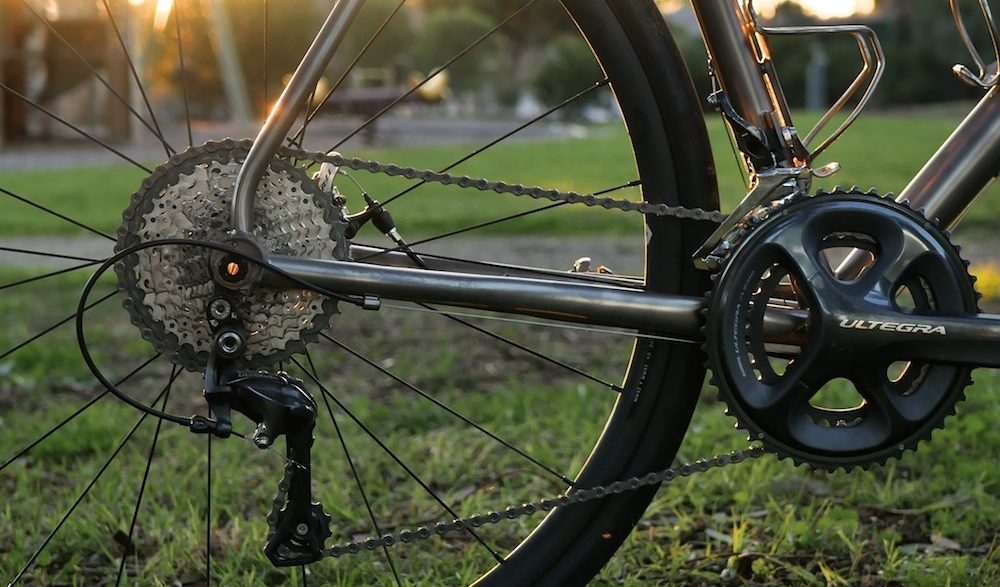
The Wolftooth Roadlink lets you use any long-cage Shimano 11-speed derailleur with an 11 to 40T cassette. I’ve run this successfully on a road bike, though it’s worth noting that extreme gear combinations – big chainring to big cog, or small to small – don’t shift perfectly. This is more of a practical hack than a long-term solution.
If you already have a 10 or 11-speed road drivetrain, the Roadlink (US $23 on Performance Bike) and lets you keep your existing shifters and derailleur. You’ll just need a new chain and cassette.
Summary
Shimano GRX, 105, and CUES compatibility is possible if you understand how derailleurs, shifters, chains, and cassettes interact!
You’ve just seen numerous excellent 2x derailleur drivetrain options that provide wide gear ranges and very low climbing ratios. While these setups are not officially supported by Shimano, they generally perform nearly as well as native component pairings.











 English (US) ·
  French (CA) ·
  French (FR) ·