

 1 day ago
31
1 day ago
31
PROTECT YOURSELF with Orgo-Life® QUANTUM TECHNOLOGY
Orgo-Life the new way to the future Advertising by Adpathway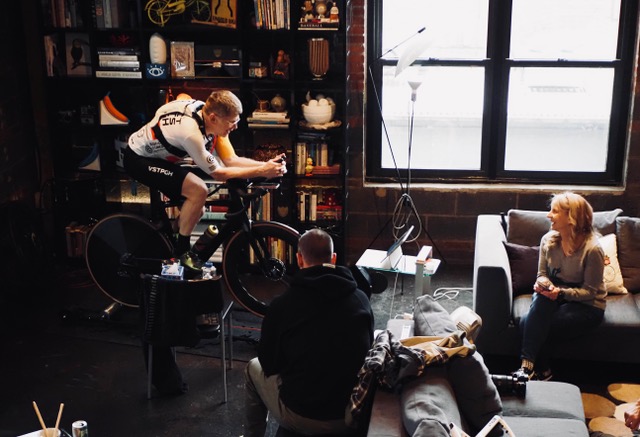
For some, winter is the time to step out of one’s comfort zone. It’s far enough from the meat of the season, try new things, start some good habits, or go far off the deep end with feats of strength.
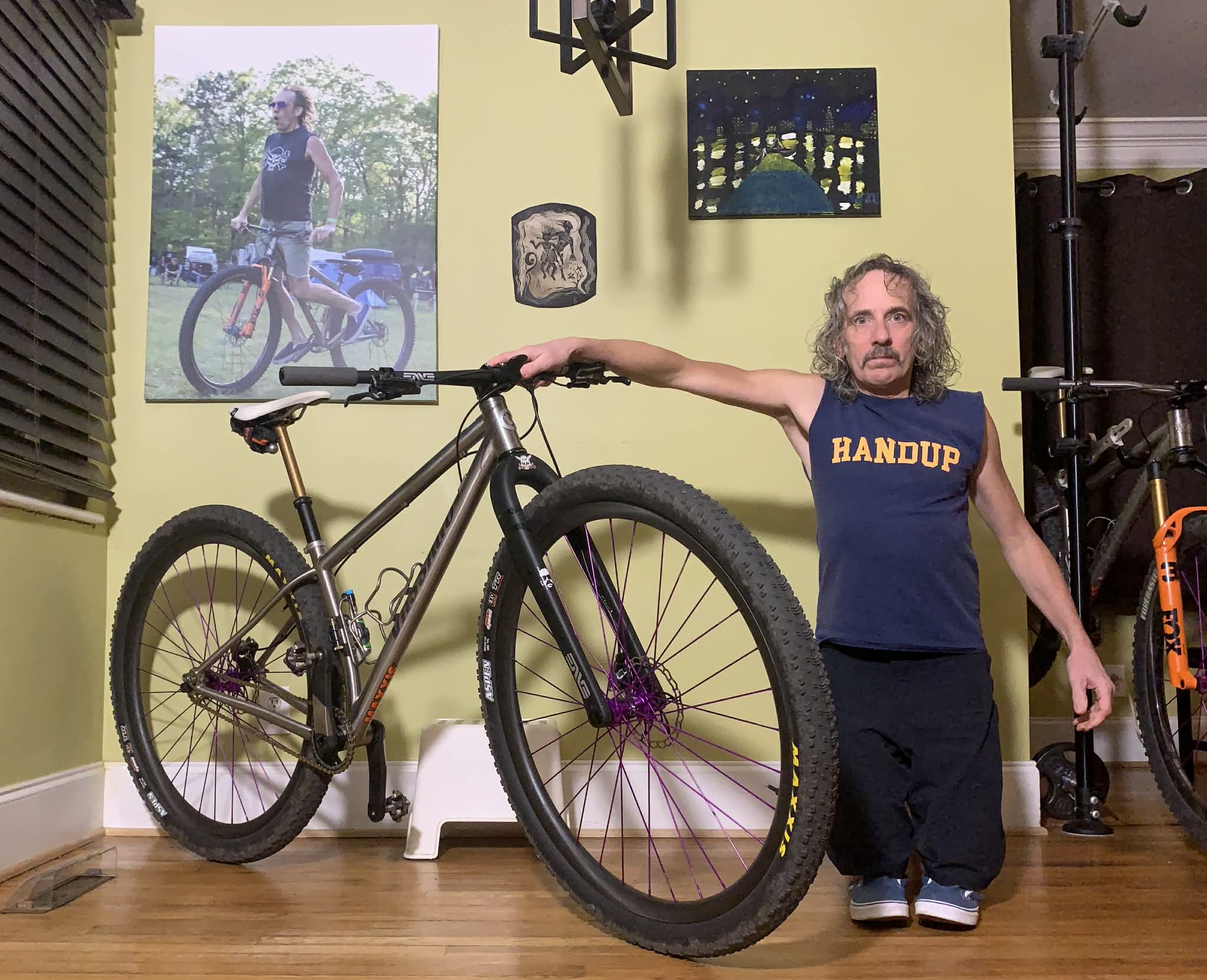 (“Welcome to the future” – Photo/Dicky)
Some of my riding friends used this time to explore the technical side of riding. Take my buddy Dicky, for example (pictured above), he used the fall/winter to build and bridge up to the pointy end of the 32″ mountain bike conversation.
 (Jeff at 762 miles, slightly cracked and slightly happy after Paris–Brest–Paris in 2023. Photo/Koontz)
My buddy Jeff, on the other hand… he went for the full feats of strength (a Festivus tradition for those who observe). Jeff challenged himself to see how long he could ride on the roller over a 24-hour period. It’s a wild idea, and not for those with a weak backside. However, Jeff didn’t do this just for the press and punishment. His underlying motivation was a ride to push him further toward his big event of this season, the Race Across America (RAAM).
I sat down with him for an interview to gain insight, see what he was thinking, and find out what’s next.
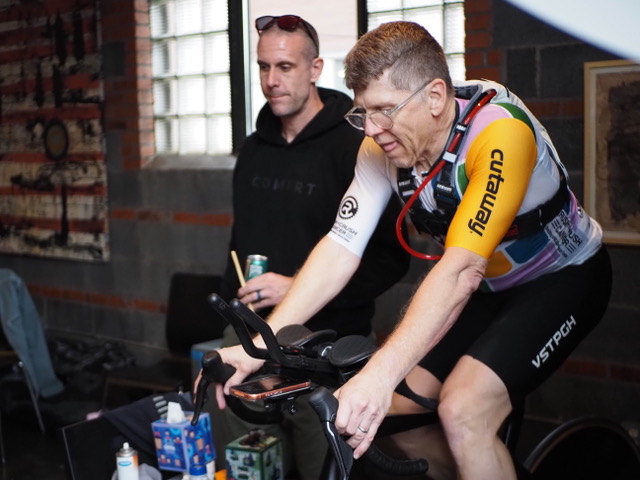 (Mid effort, with a crowd of his Visit PGH mates cheering him on. Photo/Koontz)
BikeRumor: First question, and most importantly… — WHY?!
Jeff Koontz: I love crazy ideas, and having registered for RAAM (itself a crazy idea), I needed opportunities between now and June to test fueling strategies. My body can handle whatever fueling strategy I throw at it for six hours, but beyond 10 or 12 hours, it starts to struggle to get the right fuel into the system. With that in mind—and Pittsburgh January weather—I came up with the roller challenge.
BR: Why rollers and not one of the many super-cool and highly enjoyable smart trainers?
JK: I’ve been bike racing and training since 1995, and I’ve always trained on rollers. Even with the great smart trainers out there today, I’ve always just paired my power meter and heart rate monitor to Zwift and ridden on the rollers. Over that 30-year period, I’m on just my second set of Kreitlers.
 (Koontz rolling fast at the 24-hour TT Championships. Photo/Koontz)
BR: What was the longest ride you’d completed before this effort?
JK: The longest was Paris–Brest–Paris in 2023 at 762 miles (on rollers, it was the PRL Full).
BR: Did you train specifically for this ride? Did you have a mileage goal as well as a time goal?
JK: I’ve been on a structured training plan with my coach, Josh Friedman (ATP Race Consulting), for quite a while. Since the end of the road season, we’ve been building toward RAAM. The goal was mileage in 24 hours, with an original target of 717 miles (spoiler alert: nope), measured at the wheel—not Zwift miles. That number came from two historical 24-hour roller rides from 1975, the only records I could find. The first was 687 miles, set by Olympian Jack Simes, whom I had the pleasure of messaging with before and after the challenge.
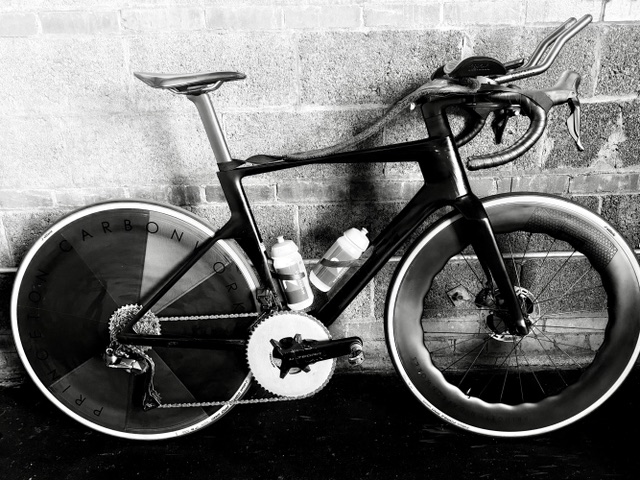 (Koontz rig, pre roller-rampage. Photo/Koontz)
BR: Walk us through your equipment choices. Were these all selected specifically for this effort?
JK: I put tri bars on my road bike—a BMC Teammachine R-01—because my hands can’t tolerate drop bars for that long, and a TT bike would’ve been brutal for 24 hours. In testing, my 54/40 chainrings were a little light, so I swapped in my TT bike’s 58/44 crankset. I also ran my TT wheelset: a Princeton Blur Disc rear wheel and a Mach 7580 front wheel, with Corsa Pro Speed tires and latex tubes at about 120 psi. I used 3” Kreitler alloy rollers, disconnecting the flywheel and headwind fan to spin as freely as possible. In December testing, I could hold 32 mph at about 170 watts and thought that, with good fueling and limited downtime, 717 miles was possible. On ride day, though, 32 mph took closer to 210 watts. Trying to stay in the 32–35 mph range early on proved unsustainable, and it wasn’t until about 12 hours in that I fully accepted my fate. I think the record may have been doable on 4.5” rollers, but that’s not what I had—and I don’t see a do-over in my future.
(Photo/Koontz)BR: How did you fuel for this? I noticed the Hydropak—walk us through the plan.
JK: My wife was home for much of it, but I didn’t want to ask her to stay up for 24 hours, and I wanted to minimize the number of bottle fillings. The Hydropak was always plain water. The front 750ml bottle was a double-strength NeverSecond carb mix to reduce liquid intake and bloating, and the rear 750ml bottle was pure, unflavored maltodextrin. Every three hours or so, I took a 500ml recovery drink mixed with coconut milk for protein, some fat, and a big mental break from the mouthfeel. I charted everything in advance so my wife would know when to supply bottles, and overnight, she left a cooler next to the trainer for easy access. I initially targeted 96g of carbs per hour, which proved too aggressive, so I backed off to find the intake rate my gut could tolerate.
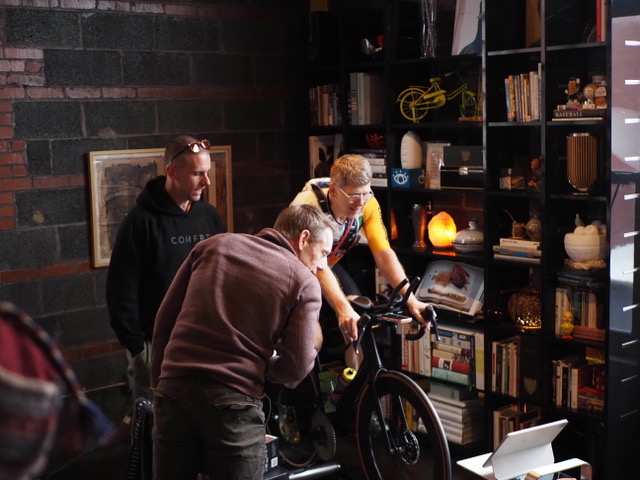 (Double-checking the stats, and keeping music going. Photo/Koontz)
BR: Music, podcasts, movies, bike races—how did you pass the time?
JK: I started with the extended editions of The Lord of the Rings—almost 12 hours. Then I switched to Game of Thrones from the beginning until about two hours to go, when teammates showed up for the final stretch and an after-party.
BR: Chamois cream or none?
JK: Yes—definitely. Assos is my go-to, and I’d recommend avoiding anything with strong menthol for an effort like this. A week later, I was peeling like a sunburn, but honestly, I’ve had worse, and my backside came through in pretty good shape.
BR: Were there dark moments where you questioned the whole thing?
JK: Oh yes…. Around midnight—eight hours in. I started at 4 pm, and when midnight hit, it dawned on me that I’d ridden a long time… and still had 16 hours to go. That realization hit hard. From there on, I took it one hour at a time, like counting down intervals—except the minutes were hours.
BR: How long did recovery take?
JK: I took two days off the rollers, then was back on them—wearing a heat suit—the following Tuesday.
 (Koontz pre Paris-Brest-Paris. Photo/Koontz)
BR: What’s next, and what did this teach you heading into RAAM?
JK: Next up is Texas Hell Week in March, capped by the Longhorn 500-mile ultra. After that, I’m targeting Crush the Commonwealth (Philly to Pittsburgh), which I’ve done before, and possibly a 24-hour TT in May. All of it feeds into RAAM on June 16. The biggest lesson was nutrition. For the power outputs I’ll manage over 24 hours, 90g of carbs per hour may be too much. I can get what I need from slightly reduced carbs, combined with fat metabolism, in Zone 2. Forcing too many carbs early created gut setbacks. Training the gut may help, but I think 90g is better for someone doing 250–300 normalized for five hours than 190 watts for 24 hours. I’ll keep experimenting.
BR: Can you share the final data?
JK: Yes…..
- Elapsed / Moving Time: 24:00 / 22:18
- Avg / Normalized Power: 171 / 190
- Calories Burned: 14,162
- Load / TSS: 915
- Miles (measured at the wheel): 628.5
- Average Speed: 26.2 mph
- Miles recorded in Zwift (Tempus Fugit): 480.3
- Average HR: 111 bpm
- Di2 data showed most time split between 58×12 (27%), 58×13 (28%), and 58×14 (27%), with heavier use of the 58×12 early and higher gears later.
BR: Any parting words for riders looking to push what’s possible?
JK: While I put a lot of work into training, there’s an equilibrium between pacing and fueling that, if you get it right, lets you ride nearly forever. You also need a solid mental framework for time, distance, and workload. That comes from experience—and the only way to get experience is to try new things. The most rewarding things in life often come from facing fears, especially when the fear of failure is high.
The post Interview: Why Did Jeff Ride The Rollers for 24 Hours… appeared first on Bikerumor.











 English (US) ·
  French (CA) ·
  French (FR) ·