

 3 hours ago
5
PROTECT YOURSELF with Orgo-Life® QUANTUM TECHNOLOGY
Orgo-Life the new way to the future Advertising by Adpathway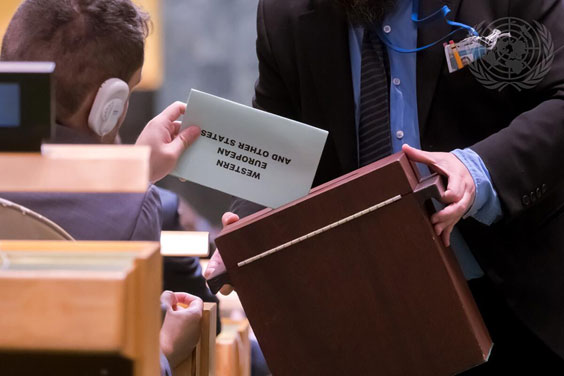 A delegate casts his ballot at the Human Rights Council elections held during the 20th plenary meeting of the UN General Assembly. Credit: UN Photo/Mark Garten
MONTEVIDEO, Uruguay / BUENOS AIRES, Argentina, November 2 (IPS) - On 13 October, Burundi won a second consecutive term on the UN Human Rights Council, the UN’s main human rights body. The CIVICUS Monitor rates civic space in Burundi as closed, the worst category. Its government has spent years silencing civil society, critics and opposition parties, including through extrajudicial killings, forced disappearances and torture.
The Council was created 20 years ago to replace the Commission on Human Rights, which had lost credibility because states with poor rights records used their seats to shield themselves from scrutiny. Clearly, problems persist.
An election without choice
Burundi secured its seat because the vote was an election in name only. Each year, the UN General Assembly elects roughly a third of the Council’s 47 members, with seats allocated among five regional groups. The resolution that created the Council asks states to consider each candidate’s contribution to human rights and expects members to uphold the highest standards. But for the second year running, every regional group put forward exactly as many candidates as seats. All 15 candidates were elected, six for a second term. Burundi received 160 votes, the fewest of any candidate, a sign that some states withheld their support. With no other candidate standing, it made no difference.
This is a longstanding problem. The Council’s first election, in 2006, was the only one in which every regional group offered a choice. Of the 20 held since since, five, including the last two, featured uncompetitive slates in every group, and in most of the rest only one or two groups held a competitive vote. When there are no alternatives, even states with the worst records are guaranteed a seat.
Alongside Burundi, nine of this year’s 15 elected states have civic space rated as obstructed or repressed. In Jordan, Kuwait and Nigeria, people face serious risks when they speak out, organise or protest. Only six of the chosen states met most of the 17 criteria set out in the International Service for Human Rights’ scorecards, which include cooperating with UN experts and paying UN dues on time.
Selective scrutiny
The Council’s 63rd session, which ended on 7 October, showed what it can still do. Despite severe budget cuts, it renewed the mandates of the Special Rapporteurs on Afghanistan, Burundi and Russia, as well as the fact-finding missions on Sudan and Venezuela.
Many states, however, chose not to take sides, putting geopolitical calculations ahead of human rights principles. Three of the four country resolutions put to a vote saw high numbers of abstentions. On Sudan, the resolution stopped short of naming the foreign governments, notably the United Arab Emirates, that the UN’s fact-finding mission has identified as fuelling the war.
Other crises barely registered. In Bahrain, close to 300 people have been arrested for protests or social media posts since the start of the US–Israeli war on Iran, but the country received only a passing mention. Ecuador and India, which jail activists and attack journalists, received no attention, perhaps because both sit on the Council after being elected unopposed in 2025. Once again, the Council took no action on China, one of its members, four years after a UN report found that abuses against Uyghur people in Xinjiang may amount to crimes against humanity. Such silences reflect political choices by the Council’s members, many of which have little interest in strengthening scrutiny that could one day turn on them.
Reform deferred
The Council’s 20th anniversary offered a chance to fix some of these flaws, but states let it pass. In July, a long-awaited review kept the Council as a subsidiary body of the General Assembly, rather than one with the same standing as the Security Council, and the next review is not due before 2035. Meanwhile, Israel, Nicaragua and the USA have said they will not cooperate with the Council, part of the wider crisis of multilateralism documented in CIVICUS’s 2026 State of Civil Society Report.
States’ failure to pay their dues has also pushed the UN into a liquidity crisis, and its response, the UN80 efficiency drive, has brought deep cuts, disproportionately affecting human rights functions. The UN Human Rights Office’s regular budget is 10 per cent smaller than last year’s, and it has shed over 110 posts. Support has been cut for around a quarter of thematic Special Procedures.
Civil society is paying the price too. Restrictions introduced as temporary, including a cut in the number of written statements accredited organisations can submit, remain in place. Meanwhile, people who share information with the UN or speak at the Council risk detention, smear campaigns, surveillance and travel bans, yet only 10 states raised concerns about reprisals. If engaging with the UN becomes too dangerous, the Council will lose the first-hand evidence it needs to respond to abuses.
A world where 73 per cent of people live in countries with repressed or closed civic space needs a Human Rights Council able to respond to grave violations and protect those who speak out. Competitive elections, adequate funding and stronger civil society participation are required to make the Council the body it needs to be.
Victoria Ubierna is Research Programme Officer at CIVICUS: World Alliance for Citizen Participation. Inés M. Pousadela is CIVICUS Head of Research and Analysis, co-director and writer for CIVICUS Lens and co-author of the State of Civil Society Report. She is also Professor of Comparative Politics at Universidad ORT Uruguay.
For interviews or more information, please contact [email protected]



© Inter Press Service (20261102052636) — All Rights Reserved. Original source: Inter Press Service










 English (US) ·
 French (CA) ·
 French (FR) ·