

 2 months ago
22
2 months ago
22
PROTECT YOURSELF with Orgo-Life® QUANTUM TECHNOLOGY
Orgo-Life the new way to the future Advertising by AdpathwaySince the formal restoration of Timor-Leste’s independence on 20 May 2002, the women’s movement has evolved beyond the goal of national liberation to the struggle to secure an equal place for women in the new state. Gender equality principles have been formally recognised in Timor-Leste over the past 24 years, with constitutional guarantees for gender equality, parliamentary quotas for women, the Law on Domestic Violence, the National Action Plan on Gender-Based Violence, and the National Action Plan on Women and, Peace and Security counting among the key achievements of the women’s movement in the post-independence period. But while important institutional gains have been achieved, an increase in gender-based violence (GBV), as well as continuing barriers to education, employment and equal pay for women and girls, lay bare the reality that deeper transformations in gender relations remain limited.
Our ongoing research into the work of three major Timorese women’s organisations highlights how the women’s movement confronts intersecting factors that constrain space for effective advocacy. The challenges, we observe, start with patriarchal legacies of the independence struggle, particularly an official memorialisation of the resistance that marginalises women’s contributions and provides the ideological backdrop to a political scene dominated by male veterans of the resistance. Trends in international development policy, meanwhile, put pressure on women’s organisations to depoliticise their activities, positioning them as adjunct to state and donor agendas. More recently, the deep inter-generational divides within Timorese society have also been felt inside the women’s movement, as younger activists contest the position of established organisations. Yet at the same time, campaigns for justice for victims of sexual abuse have lately shown the potential for new alliances between veteran activists and the younger women who will carry forward their work forward.
East Timorese women’s movement: past and present
The East Timorese women’s movement has a long history of political mobilisation. During the occupation, the Popular Organisation of Timorese Women (Organização Popular de Mulheres Timorenses/OPMT), founded in 1975 as the women’s wing of FRETILIN just before the Indonesian invasion, became a key vehicle for women’s participation in the struggle for the “liberation of the homeland and the people” (liberta patria e liberta povu). Women actively contributed to the resistance movement as combatants, diplomats, and clandestine operatives.
Women’s liberation was initially connected to the broader revolutionary struggle against Indonesian occupation. This changed in the early 1980s, when the Indonesian regime destroyed much of the resistance leadership. Under the leadership of Xanana Gusmão the resistance movement shifted its focus toward survival, sidelining earlier political programs aimed at women’s emancipation.
The fall of Indonesia’s authoritarian New Order regime in 1998 and the wave of democratisation that followed created new opportunities for the East Timorese resistance movement, both in the Indonesian archipelago and overseas, to fight for national liberation. Women’s NGOs such as the East Timorese Women’s Communication Forum (Forum Komunikasi untuk Perempuan Loro Sae/FOKUPERS)—founded in 1997 to support women victims of occupation-era human rights violations and gender-based violence—became active participants in the pro-independence campaign. Domestic and international pressures on Indonesia eventually led to the 1999 referendum on East Timor’s future.
Following the successful vote for independence, the transitional period (1999–2002) under the United Nations Transitional Administration in East Timor (UNTAET) saw women actively involved in national reconstruction and post-conflict development. In March 2000, a historic workshop in Dili brought together women from diverse backgrounds, including the diaspora, the church, political parties, and grassroots activists. The workshop resulted in the creation of the Women’s Network of Timor-Leste (Rede Feto Timor-Leste/RFTL) by 11 women’s organisations, including OPMT and FOKUPERS.
It was also from this workshop that the idea of holding the First National Congress of East Timorese Women emerged. Held in Dili in June 2000, the Congress brought together around 500 women from across Timor-Leste. Since then, the Congress has been held every four to five years, with the last Congress taking place on 17–21 December 2024. It provides a platform for women to discuss and address the most pressing issues that they faced, ranging from the economy and healthcare to human rights and reconciliation. The Congress produces a Platform of Action (PoA), which guides RFTL’s advocacy for women’s rights at both national and international levels.
Gendered valourisation of resistance
The legacy of the independence struggle has strongly shaped the political and social order of post-independence Timor-Leste in ways that sustain patriarchal ideas and practices. After the restoration of independence, the state institutionalised the valourisation of the resistance movement and its role in national liberation. Artcle 1, Section 11 of the Constitution acknowledges and values “the contribution of all those who fought for national independence”. However, despite the Constitution’s universal language, in practice the state’s recognition of those contributions has been highly gendered.
“Fighting” is often narrowly understood as taking up arms, and this understanding has disregarded the everyday yet essential contributions made by women to sustain the resistance movement. The limited conception of what fighting constitutes renders East Timorese women victims rather than active participants in the liberation struggle. As such, women’s historical role has been sidelined in both official narratives and state policies.
Related
Women and power in Timor’s elections
Quotas guarantee high levels of female representation in parliament. But patronage, and thus political power, remains decidedly in male hands.
The East Timorese feminist scholar and activist Berta Pereira has argued that Maunbootizmu (from maun boot, meaning “big brothers”), a set of unwritten hierarchical rules that centres the interests and authority of older male veterans of the national liberation struggle, emerged after the restoration of independence. Rooted in patriarchal culture and colonial legacies, Maunbootizmu is further legitimised by the glorification of sacrifices made by male fighters during the Indonesian occupation. Within this structure, the voices, knowledge, and experiences of women and young people are marginalised, while political and social power remains concentrated among maun boot.
Maunbootizmu has led to the construction of a hegemonic militarised masculinity within electoral and party politics in Timor-Leste, with the party system dominated by male resistance figures and electioneering marked by the activation of male-oriented patronage networks. Women’s organisations successfully advocated for parliamentary quotas, which increased women’s participation in formal politics. Women currently hold 35.4% of parliamentary seats, giving Timor-Leste the highest proportion of women legislators in Southeast Asia. In 2023, Maria Fernanda Lay of the National Congress for Timorese Reconstruction (Congresso Nacional de Reconstrução de Timor/CNRT) party became the country’s first female parliamentary speaker. Despite these achievements, our interlocutor explained that due to the persisting dominance of male political elites, political parties are unable to articulate, much less legislate, the needs and interests of East Timorese women.
The gendered valourisation of resistance has also influenced the trajectory of women’s organisations themselves. With the institutionalisation of party politics, OPMT has turned into a women’s wing of the FRETILIN party. Our focused group discussion with the first and second generations of OPMT members revealed that, after independence, efforts to strengthen OPMT networks at the village level were largely directed toward supporting FRETILIN’s electoral campaigns. For instance, in preparation for the 2027 elections, OPMT’s national committee has organised village-level conferences since March 2026. Consequently, the organisation has struggled to develop broader political programs that focus on women’s emancipation.
The normalisation of Maunbootizmu has also reinforced patriarchal gender relations within society. One long-time OPMT member who joined the liberation struggle in 1975 told us during our discussion that “what we’ve learned and practiced in the jungle no longer existed”. Gender-egalitarian values have gradually changed into more patriarchal structures. She described how patriarchal practices such as polygamy and violence against women—once discouraged within the resistance movement during the early years of the struggle—have become increasingly practiced today, even among male political elites. Although the women’s movement has achieved important institutional reforms promoting gender equality, deeply rooted Maunbootizmu continues to hinder broader transformations in gender relations.
From resistance movement to donor-driven advocacy
International agencies, particularly the United Nations, played a major role in rebuilding Timor-Leste after the independence referendum. Through financial and technical assistance, they supported women’s organisations and helped secure gender-equitable policy reforms.
However, feminist scholars such as Melissa Johnston argue that gender interventions led by international agencies have inadvertently strengthened patriarchal structures in the post-conflict context. These international agencies have shaped how mass organisations and social movements that had contributed to the struggle for national liberation, including youth and women’s groups, function in the post-independence period. To be eligible to receive funding from international agencies, most community-based organisations have transformed themselves into NGOs, which over time has become the dominant form of civil society organising in Timor-Leste.
This shift has affected the ability of the women’s movement to translate formal policy gains into deeper social change. Critically reflecting on this development, one respondent during an interview explained that:
The UN entered East Timor and brought new concepts, such as gender equality, that most of us don’t understand. In doing their work here, they [international agencies] did not engage with OPMT members who fought in the jungle and who became clandestine activists. Only a handful of those women had formal education. So, it was us who went to universities, spoke English and knew how to use computers and write proposals, who took part in the process. This in a way has made our struggle dissociated from the experience of those [OPMT] women.
In the early transitional years, international funding provided important opportunities for emerging women’s organisations to pursue emancipatory programs. For instance, Grupo Feto Foin Sae Timor Leste (Timor Leste Young Women’s Groups/GFFTL) used donor funding to run literacy campaigns for women in rural areas. According to a former GFFTL activist, donors at that time were relatively flexible, allowing local women’s organisations to implement projects that reflected community needs.
However, the global rise of the “aid effectiveness” agenda and the decline of the international donor presence in Timor-Leste—especially after the establishment of the Petroleum Fund in 2005—began to condition the ways women’s organisations operate. Over the past two decades, the evolving donor mechanisms and priorities and the increased reliance of civil society on external funding have constrained the ability of the women’s movement to mobilise against structural inequalities and injustices.
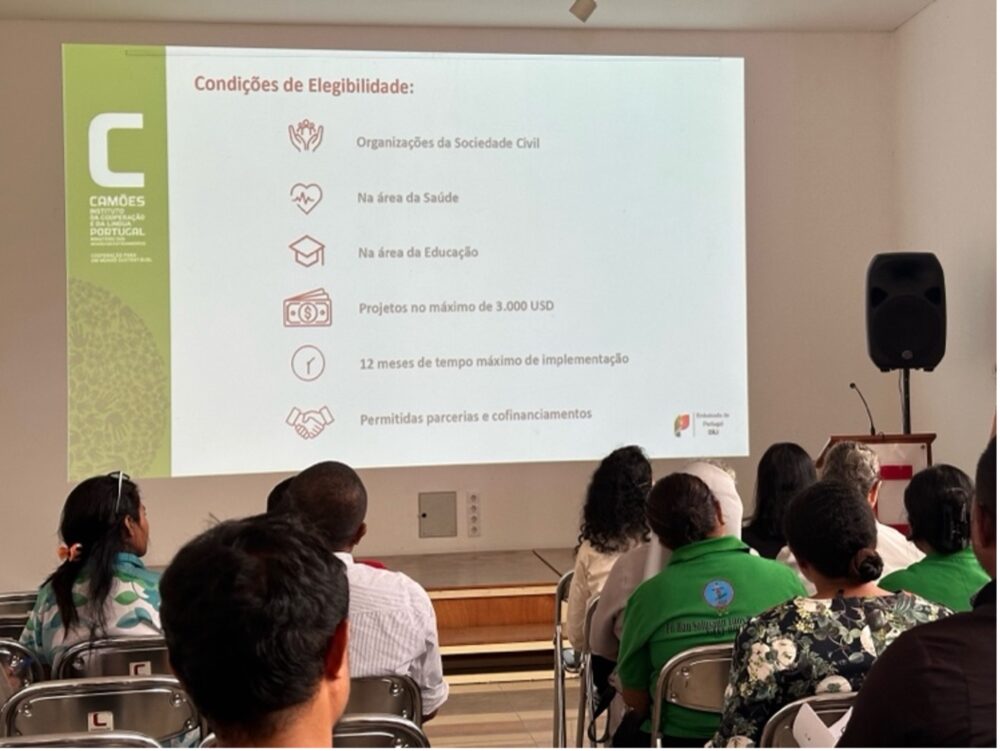
A workshop on a call for small project proposals at the Portuguese Embassy, March 2026; the workshop was attended by NGO representatives (Photo: Authors)
Berta Pereira identifies this trend as the neoliberal capture of the women’s movement, depoliticising the grassroots resistance movements by transforming them into organisations driven by and dependent on donors. Women’s organisations, such as FOKUPERS and RFTL, have increasingly focused on service delivery, short-term projects implementation, and policy monitoring, while also managing endless proposal writing and reporting cycles to ensure sustainable funding. Competition for limited donor resources has further fragmented the women’s movement.
As donor priorities became more influential, the voices and needs of women themselves were often sidelined in determining organisational agendas. This influence was reflected in the language used by women’s organisations, where participants in programs were commonly referred to as “beneficiaries,” demonstrating the internalisation of donor-centred frameworks. Overall, the shift from community-based organising to donor-driven advocacy has made the work of women’s organisations in translating formal gains in gender quality policies into transformative change in gender relations all the more strenuous.
Emerging young feminist movements
The past decade has seen the rise of new young feminist movements in Timor-Leste that seek to reclaim the radical legacy of East Timorese women’s resistance against patriarchal, colonial, and capitalist forces.
Revolutionary Feminists (Feminista Revolusionaria/FERA), established in 2021, is one of these emerging young feminist groups. Rooted in Marxist and anti-colonial thought, FERA draws inspiration from the history of women’s participation in the resistance movement. A FERA activist explained that:
We realised that we are so far from our history. Our history was feminist. The way OPMT organised themselves back then is very famous, and we’re so far from them… Today many women’s organisations focus on “elite women” issues, and nobody really stands for female labourers, like street vendors, sex workers, and farmers in the rural areas… And we thought, like, let’s start over. Let’s create the seeds of revolutionary women. So, that’s why we started.
Since its founding, FERA has focused on political education for young people. It organises feminist reading groups, discussion and creative activities centred on the historical struggle of East Timorese women. It has also organised and participated in numerous solidarity actions supporting marginalised communities, including women victims of forced evictions by the state. Through these efforts, FERA seeks to reshape public understandings of women’s roles and place in Timor-Leste’s political and social life.
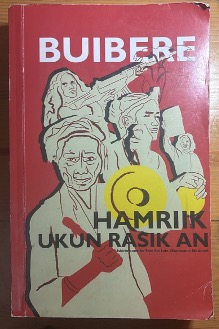
The cover of “Buibere Hamriik Ukun Rasik An”; OPMT published the volume in 2020 (Photo: Authors)
According to FERA activists, political education and action is critical to developing historical and feminist consciousness among young people. One activist explained that she only learned about OPMT through its recently published volume, Buibere Hamriik Ukun Rasik An: Istória kona-ba Feto iha Luta Libertasaun Nasionál, because accessible materials on women’s participation in the resistance remain limited.
In March 2026, FERA collaborated with other young feminist groups, such as Espasu Buibere and Feminista Progresivu, to organise a public discussion for International Women’s Day with the theme of “Strengthening the Relationship of Women’s Movements”. An OPMT member was invited as a speaker during the seminar. During the discussion session, we observed intergenerational tensions between younger feminists and older women activists: younger activists often viewed senior women leaders as disconnected from the contemporary realities faced by East Timorese women, while older activists sometimes regarded younger feminists as overly radical.
Despite these tensions, the forum created an important space for dialogue between these two generations of activists. Emerging young feminist movements have therefore helped fill the lacuna of collective spaces to foster intergenerational solidarity that established women’s organisations have struggled to provide.
Moving forward: building intergenerational solidarity
24 years after the restoration of independence, East Timorese women continue to fight for equality, justice, and freedom amid significant economic, organisational and ideological barriers. Yet recent developments also demonstrate the possibility of renewed solidarity across generations of women activists.
One significant example is the case of the defrocked Catholic priest, Richard Daschbach, who was accused of sexually abusing 14 girls at the Topu Honis shelter during the resistance period. In 2018, one of his victims reported the abuse to the Vatican. The case became a major flashpoint in Timor-Leste because it combined many of the challenges confronting the women’s movement, including gender-based violence, the power of elite male figures, and the influence of the Catholic Church.
The controversy surrounding the case highlights how the gendered valourisation of resistance continues to shape the East Timorese society and politics. Despite admitting to the abuse allegations, Daschbach received strong showing of support from several high-profile male figures, including Xanana Gusmão, the epitome of maun boot politics. In February 2021, Gusmão visited Daschbach at his private residence on the latter’s 84th birthday. Women’s and human rights activists condemned the visit, arguing that it reinforced the belief that men associated with the resistance struggle deserved sympathy and protection. The debate around Gusmão’s visit demonstrates how narratives glorifying resistance can undermine women’s access to justice and equality.
Related
Women and power in Timor’s elections
Quotas guarantee high levels of female representation in parliament. But patronage, and thus political power, remains decidedly in male hands.
Activists also noted that some church-linked donors withdrew funding from campaigns against gender-based violence following the case, illustrating how donor politics can constrain feminist advocacy.
Although the case divided the deeply Catholic country and exposed victims to intimidation and violence, it united different sections of the women’s movement in support of the survivors. Women’s organisations, such as FOKUPERS and RFLT, quickly mobilised to support the victims. They met with church leaders, sent letters to the Vatican demanding accountability, and organised public marches against gender-based violence.
This collective advocacy contributed to Daschbach being found guilty and sentenced to 12 years in prison in December 2021. Yet just 4 years into his sentence, the Timor-Leste government proposed to give clemency for the 88-year-old disgraced priest on 20 May 2025 as part of the commemoration of the Restoration of Independence Day. Major women’s organisations and young feminist movements responded immediately by sending a letter to President José Ramos Horta, urging the state not to pardon Daschbach and to stand with survivors of the abuse. In an open letter to the president, FERA, Movimentu Rosas Mean, and Espasu Buibere, wrote:
Whose peace are we protecting? Whose freedom do we prioritise? And at what cost? The pardon will never be about reconciliation, but it will reinforce a culture where men in power and in dominant institutions are never truly held accountable, where survivors are kept silent, and justice is kept ever further away from the most vulnerable.
The Daschbach case highlights how issues central to East Timorese women—particularly justice for GBV survivors—can mobilise diverse elements of the women’s movement in ways that deepen intergenerational solidarity. This year’s commemoration of the restoration of independence should therefore serve as a reminder that the struggle for women’s rights and freedom in Timor-Leste continues. Yet the collective action by women and feminist activists from different generations, grounded in the legacy of East Timorese women’s resistance, still offers the possibility of building an East Timorese society that is gender equal and just.
We would like to express our deepest gratitude to our respondents, women and feminist activists who continue to fight for the liberation of women in Timor-Leste, who participated in the research project.
• • • • • •













 English (US) ·
  French (CA) ·
  French (FR) ·