

PROTECT YOURSELF with Orgo-Life® QUANTUM TECHNOLOGY
Orgo-Life the new way to the future Advertising by AdpathwayTanaïs’s new book, Stellar Smoke, is available now from Dutton, so we asked them a few questions about writing practice, interviews, favorite non-literary media, and more.
Article continues after advertisement
*
Who do you most wish would read your book? (your boss, your childhood bully, etc.)
Friends I love still, but haven’t spoken to for the last several years, because we fell out of friendship. Because I ghosted them, or they ghosted me. Because I hurt them, or they hurt me. I’ve been on both ends of a breakup. I think of us as planets ellipsing our own orbits; we needed the space to be, and to become. There’s an intensity to queer femme friendships, and sometimes the merging has been too much to bear.
I’ve come to understand that whenever there’s a breakup, there’s a need to wrest back energy, and to pour this into ourselves, into our art, our work. Is it worth it? I don’t know, but sometimes that’s how books get written. Those lost loves, and the subsequent years of relief and regret, shame, and silence; are all embedded in this novel. Writing a book feels so relentless, sometimes like the hardest thing you can ever do, but then you realize that a phone call, sitting down together, eye to eye, crying, or upset, is much, much harder.
What time of day do you write?
I write 9 to 5, but pm to am. I need to write when the veil is thin, when the world is asleep, and no one can disturb me. I like to write by candlelight, with my computer dimmed to the color of dusk, and often I write by hand, without my glasses, so my face is right up to the pages of my notebook. It’s the most real that I feel, the most in touch with my natural disability of limited sight, but it’s liberating to be that close to my words. The early process of a book is all written by hand. I have to transcribe this scrawl into legible pieces of text. I asked my mother once what time I’d go to sleep as an infant, and apparently I’ve always been this way. But there are phases during the writing process, during the last, last phase of revisions, where I switch to daylight hours. There’s a clarity and a boundary between work and play in the daytime that’s really helpful during revision.
Who is the person, or what is the place or practice that had the most significant impact on your writing education?
Kiese Laymon, who I’ll be launching Stellar Smoke with at The Center for Fiction. When I was at Vassar, he’d seen a play that I wrote and directed, about four South Asian femme friends, reckoning with the aftermath of one’s suicide. Afterward, he came up to me, stunned that I was a mere sophomore. Even at such a young age, I’d spent a few years counseling survivors of domestic violence in Family Court, was a survivor myself, and I knew that writing and performance would be transmutative throughout my life. He was the brilliant young teacher on campus, and everyone was raving about his composition class.
And he’s the one who really made me believe in myself as a writer. Let the sentences breathe. Let the characters be. Revision, revision, revision will set you free. He remains one of the warmest, most generous, most radically loving writers alive. His devotion to Black love, freedom and art is humbling to witness. It’s wild to think we were in our twenties. It feels like kismet to have met him in this lifetime. And here we are, still doing what we love.
What do you always want to talk about in interviews but never get to?
My new novel, Stellar Smoke, is about a real human musician confronting her estranged, and recently dead, mother, who happens to be a machine consciousness. My book’s origin story isn’t that this is my ardent cyborg feminist response against a tech broligarchy, which insists that all human life and our minds will be destroyed by artificial intelligence. (I still believe that immersing ourselves in real life, with one another, in nature, and human books and art can save us.) I realized that the origin of this book goes back to the 1980s, when my mother, in her postpartum mood, would sit four-year-old me in front of a television, with a tomato and mayo on white bread and an ice-cold Coca-Cola.
I spent hours solo, watching the iconic cartoons of that era, My Little Pony, She-Ra: Princess of Power, and, the most influential, Jem and the Holograms.The premise of that show: a young woman named Jerrica transforms into Jem, a rock star, through Synergy, a sophisticated, purple-hued artificial intelligence based on Jerrica’s late mother. Synergy exists merely to help Jem and her friends, but the deeper questions–of how we never truly know our mothers, how the line between human and machine gets blurred when there’s an emotional dependence—are never explored. I imagine little me, yearning for my own mother, whose attention had been diverted to my younger sister, and finding refuge in that cartoon, which implanted a seed that blossomed into Stellar Smoke.
Which non-literary piece of culture—film, tv show, painting, song—could you not imagine your life without?
David Lynch’s Mulholland Drive, which I most recently saw again at The Metrograph in 35mm. When I was studying abroad in Nairobi in 2003, just a couple of years after it was released, I found a bootleg DVD and watched that thing twenty, thirty times. It’s a queer femme masterpiece, and the chemistry between Naomi Watts and Laura Elena Harring is electric, devastating. There is a psychedelic surreality in Lynch’s oeuvre, but this film has all the things I want in a work of art—mystery, sex, power struggles at their most furtive, and frightening, and so utterly lush and stark in its beauty.
_______________________________
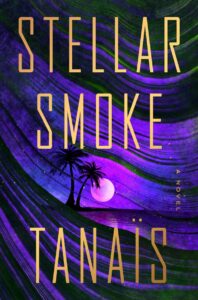
Stellar Smoke by Tanaïs is available from Dutton, an imprint of Penguin Publishing Group, a division of Penguin Random House, LLC.












 English (US) ·
 French (CA) ·
 French (FR) ·