

 2 months ago
105
2 months ago
105
PROTECT YOURSELF with Orgo-Life® QUANTUM TECHNOLOGY
Orgo-Life the new way to the future Advertising by Adpathway
And it’s one, two, three strikes you’re dead at the old ball game!
The rise of Shohei Ohtani has completely cemented Japan’s already famous reputation as a country that has wholly embraced the sport of baseball. However, there’s a common misconception that baseball came to Japan as a result of the American occupation following World War II, when in fact the sport’s roots here go back much further.
Baseball is said to have been introduced to Japan around the mid to late 19th century, just as Japan was undergoing the Meiji Restoration, in which the political system changed from feudal samurai lords to a Western style of government. At this time, the country was rapidly embracing foreign culture while also a product of its own history, and baseball served as a prime example of this crossroads in time.
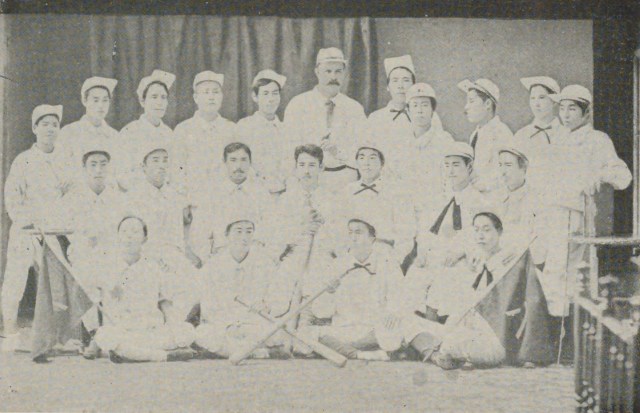
▼ The Shinbashi Athletic Club, 1880, Japan’s first proper baseball team
The name of the sport itself in Japanese, “yakyu,” literally translates to “field ball,” which most would agree is a reasonable name for a sport played on a field with a ball. This name is often mistakenly credited to the famed haiku poet Masaoka Shiki, a dedicated fan and player of the sport who also coined several baseball terms still used in Japanese today, like “dasha” (batter) and “sosha” (runner). The mistaken credit stems from the fact that Masaoka’s childhood name was “Noboru” and later in life he adopted it as a pen name using the same kanji as “yakyu,” where “no” means “field” and “boru” is just a Japanese pronunciation of “ball.” The true credit for “yakyu” however, goes to teacher and baseball player Chuman Kanae, who officially used the term in 1894, a few years before Masaoka even wrote that “there is no translation” for the name of the sport.
Natsukusa ya (Summer grass)
Besu boru no (baseball)
Hito Toshi (players far off)
– Haiku by Masaoka Shiki (1898)
This was all still just at the cusp of the Westernization of Japan, and the concept of using katakana to create foreign loan words was not yet common practice. The elites playing in schools at the time were likely well enough versed in English to be able to use terms like “baseball,” “out,” and “safe,” but to reach the masses, translators had to use relatable terms that harkened back to the days of the samurai.
It made sense, since swinging a bat wasn’t far removed from swinging a sword. This feudal imagery is said to be why baseball caught on in Japan as opposed to other emerging sports of the time, like rugby or soccer. It’s also where a lot of the terms that we still see today came into being.
In Japanese baseball, an out is referred to as a “death” (shi), a fielder outing a batter by catching a fly ball or tagging them is called a “stab-kill” (shisatsu), a double play is a “combo kill” (heisatsu), and the lead batter is called the “shock troop captain” (kirikomi taicho). Some terms used in English could more easily be localized in Japan in this way, such as a “sacrifice” (gisei), while others took on slightly different meanings, like a “dead ball” (shikyu), which in English means a ball that is out of play but in Japan refers to hitting the batter with a pitch.
Over time, foreign loan words did catch on with the public, and terms like “strike” were adopted, but during World War II, Japan banned the use of American language and baseball reverted to the more classical terms. A strike officially became “seikyu” (correct ball), which evolved from “kokyu” (good ball), meaning a pitch that was good enough for a batter to hit properly. It didn’t really catch on, however, and “strike” endured through the language prohibition.
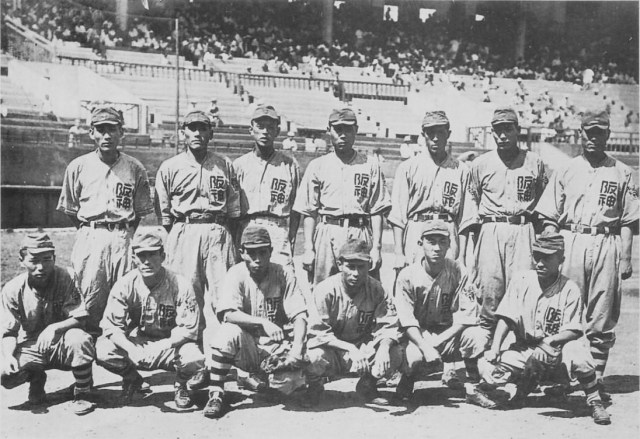
▼ By 1944, the Osaka Tigers (now Hanshin Tigers) changed their name to simply “Hanshin,” written on their uniform in kanji characters rather than using the English alphabet.
Adding in some terms also commonly used in English like “stealing” a base (“torui” in Japanese), baseball really began to sound like a nefarious pastime. Looking at it through a modern lens, it feels a little strange to have your kid’s little league coach shouting “Stab!” “Death!” “Combo kill!” and “Steal!” at them.
That’s why the Miyagi Prefecture High School Baseball Federation is currently forming a committee to review baseball terminology and consider changing it to something a little less homicidal. However, as with any break from tradition, opinion on the matter varies quite a bit.
“I don’t think the kids who play baseball give it that much thought. This is just over-policing language.”
“I think it would be better to teach kids the meanings behind the words and the history of how they came to be.”
“If they change the language, they have to change it everywhere rather than just Miyagi, or there will be communication problems.”
“Changing it to the English terms would make the most sense. But for the record, I’m not trying to pander to the US.”
“Soccer uses English terms like ‘corner kick’ and ‘offside,’ and no one has a problem. Why can’t baseball do the same?”
“Speaking as both a teacher and a parent, I’m in favor of this. But rather than flat out rejecting the terms of our predecessors, it would be a great idea to survey young players and see what terms would better suit our modern era.”
“I never heard of baseball players getting killed or stabbed, so I think it’s OK as it is.”
“They should change ‘kei-en’ too, then.”
In Japanese baseball, “kei-en” is the term used when a pitcher intentionally walks a batter. Oddly enough, in a sport filled with violent terminology, one of the more dishonorable acts in the game is actually given one of the most polite terms, meaning “respectfully keeping at a distance.”
With such a richly complex history, the suggestion of teaching players the stories behind the terms is probably the more valuable way to proceed. Then, with full understanding, if the players themselves feel a change is needed, it will likely come about organically. Otherwise, we can generally trust people to understand that words can have different meanings in different contexts.
Source: TBS News Dig, Yahoo! Japan News, Note 1, 2, Baseball and the Quest for National Dignity in Japan, Haiku Poets: Masaoka Shinji
Images: Pakutaso, Wikipedia/Ginza Futamikan, Wikipedia/Michiyoshi Nakano
● Want to hear about SoraNews24’s latest articles as soon as they’re published? Follow us on Facebook and Twitter!















 English (US) ·
  French (CA) ·
  French (FR) ·
