

PROTECT YOURSELF with Orgo-Life® QUANTUM TECHNOLOGY
Orgo-Life the new way to the future Advertising by Adpathway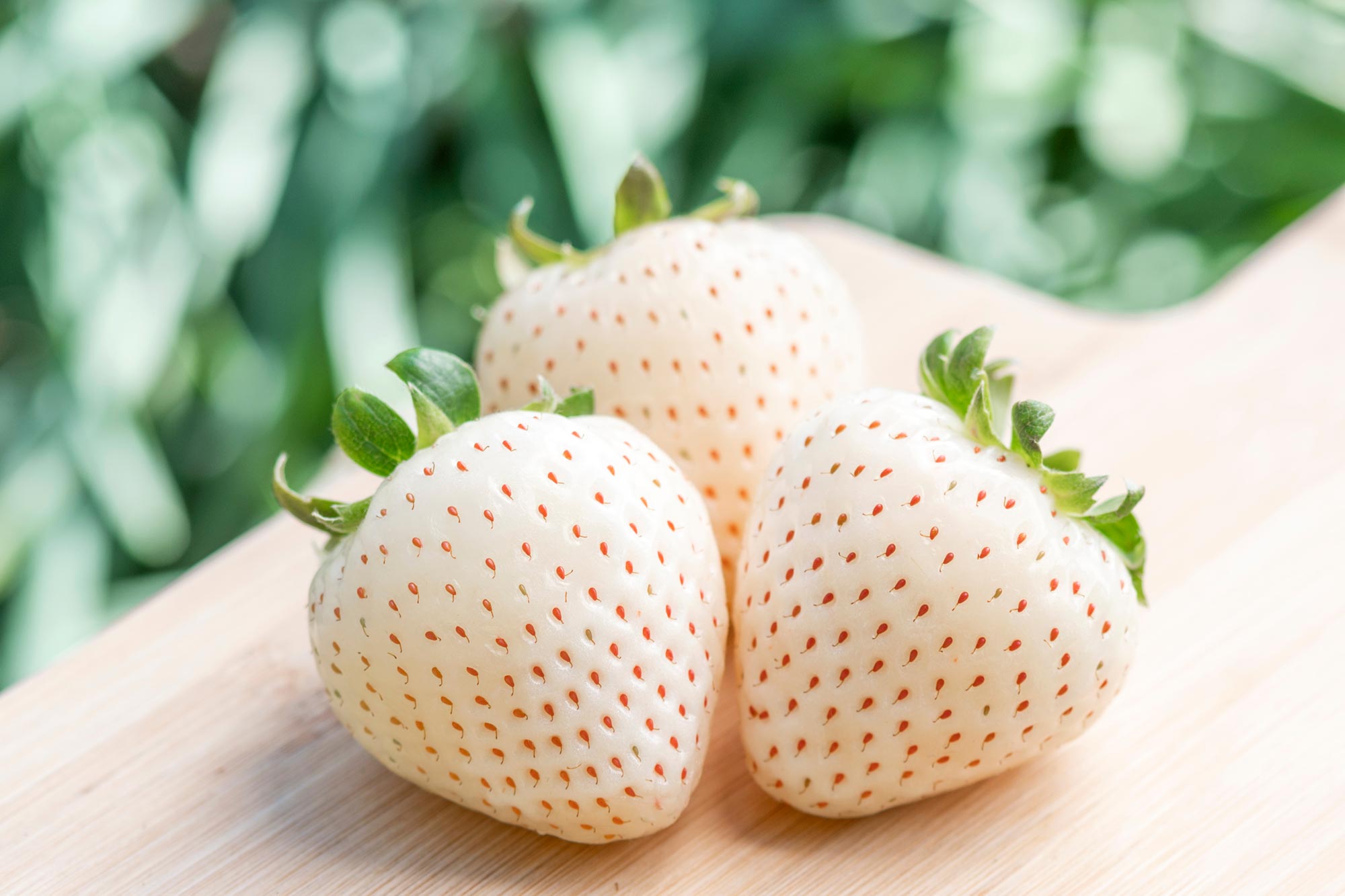 White strawberries are varieties that develop little or no red anthocyanin pigment as they ripen, leaving the fruit pale white, cream, or light pink. Their unusual appearance can result from natural genetic variation affecting pigment production, and some varieties may still develop red seeds or a faint blush. Credit: Shutterstock
Precisely editing the dominant MYB10-1B gene copy converted red strawberries into stable white fruit and demonstrated a targeted strategy for modifying polyploid crops.
A strawberry’s familiar red color depends on a complicated genetic system. Cultivated strawberries carry eight sets of chromosomes, so many genes occur in several closely related copies, making it difficult to change one trait without affecting others. Researchers have now shown that targeting just one dominant gene copy with CRISPR/Cas9 can turn red strawberries white while leaving closely related copies intact.
The color comes largely from anthocyanins, pigments produced through a tightly controlled biochemical pathway. One of its major regulators is the transcription factor MYB10, which switches on several genes involved in pigment production. Because cultivated strawberries are octoploid, meaning they contain eight chromosome sets, most genes are represented by multiple homologous copies that do not necessarily contribute equally to gene activity.
That redundancy has made both genetic research and breeding more difficult because altering a less important copy may produce no visible change. Naturally occurring white strawberries have suggested that particular MYB10 variants can determine fruit color, but confirming the role of individual copies in commercially important varieties has remained challenging.
A single gene copy controls color
Researchers from Kongju National University, the National Institute of Horticultural and Herbal Science of Korea, Chungbuk National University, and the University of Florida addressed that problem by precisely editing one dominant copy. In a study published in Horticulture Research, they used CRISPR/Cas9 on the commercial octoploid strawberry cultivar ‘Florida Brilliance’. Disrupting MYB10-1B converted normally red fruit into stable white fruit.
Before editing the plants, the researchers established that MYB10-1B was the dominant MYB10 copy controlling anthocyanin accumulation as the fruit ripened. Transcriptome analysis, which measures gene activity, showed that MYB10-1B was strongly expressed in red fruit, while the other copies contributed relatively little and did not compensate when MYB10-1B was disabled.
That distinction allowed the researchers to design CRISPR/Cas9 to recognize small sequence differences among the homoeologs. The approach selectively altered MYB10-1B while largely avoiding its closely related copies.
Precise editing turned red fruit white
The edited plants were then examined with high-resolution melting analysis, targeted amplicon sequencing, and whole-genome resequencing. The white-fruited plants carried either homozygous or biallelic mutations specifically in MYB10-1B, while only minimal off-target changes were detected elsewhere in the genome.
The fruit remained white throughout development, but its seeds stayed red, pointing to tissue-specific differences in how pigmentation is regulated.
Additional gene expression analysis showed that disabling MYB10-1B sharply reduced the activity of important anthocyanin production genes, including CHS, DFR, and ANS. Taken together, the results identify MYB10-1B as the key genetic switch controlling the color of the strawberry receptacle and show that individual homoeologs can be selectively edited in crops with complex polyploid genomes.
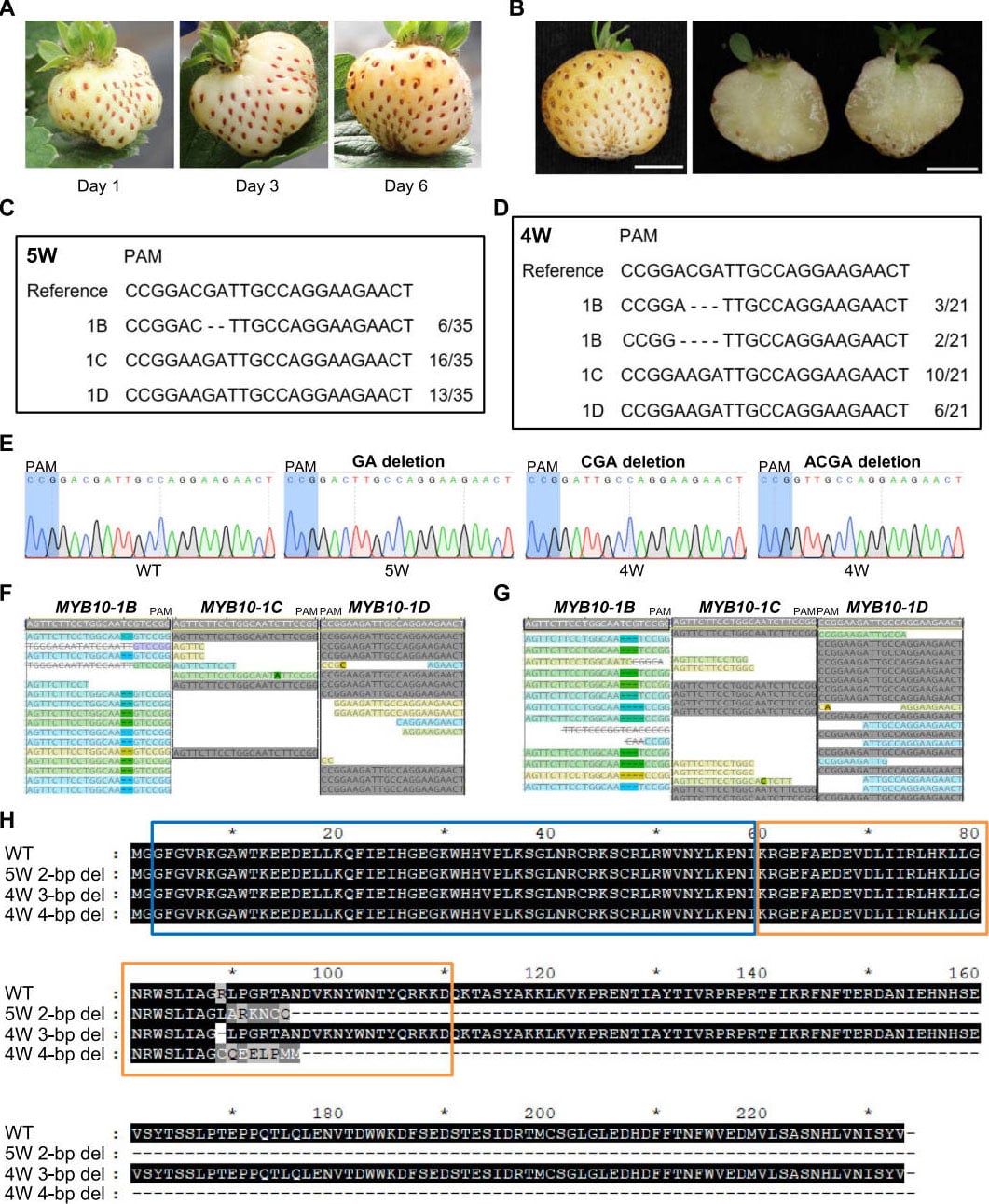 CRISPR/Cas9-mediated mutagenesis of MYB10-1B results in white strawberry fruits. Credit: Horticulture Research
Precision could reshape polyploid breeding
“This work shows that in polyploid crops, precision matters more than power,” said the study’s corresponding author. “Rather than knocking out all gene copies, we demonstrated that editing a single, dominantly expressed homoeolog is enough to drive a dramatic and stable phenotypic change. This approach reduces unintended effects and opens new possibilities for functional genomics and breeding in crops with complex genomes. It provides a practical roadmap for translating genomic knowledge into real-world trait improvement.”
The implications extend beyond producing white strawberries. The same strategy could potentially be used to fine-tune traits such as flavor, nutritional content, and stress tolerance in other polyploid fruits and vegetables.
By modifying a specific influential gene copy rather than disrupting every related copy, homoeolog-specific editing could give breeders greater control while preserving the valuable genetic backgrounds of established crop varieties. Improvements in high-quality reference genomes and increasingly precise CRISPR design are making that level of targeting more practical, expanding the options for modifying complex traits in polyploid crops.
Reference: “Whitening fruit by CRISPR/Cas9-mediated homoeolog-specific gene editing of MYB10-1B in strawberry (F. × ananassa)” by Man Bo Lee, Yoon Jeong Jang, Hyeondae Han, Kanika Saxena, Youngjae Oh, Jae Yoon Kim and Seonghee Lee, 15 October 2025, Horticulture Research.
DOI: 10.1093/hr/uhaf272
This research is supported by grants from the United States Department of Agriculture National Institute of Food and Agriculture (NIFA) Specialty Crops Research Initiative (#2017-51181-B6833 and #2022-51181-38328-0). This work was also supported by ‘Cooperative Research Program of Agriculture Science and Technology Development’ (Project No. PJ017707), Rural Development Administration, Republic of Korea, and the 2025 RDA Fellowship Program of the National Institute of Horticultural and Herbal Science, Rural Development Administration, Republic of Korea. This work was supported by the National Research Foundation of Korea (NRF) grant funded by the Korea government (MSIT) (RS-2024-00355164).
Never miss a breakthrough: Join the SciTechDaily newsletter.
Follow us on Google and Google News.

















 English (US) ·
  French (CA) ·
  French (FR) ·