

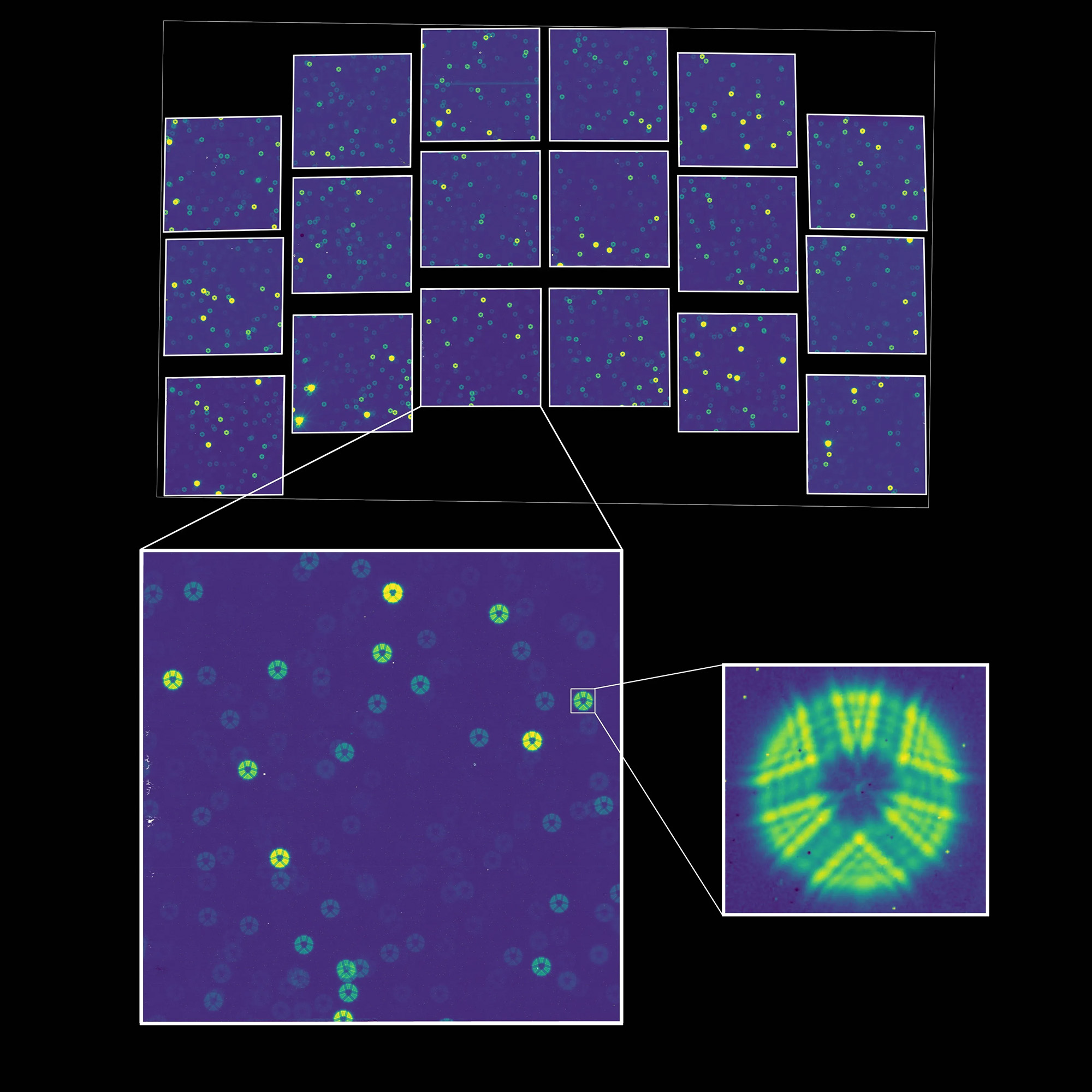
Roman's first test image shows hundreds of stars as green rings of light. After a few more months of tuning, it will capture images as crisp as Hubble's but 100 times bigger.
(Image credit: NASA's Goddard Space Flight Center, Tyler Desjardins (STScI))
Quick facts
What it is: Hundreds of stars, captured in the Nancy Grace Roman Space Telescope's first test image
Where it is: An unknown section of space
When it was shared: Sept. 15, 2026
Imagine opening your eyes for the first time and seeing that the sky is full of green doughnuts.
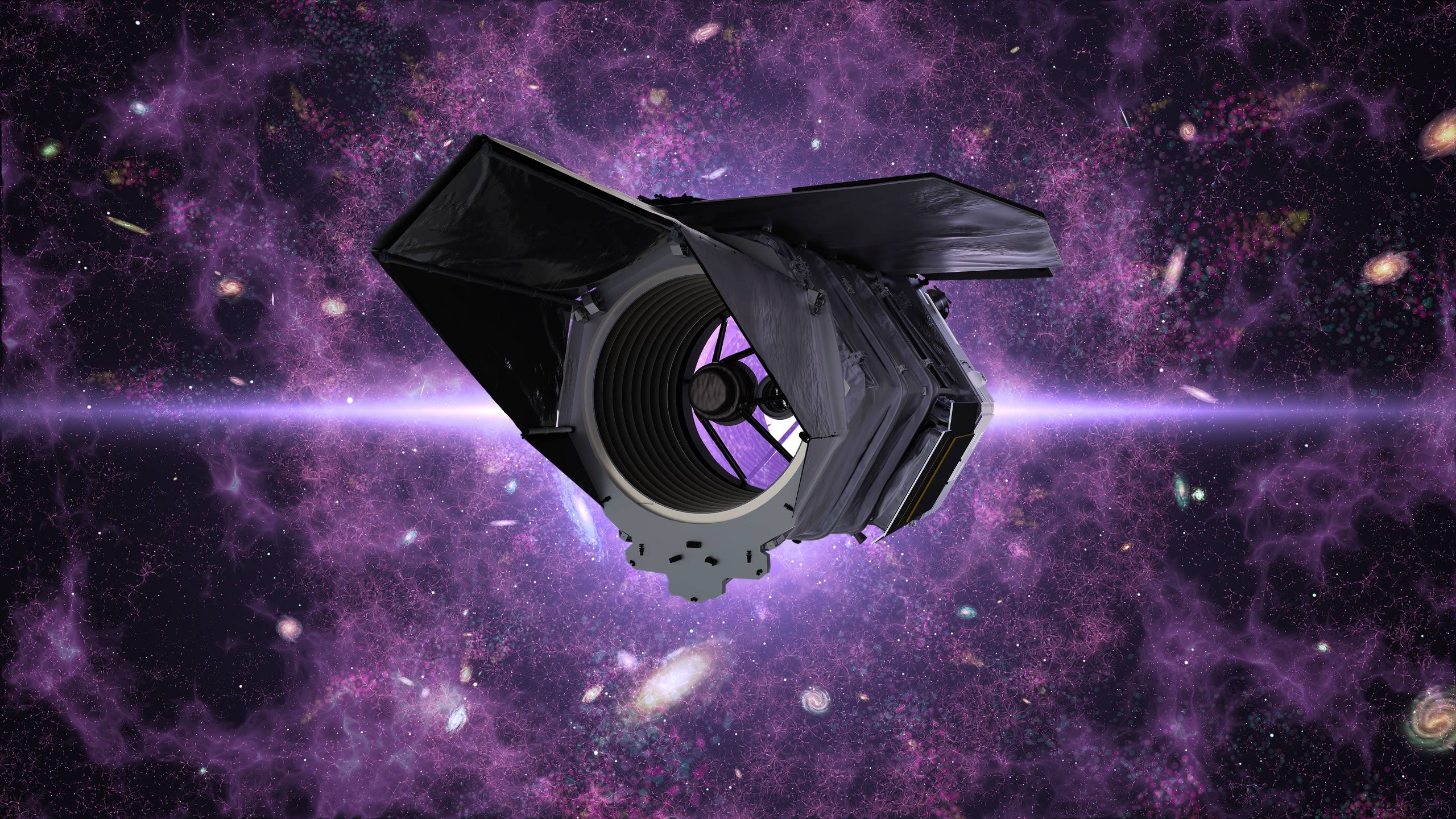
This was the view that greeted NASA's Nancy Grace Roman Space Telescope, which just activated its powerful, 300-megapixel infrared camera for the first time.
The telescope, which launched to space on Aug. 30, is partway through a months-long commissioning process, with NASA scientists testing and tuning each of the spacecraft's instruments as it undertakes a million-mile (1.6 million kilometers) journey to Lagrange point L2 — an orbital "parking spot" where the competing gravity of Earth and the sun will hold Roman in place, alongside the James Webb Space Telescope (JWST) and other scientific spacecraft.
Roman's camera system, known as the Wide Field Instrument (WFI), hasn't been fully focused yet, so the stars look like lime-colored loops in this debut test image. But so far, all systems are working as they should, according to a NASA statement.
By the time Roman is ready to beam home its first full science images in early 2027, it will be capturing cosmic snapshots as crisp and detailed as those from the Hubble Space Telescope — but each of Roman's images will cover an area 100 times larger than Hubble's.
"After years of effort to build and test the instrument on the ground, we now have confirmation that it is operational in space. This is a huge milestone," Josh Schlieder, chief WFI scientist at NASA's Goddard Space Flight Center in Maryland, said in the statement. "There is much to do, but we are on our way to groundbreaking science."
(Image credit: NASA)
The wavy rows of squares in the new image are key to Roman's photo-taking power. Each square represents one of Roman's 18 detectors, which translate photons from distant light sources into electrical signals that encode enormous images of the universe. Scientists are preparing for the telescope to beam roughly 1.4 terabytes of data — about five to 10 times the storage capacity of an average smartphone — back to Earth every day.
Get the world’s most fascinating discoveries delivered straight to your inbox.
With all that data, NASA scientists expect Roman to push the frontiers of some of the biggest mysteries in astronomy. Planned long-term surveys of distant galaxies will help scientists discover new objects and calculate the expansion of the universe, potentially shedding new light on the phenomenon of dark energy.
The telescope will also contribute to the search for alien life. By selectively blocking out starlight with Roman's built-in coronagraph — another instrument that NASA successfully tested this week — the telescope will be able to zoom in on exoplanets with unprecedented precision, free from stellar glare. These observations could increase the number of known alien worlds from the current count of over 6,000 to more than 100,000 by the end of Roman's planned 10-year mission.
But in a final piece of good news, that 10-year mission now looks likely to double. According to NASA, a successful thruster burn (combined with bonus fuel loaded onto the spacecraft at launch) means that Roman may be looking at 22 years worth of power rather than 10. Like Hubble, which has continued operating far beyond its initial mission parameters, Roman may be an orbital gift that keeps giving for decades.
Are you a UFO fanatic? Find out with our extraterrestrials quiz!

















 English (US) ·
  French (CA) ·
  French (FR) ·