

PROTECT YOURSELF with Orgo-Life® QUANTUM TECHNOLOGY
Orgo-Life the new way to the future Advertising by Adpathway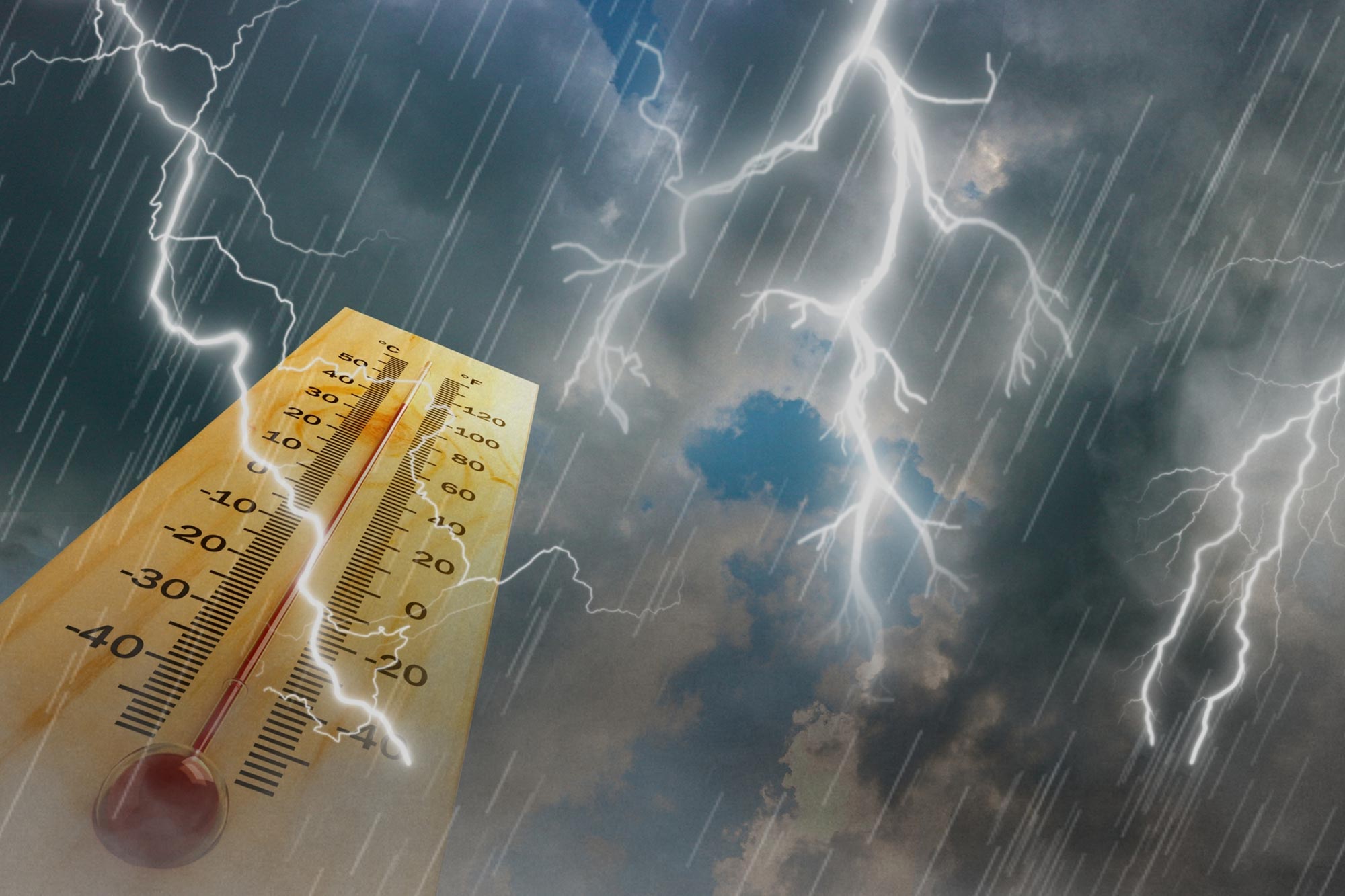 Researchers argue that solar radiation may ultimately erase the atmospheric information needed for perfect forecasts. Their energy-based framework points to a surprisingly distant theoretical boundary, while revealing a much shorter window for high-skill prediction. Credit: Shutterstock
A new study suggests the atmosphere may retain enough information for weather to remain theoretically predictable for roughly 129 days under ideal conditions.
How far into the future could weather ever be predicted, even if forecasters knew the atmosphere perfectly? Meteorologists have wrestled with that question since numerical weather prediction emerged in the late 1950s. Research published in Advances in Atmospheric Sciences now proposes a theoretical answer: under ideal conditions, the ultimate limit may be about 129 days.
Past efforts to establish that boundary have generally examined how tiny errors in current forecasts amplify as predictions extend farther into the future. Lead author Dr. Wei Zhang, a climate scientist at the University of Miami and the NOAA Cooperative Institute for Marine and Atmospheric Studies (CIMAS), argues that this approach leaves an important gap because researchers do not know how errors smaller than those in today’s forecasts would evolve.
“How could we say we can accomplish something like making skillful very long-range forecasts without actually being able to demonstrate it?” Dr. Zhang asks. “Unfortunately, there is no observational, theoretical, or modeling experience as to how errors smaller than in today’s forecasts may behave.”
Without that knowledge, attempts to establish a firm limit have remained uncertain.
Forecast errors leave a blind spot
Zhang and co-author Dr. Zoltan Toth (recently retired from NOAA) instead looked for a fundamentally different way to approach weather predictability. “Our question was whether there is a dramatically different, new perspective to approach the perennial questions of predictability,” Toth recalls.
They began by defining an idealized problem. Suppose the atmosphere’s initial state were known exactly, along with the physical laws governing it and every future macro-scale boundary condition. Under those assumptions, what would ultimately prevent a perfect weather forecast from continuing indefinitely?
Rather than tracking forecast errors, the researchers examined the atmosphere’s energy. If its initial condition and dynamics were both perfectly known, they reasoned, information about that starting state should remain preserved, allowing the true atmospheric state to be predicted indefinitely. One source of uncertainty would remain: the unknown quantum-scale phase of photons continuously arriving in solar radiation.
The researchers then considered how solar energy moves through the atmospheric system. Because incoming radiation ultimately powers atmospheric motion and eventually influences every molecule, uncertainty associated with those photons should gradually spread throughout the atmosphere. Once that happens, they argue, the atmosphere loses the information carried from its perfectly known initial state. They describe this threshold as the “energy turnover point,” beyond which internal weather prediction becomes impossible.
The theoretical ceiling is 129 days
Using estimates of the atmosphere’s total energy, incoming solar energy, and the observational uncertainties in those quantities, the researchers calculated a likely internal predictability limit of 129 ± 7 days (as opposed to predictability driven by external influences). Today’s useful weather forecasts extend to roughly 14 days, suggesting that the theoretical ceiling sits much farther away.
However, the additional predictability would not provide equally strong forecasts throughout that entire period. The researchers estimate that roughly half of the extra time could represent a meaningful extension of current forecast skill, while the remaining portion would provide increasingly marginal information. Under ideal conditions, for example, the level of skill associated with a 5-day forecast today might theoretically remain possible out to about 62 days, with only low-confidence guidance available afterward.
Dr. Zhang and his colleagues are developing independent estimates to test the proposed limit. If those approaches support the result, the 129-day figure could represent both a theoretical boundary for weather prediction and a benchmark for how much forecasting science may still be able to improve.
Reference: “A New Approach to Estimating the Limit of Predictability” by Wei Zhang, Zoltan Toth, Feifan Zhou, Jie Feng, Malaquias Peña and Ben Kirtman, 29 July 2026, Advances in Atmospheric Sciences.
DOI: 10.1007/s00376-026-5621-8
Never miss a breakthrough: Join the SciTechDaily newsletter.
Follow us on Google and Google News.










 English (US) ·
  French (CA) ·
  French (FR) ·