

PROTECT YOURSELF with Orgo-Life® QUANTUM TECHNOLOGY
Orgo-Life the new way to the future Advertising by Adpathway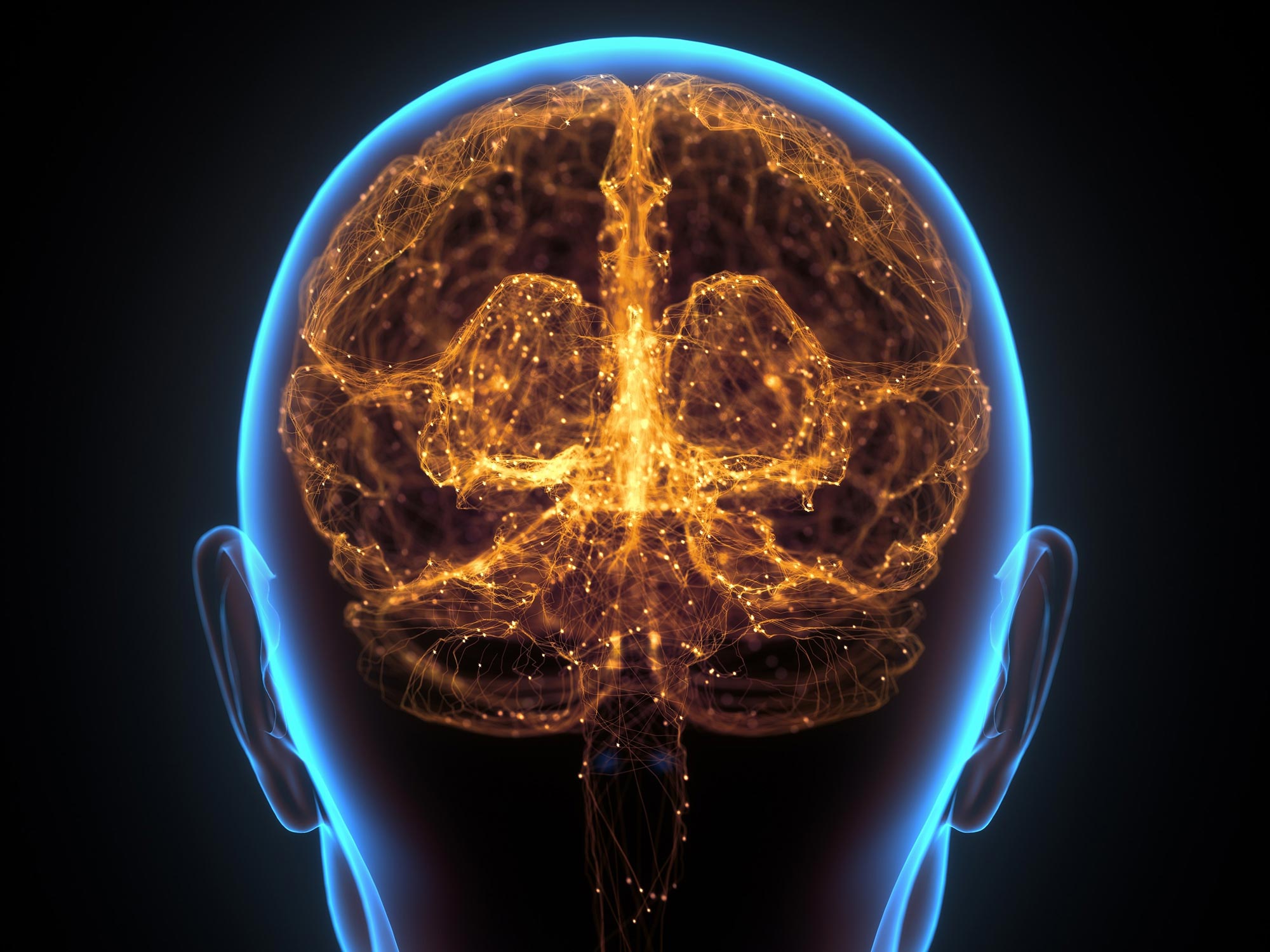 The skull may contain specialized immune centers positioned to communicate directly with the brain. In mice, these nearby immune hubs responded rapidly to brain tumors and influenced how effectively the body fought the cancer. Credit: Stock
Researchers discovered lymph node-like immune hubs inside skull bone marrow that appear to act as rapid-response centers for the brain.
For decades, the brain was thought to operate largely apart from the immune system. Researchers at Washington University School of Medicine in St. Louis have now identified lymph node-like structures inside the skull bone marrow of mice that respond rapidly to brain cancer, before more distant lymph nodes receive signals that abnormal cells are present. They also found evidence of similar immune cells in human skull bone marrow.
The findings add to growing evidence that the brain communicates directly with the immune system and suggest that specialized immune centers are positioned unusually close to the organ they help protect.
Published August 19 in Nature, the study is the first to identify these types of immune hubs inside bone.
“This study reveals that the skull bone marrow is far more than just a structural framework—it harbors previously unrecognized hubs for brain-specific immune responses,” said senior author Jonathan Kipnis, PhD, the Alan A. and Edith L. Wolff Distinguished Professor of Pathology & Immunology and a BJC Investigator at WashU Medicine. “Uncovering this localized immune niche changes how we view neuroimmune interactions and opens exciting new avenues for treating brain tumors and other neurological diseases.”
Skull channels connect brain and immune hubs
Kipnis’ laboratory previously challenged the long-held view that the brain is isolated from the immune system by discovering lymphatic vessels in the dura mater, the outer layer of tissue surrounding the brain beneath the skull. More recently, the researchers identified tiny physical channels bridging the skull, dura, and brain tissue, creating a direct route through which immune cells and cellular waste can travel between the brain and nearby skull bone marrow.
In the latest mouse experiments, researchers followed proteins as they moved from the brain through these channels and into the skull bone marrow. There, they found immune structures normally associated with lymph nodes. Such structures act as training centers where T follicular helper cells assist B cells in producing large quantities of antibodies that help defend against infection and disease.
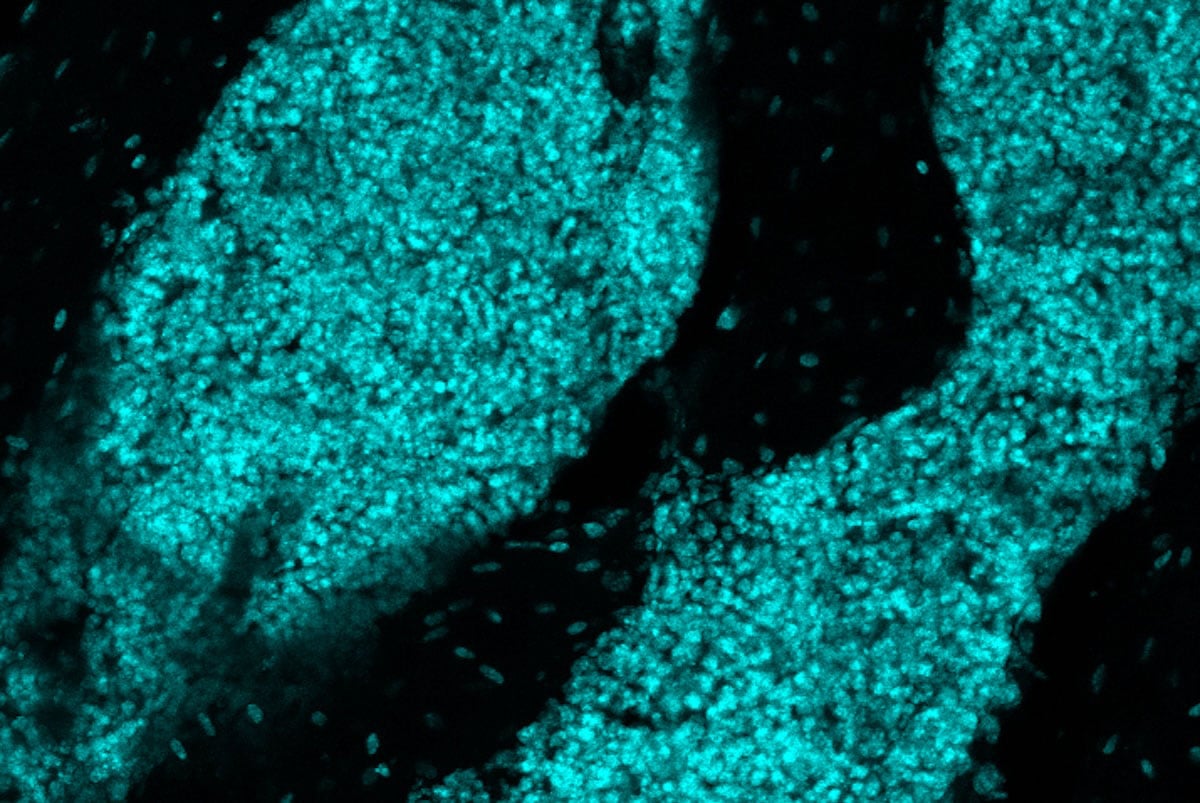 Researchers at WashU Medicine discovered lymph node-like structures (cyan) in the skull bone marrow of mice that play a role in mounting a rapid immune response in the brain. Credit: Jang Hyun Park
“We have never seen such structures in healthy bone marrow before,” said Jang Hyun Park, PhD, the study’s first author and a postdoctoral research fellow in the Kipnis lab who is starting his own lab at the Korea Advanced Institute of Science and Technology this fall. “It is an exciting discovery that points out that a complex brain requires its own specialized immune structures to defend it.”
Local immune hubs slowed brain tumors
To determine whether these skull immune centers actually contribute to protection against brain disease, the researchers turned to a mouse model of glioblastoma, an aggressive brain cancer. When they disrupted the skull immune hubs with a drug, tumors grew faster than they did in mice whose hubs remained intact. Disabling the structures also reduced survival, indicating that these nearby immune centers contribute to the brain’s defense against cancer.
“The finding fundamentally changes our current understanding of neuroimmunology. Knowing that the brain relies on first responders in the surrounding skull for defense has the potential to change how we think about developing therapies for many neurological conditions, including Alzheimer’s disease.”
Boosting skull immunity improved survival
The researchers then tested whether strengthening immune activity within the skull marrow could improve the response against cancer. They placed a gel containing three immune-boosting proteins directly beneath the scalp, stimulating greater antibody production inside the skull bone marrow. Tumor-fighting immune responses appeared first in the skull immune hubs and only later in nearby lymph nodes outside the skull. Mice receiving the treatment rejected tumors more effectively and survived longer than control mice.
“The finding fundamentally changes our current understanding of neuroimmunology,” said Kipnis. “Knowing that the brain relies on first responders in the surrounding skull for defense has the potential to change how we think about developing therapies for many neurological conditions, including Alzheimer’s disease, Parkinson’s disease, schizophrenia, long COVID, and many others that have an immune component to them. Such therapies could access these immune hubs directly through the skull, without major peripheral side effects.”
Reference: “Functional role of skull lymphoid structures in CNS immunosurveillance” by Jang Hyun Park, Daviti Abramishvili, Gustavo Gastão Davanzo, Ruben Silva, Xingxing Gu, Siling Du, Daniel D. Lee, Bernd H. Zinselmeyer, Jackson S. Turner, Gwendalyn J. Randolph, Igor Smirnov and Jonathan Kipnis, 19 August 2026, Nature.
DOI: 10.1038/s41586-026-10951-4
This work was supported by grants from the National Institutes of Health, grant number R37AG034113; Cure Alzheimer’s Fund; the BJC investigators program at WashU Medicine; the Basic Science Research Program through the National Research Foundation of Korea (NRF) by the Ministry of Education, grant number 2022R1A6A3A03065522; and by a fellowship grant from the ChadTough Defeat DIPG Foundation.
Never miss a breakthrough: Join the SciTechDaily newsletter.
Follow us on Google and Google News.














 English (US) ·
  French (CA) ·
  French (FR) ·