

PROTECT YOURSELF with Orgo-Life® QUANTUM TECHNOLOGY
Orgo-Life the new way to the future Advertising by Adpathway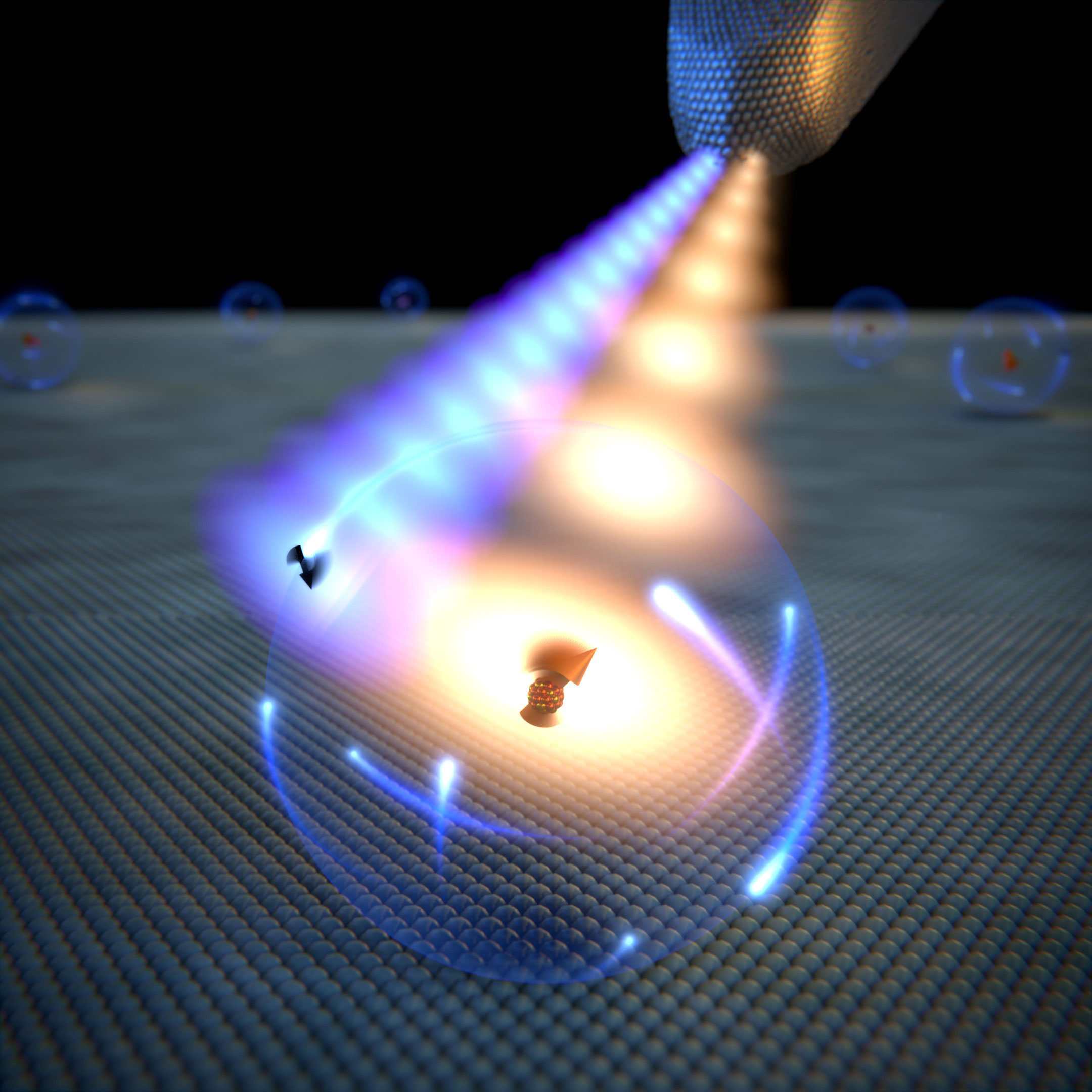 Impression of the experiment where the spins of the electron (blue) and the nucleus (orange) within a single atom are independently controlled by wave signals from the probe tip of a tunneling microscope. Credit: Studio Scixel
A new technique allows researchers to manipulate magnetism deep within a single atom.
Scientists have used radio waves to control the magnetic spin of a single atomic nucleus, achieving a result that challenges their understanding of how atomic magnetism works. The experiment, conducted at Delft University of Technology and published in Nature Communications, demonstrates that nuclear spin can be manipulated under conditions where researchers did not expect it to respond.
Unlike the relatively strong magnetism associated with electrons, nuclear magnetism is extremely weak and more isolated from its surroundings. “By far the strongest magnetism comes from the electrons,” says lead researcher Sander Otte. “But in some atoms, the nucleus also carries a spin. That spin is much weaker, but it is also much better shielded from the outside world.”
An Unexpected Response From the Atomic Nucleus
To investigate magnetism at the atomic scale, Otte’s team uses a modified scanning tunneling microscope capable of directing electrical signals at individual atoms. Previous experiments primarily examined electron spin, which is easier to detect and manipulate. Nuclear spin could be observed indirectly through the hyperfine interaction, a quantum coupling between the magnetic properties of an electron and the nucleus.
In the latest experiment, lead author Hester Vennema and her colleagues applied two signals simultaneously, one targeting the electron and another targeting the nucleus. By examining their effects separately, the researchers discovered that they could flip the nuclear spin even when it was largely disentangled from the electron spin. This contradicted their expectation that the nucleus would not respond independently to the microscope’s electrical signals.
“According to our simple understanding, this should not really happen,” says Otte. “The nuclear spin should not be sensitive at all to the electrical signals from a scanning tunneling microscope.”
Controlling Atomic Magnetism With Precise Frequencies
The researchers achieved this control by adapting double magnetic resonance, an established technique, to work with a single atom. The method allowed them to address the nucleus and electron independently using signals tuned to their respective magnetic resonances. In quantum mechanics, spin can change between specific allowed states, and each transition requires a signal with the appropriate frequency.
“You can compare it to the strings of a guitar,” Vennema explains. “Each possible spin rotation is like a string with its own note. You have to play precisely the right note to make a particular string vibrate. The ‘notes’ of a nuclear spin are a hundred to a thousand times lower than those of an electron spin.”
Implications for Quantum Information Storage
Nuclear spins are promising candidates for storing quantum information because they are relatively well protected from external disturbances that can disrupt delicate quantum states. The ability to control an individual nuclear spin could eventually support new methods for storing and reading quantum information, although practical applications remain a future possibility.
For now, the experiment leaves a fundamental question unanswered: What physical mechanism allows the nuclear spin to respond when its coupling to the electron spin is insufficient to explain the observed behavior? Understanding that process will require further investigation.
“Back to the drawing board, then,” says Otte. “That is really how science works. There is always something new left to figure out.”
Reference: “Nuclear magnetic resonance on a single atom with a local probe” by Hester G. Vennema, Cristina Mier, Evert W. Stolte, Leonard Edens, Jinwon Lee and Sander Otte, 24 October 2026, Nature Communications.
DOI: 10.1038/s41467-026-78801-5
Never miss a breakthrough: Join the SciTechDaily newsletter.
Follow us on Google and Google News.
























 English (US) ·
 French (CA) ·
 French (FR) ·