

PROTECT YOURSELF with Orgo-Life® QUANTUM TECHNOLOGY
Orgo-Life the new way to the future Advertising by Adpathway CsV3Sb5 is an unusual quantum material known as a kagome metal, named for the interconnected triangular pattern of atoms in its crystal structure. Credit: Stock
Stretching a quantum material revealed two distinct superconducting states, challenging previous assumptions about its behavior and offering new clues to the mechanisms behind superconductivity.
Stretching a crystal by less than 1% has allowed scientists to separate two distinct superconducting states in a material that has puzzled physicists for years. The experiment also increased the temperature at which superconductivity begins, without substantially changing another form of electronic order within the crystal.
The findings could help settle a long-standing debate surrounding CsV3Sb5, an unusual metal whose superconducting properties have produced conflicting experimental results. By controlling strain along a single direction, researchers found a way to investigate superconductivity independently of the charge ordering that normally complicates its behavior.
Why This Unusual Metal Has Puzzled Physicists
CsV3Sb5 belongs to a family of materials called kagome metals, named for the distinctive pattern of interconnected triangles formed by their atomic structures. This geometry can produce unusual electronic behavior, including competing forms of quantum order.
At approximately 94 kelvin (−290°F), CsV3Sb5 develops a charge density wave, a periodic rearrangement of electronic charge. At much lower temperatures, around 2.5 kelvin (−455°F), it becomes superconducting, allowing electrical current to flow without resistance. Scientists have struggled to determine how these two states interact and what type of superconductivity the material supports.
One unresolved question concerns the superconducting gap, an energy gap associated with the pairing of electrons. Some experiments have suggested that this gap remains open throughout the material’s electronic structure, while others have indicated the presence of nodes, locations where the gap falls to zero. These possibilities point to different characteristics of the underlying superconducting state.
Stretching the Crystal Changes Its Superconductivity
To investigate, a team led by Associate Professor Shinji Kawasaki and Professor Guo-qing Zheng of Okayama University in Japan applied controlled strain to high-quality CsV3Sb5 crystals. Using a custom piezoelectric strain cell, they stretched or compressed the material along one crystallographic direction while monitoring its superconducting transition and local electronic properties through nuclear quadrupole resonance measurements.
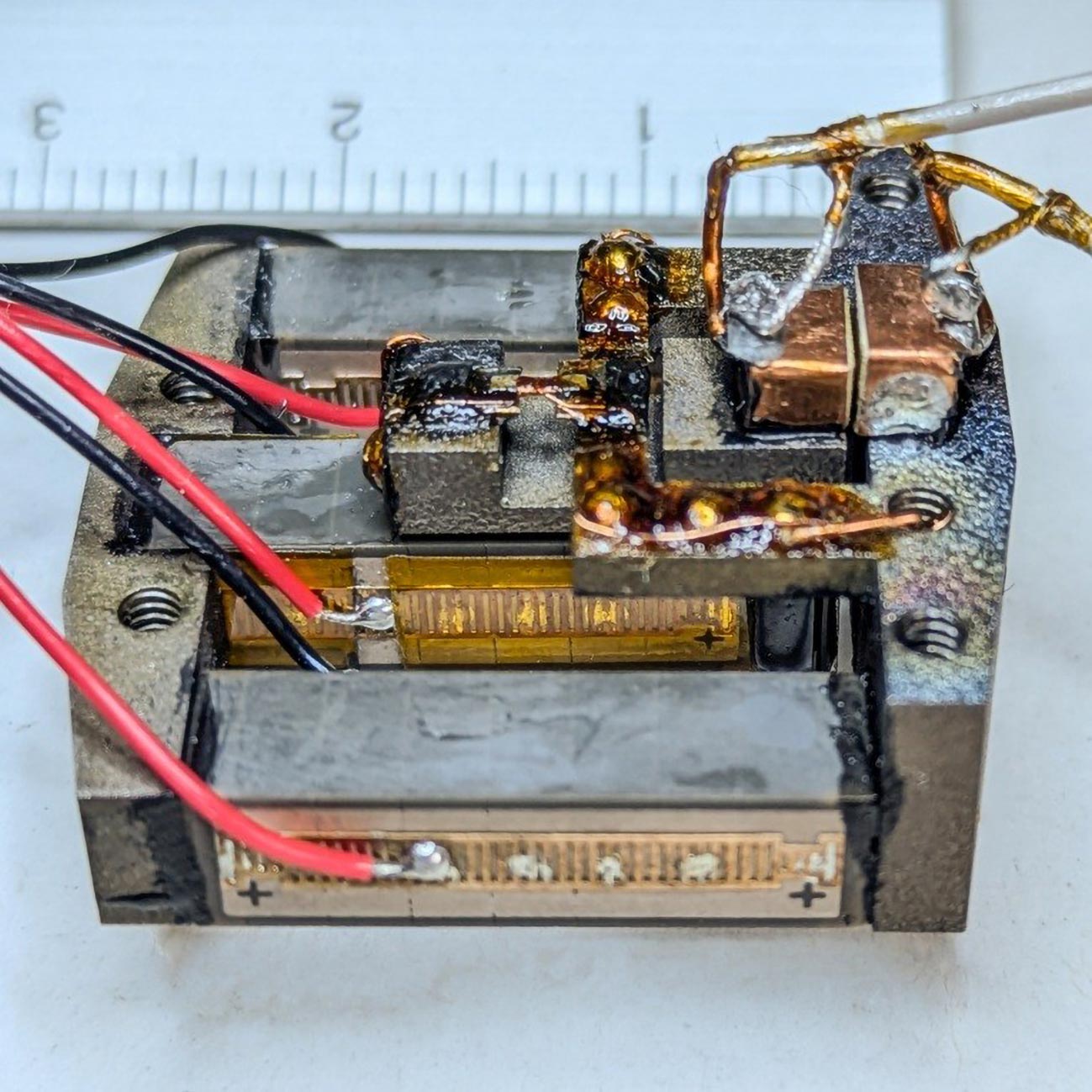 A close-up of the piezoelectric-driven strain cell, hand-built by the research team, used to apply precise mechanical strain to single crystals of CsV3Sb5 while measuring their superconducting properties at low temperature. The apparatus enabled the discovery of two distinct, hidden superconducting states in the material. Credit: Associate Professor Shinji Kawasaki and Professor Guo-qing Zheng from Okayama University, Japan
Stretching produced a clear increase in the superconducting transition temperature. Without applied strain, superconductivity began at approximately 3.0 kelvin (−454°F). Under tensile strain of +0.90%, that temperature rose to 3.6 kelvin (−453°F). Compression did not produce the same enhancement.
The charge density wave, however, remained essentially unchanged. Unlike hydrostatic pressure, which can influence superconductivity by modifying charge order, uniaxial strain allowed the researchers to strengthen superconductivity while leaving the existing charge density wave largely intact.
Two Superconducting States Emerge Under Strain
At the highest tensile strain, the researchers detected two separate superconducting transitions. The first appeared at 3.6 kelvin and was associated with a nodal superconducting state. A second transition occurred at 3.0 kelvin and exhibited a nodeless state.
The measurements provide evidence for two superconducting states that are nearly degenerate under ordinary conditions, meaning their energies are very similar. Applying strain appears to separate these states, offering a possible explanation for why earlier experiments reached different conclusions about the material’s superconducting gap.
“For years, different measurements of CsV3Sb5 have pointed toward seemingly different superconducting states,” says Prof. Kawasaki. “Our results show that these states can coexist and that uniaxial strain can separate them, giving us a direct way to study each state.”
A New Way to Investigate Unconventional Superconductivity
The measurements also showed that tensile strain strengthened the unconventional nodal component. Its estimated contribution increased from approximately 10% without applied strain to about 26% at +0.90% strain, suggesting that stretching selectively favors this superconducting pairing channel.
“Strain gives us an independent control knob in this material—it enhances superconductivity without changing the bulk charge density wave,” says Prof. Kawasaki.
The approach could be extended to other unconventional superconductors in which multiple electronic orders coexist, including iron-based superconductors and heavy-fermion materials. Applying strain may help researchers distinguish the mechanisms responsible for superconductivity from the effects of competing charge or spin order.
Reference: “Strain-Tuned Nodal Superconductivity in the Charge-Ordered Kagome Metal CsV3Sb5” by Yusuke Takeuchi, Akito Kobayashi, Saki Uchida, Takumi Nagao, Seigo Ogawa, Rui Zhou, Shinji Kawasaki, Fei Song, Hao Ni, Yong Zhao and Guo-qing Zheng, 28 August 2026, Physical Review Letters.
DOI: 10.1103/mzgp-2lzb
Funding: JSPS KAKENHI, JSPS Program for Forming Japan’s Peak Research Universities (J-PEAKS), Murata Science Foundation, Electric Technology Research Foundation of Chugoku, Electric Technology Research Foundation of Chugoku, CAS PIFI program
Never miss a breakthrough: Join the SciTechDaily newsletter.
Follow us on Google and Google News.



















 English (US) ·
  French (CA) ·
  French (FR) ·