

PROTECT YOURSELF with Orgo-Life® QUANTUM TECHNOLOGY
Orgo-Life the new way to the future Advertising by Adpathway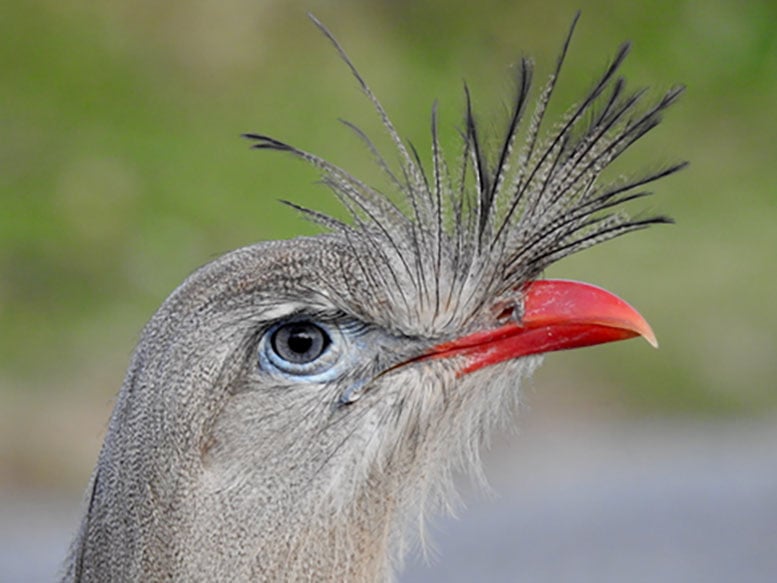 The red-legged sereima (above), which is a contender for the title of “world’s loudest bird” with the bare-throated bellbird (top of page). Credit: João Menezes
An unprecedented study of 123 bird species reveals clues about how some birds produce such powerful calls while leaving open the question of why extreme loudness evolved.
A bird can unleash a call loud enough to rival a jackhammer, yet measuring that blast in the wild is surprisingly difficult. Sound weakens as it travels, so a call that overwhelms a microphone nearby may barely register from farther away. For biologists trying to compare species scattered across different landscapes, that simple fact has made one basic question unusually hard to answer: just how loud can birds get?
Carrying a portable sound meter and a laser rangefinder into the field, University of Massachusetts Amherst biologist Jeff Podos and his former graduate student João C.T. Menezes set out to put reliable numbers on bird calls. Among the species they measured, the bare-throated bellbird and the red-legged seriema stood out as two contenders for the world’s loudest bird. The study was published recently in Evolution.
Distance complicates every wild bird call
“Figuring out how loud a bird call is should be pretty easy in the lab,” says Menezes, who completed this research as part of graduate work at UMass Amherst. “But until very recently, it has been very challenging to do in the field, and there’s very little data to draw on.”
Measuring a bird’s call in the wild becomes difficult because loudness, or amplitude, changes depending on how far the microphone is from the animal. Researchers therefore need to know both the sound level and the bird’s distance at the moment it calls. Scientists can capture birds and test them under controlled laboratory conditions, but that approach quickly becomes impractical when comparing large numbers of species across countries.
“You have to get your boots on the ground,” says Podos, who accompanied Menezes in measuring the amplitudes of 123 birds in the areas around Amherst, Massachusetts, and across Brazil.
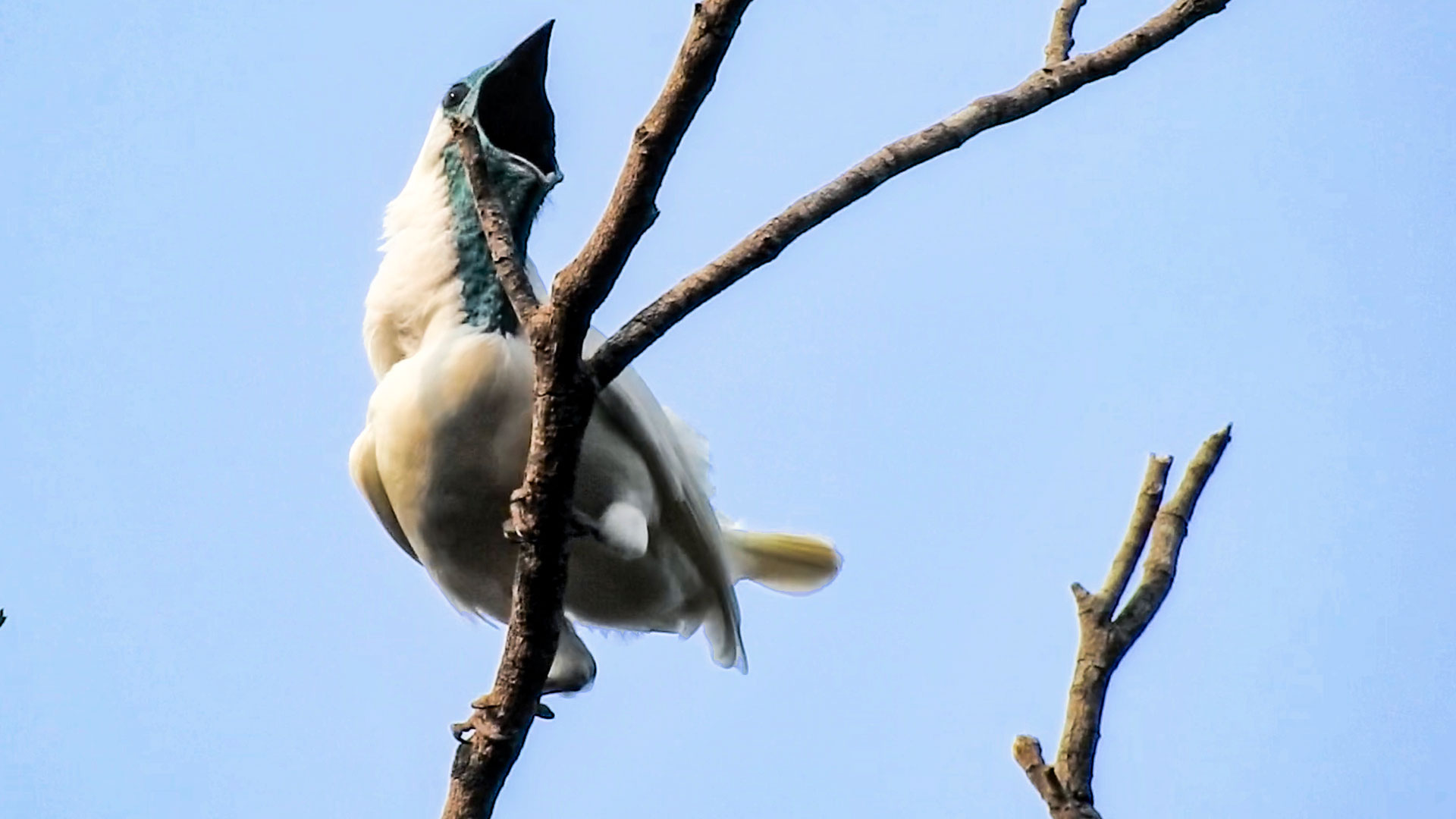 A male bare-throated. Credit: University of Massachusetts Amherst
Golfers and workplace safety specialists helped make that fieldwork possible, although neither group was designing equipment for ornithologists. Accurate laser rangefinders developed for golf allowed the researchers to pinpoint a bird’s distance, while portable, high-resolution sound meters could record the strength of its call. Used together, the devices gave Menezes and Podos a practical way to measure bird volume in the wild.
Moving from species to species, the researchers assembled reliable amplitude measurements for 123 species, including 113 whose call volumes had never been cataloged. “We’ve been able to vastly increase the number of species for which there is amplitude data,” says Podos. “This is basic, foundational research that no one else has managed to do on this scale, and it points to all sorts of other questions that would be fun to follow up.”
Bird calls span a 58-decibel range
Across those measurements, bird calls spanned a striking 58-decibel range. At the quieter end, a hummingbird registered about 64 decibels, roughly comparable to a normal conversation. At the other extreme, bare-throated bellbirds and red-legged seriemas climbed above 120 peak decibels, putting them at the very top of the species the researchers measured.
Podos had encountered such extreme volume before. In 2019, he reported that the Amazon’s white bellbird produced the world’s loudest known bird call, louder than standing next to a revving chainsaw. Guinness World Records later recognized the finding. Record-setting calls, however, are only a side effect of a much broader question that Podos and Menezes are trying to answer.
Comparing the bodies of the birds with their measured calls revealed some of the physical machinery behind extreme volume. Larger birds tended to be louder, possibly because their bulkier muscles allow them to compress and force out more air. Wider beak openings were also associated with louder calls, much as the broad bell of a trumpet helps project sound outward.
https://youtu.be/9r35UUlsS_8
A new contender for the world’s loudest bird: bare-throated bellbird. A male bare-throated bellbird sings in the Atlantic Forest of Brazil, near Macuquinho Lodge, Salesópolis, SP. Credit: João Menezes
Loudness defies the expected ecological patterns
While body size and beak width offered a physical explanation for loudness, the researchers found no similarly clear ecological pattern. Menezes and Podos had expected especially loud calls to appear more often in birds that were weak flyers, lived in dense forests, or practiced polygamy. Each idea offered a plausible advantage for shouting farther: limited mobility could make long-distance communication useful, thick vegetation could block visual signals, and mating calls that carry farther might reach more potential partners.
Instead, the measurements failed to produce clear, broad support for those predictions. Loudness could be linked to body size and beak opening, but the ecological and evolutionary reasons some birds became exceptionally loud remained much harder to pin down.
“We now know some of the hows,” says Menezes. “Bigger bodies and wider beaks, but we’ve yet to discover the whys, and we probably need much more data from many more species to be able to tease out what’s going on the ecological and evolutionary front.”
Back in the field, that unanswered question means more birds to find, more distances to measure, and more calls to catch at exactly the right moment. Podos is eager to return with Menezes, a golf rangefinder, and a sound meter in hand.
“Yogi Berra said ‘you can observe a lot by watching,’ and the world has some beautiful things to see,” says Podos. “You can’t do this kind of work in the lab, or by scraping data from the internet. You have to get out into the world, you have to pay careful attention to what you’re seeing and hearing, and anything you do in the field that forces you to observe more carefully is really fun—it takes you back to the roots of why we do science in the first place.”
Reference: “Evolutionary drivers of vocal amplitude in birds” by João C T Menezes and Jeffrey Podos, 29 September 2026, Evolution.
DOI: 10.1093/evolut/qpag153
Never miss a breakthrough: Join the SciTechDaily newsletter.
Follow us on Google and Google News.























 English (US) ·
  French (CA) ·
  French (FR) ·