

 3 hours ago
2
3 hours ago
2
PROTECT YOURSELF with Orgo-Life® QUANTUM TECHNOLOGY
Orgo-Life the new way to the future Advertising by AdpathwayThe LatAm Brief
One email, every weekday morning. What moved in Latin American markets, politics and expat life.
Yesterday’s subject line: “Argentina gives Britain two weeks over Falklands oil”
Free. We send a confirmation link first — nothing arrives until you click it. Unsubscribe with one click in any edition. If you stop opening us for 30 days we stop sending by ourselves, as we assume the interest is no longer there. See our privacy policy. We never share your email.
POLITICS · NICARAGUA
Key Facts
- —The country Nicaragua, run by co-presidents Daniel Ortega and Rosario Murillo under a 2025 constitutional reform. It left the Organization of American States (OAS) in November 2023.
- —What happened On 28 September 2026 an OAS draft resolution for the foreign ministers’ meeting of 2 October was published. It demands Managua revoke constitutional changes approved in 2025 and 2026.
- —Who is involved Peru presented the draft with Colombia and the United States, Divergentes and Confidencial reported on 28 September. The meeting itself was called by a 29–1 council vote on 19 August.
- —What it means for you Nothing changes on the ground yet. If adopted, a ministerial group would report within 30 days and could propose coordinated diplomatic, economic and financial steps.
- —Still open Whether the wording survives negotiation, whether it passes by consensus, and whether Managua engages with the proposed group at all.
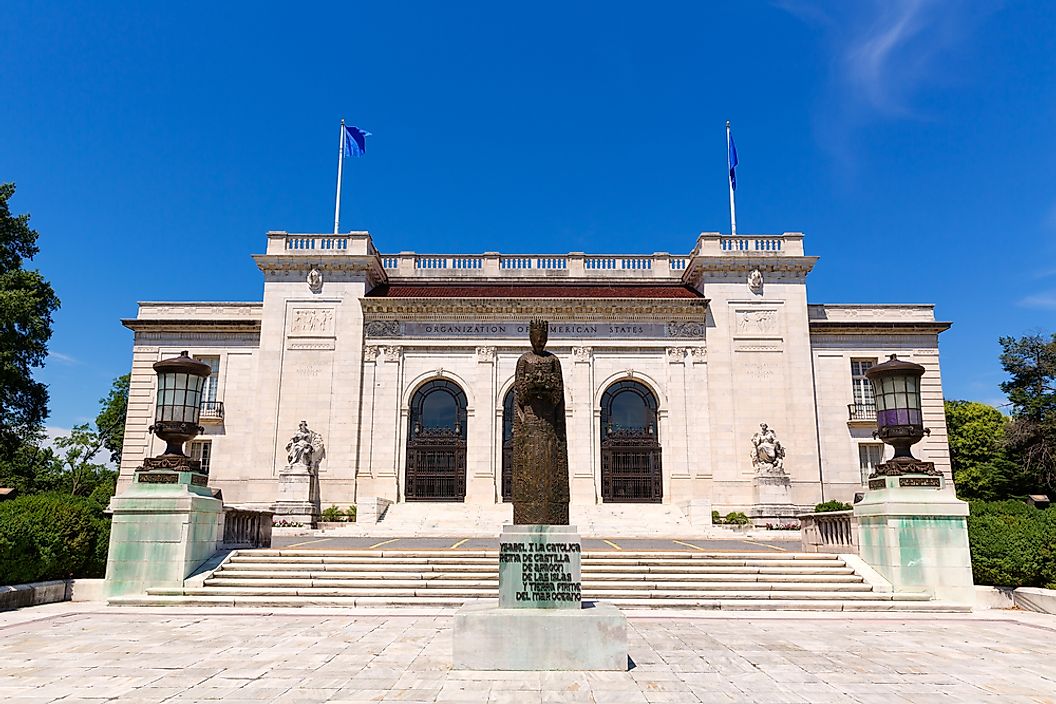
An OAS draft resolution circulated on 28 September asks Nicaragua’s government to revoke the constitutional changes it approved in 2025 and 2026. Foreign ministers of the Organization of American States (OAS) meet in Washington on Friday 2 October to consider it.
Free daily brief — no card needed
Get every Latin America story in one morning email
We build you a personalized brief around the topics you follow — free for 7 days. Love it? Your first month after that is US$1.
Yes, email me my free daily brief — I can unsubscribe any time.
The text is a draft, not a decision, and diplomats may still amend it this week to win consensus, Divergentes reported. Its title is “The situation in Nicaragua and its continued collective consideration”.
One-stop reference
Company Intelligence
Every listed company in Latin America — financials, ownership and structure for 1,450+ companies across 26 exchanges, in one place.
How the Meeting Was Called
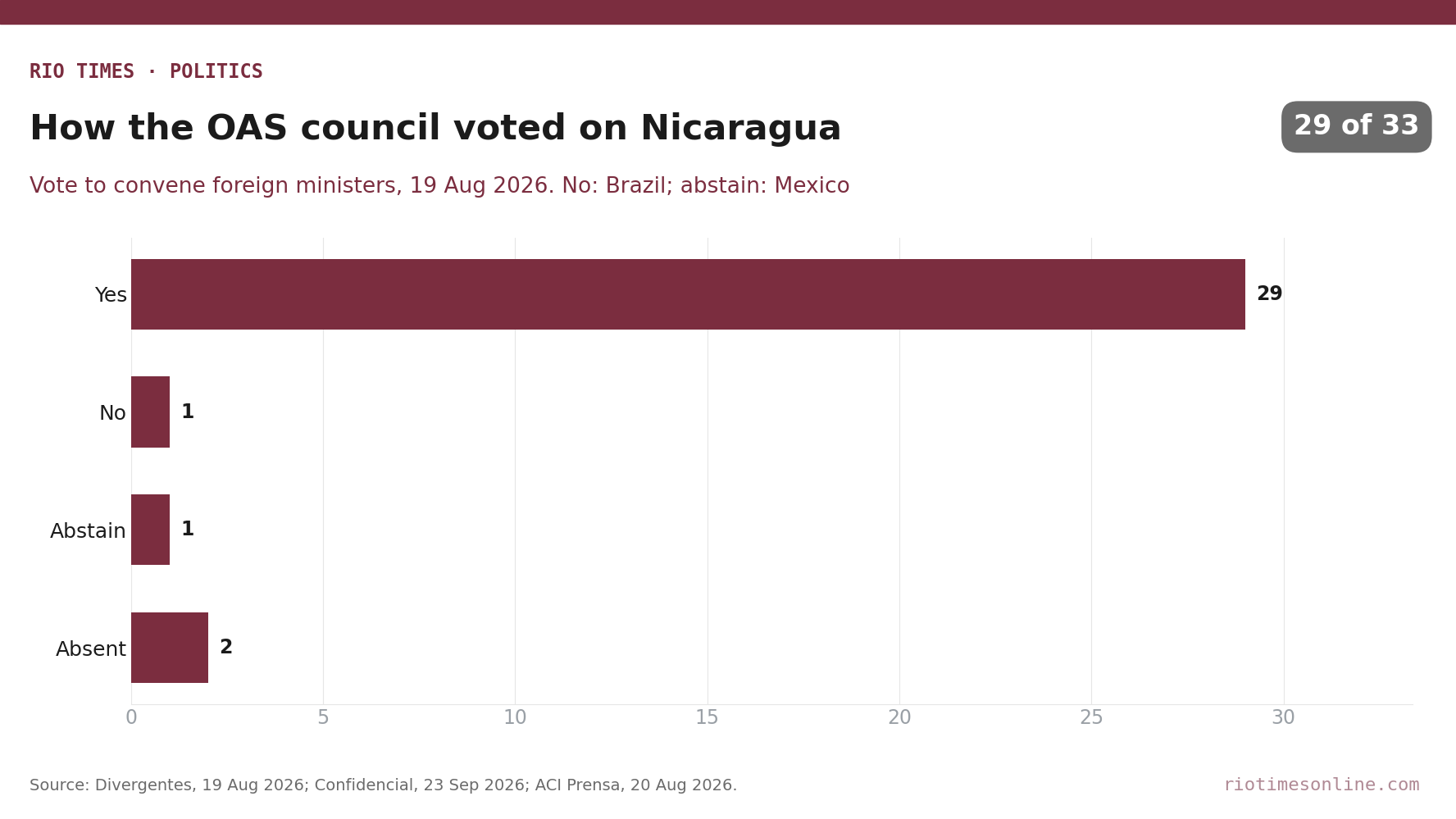
The OAS Permanent Council, the body of ambassadors that runs the organisation between summits, voted on 19 August to convene the ministers. The tally was 29 in favour and one against, Divergentes and Confidencial reported.
Brazil voted against, Mexico abstained and two delegations were absent, according to Confidencial and ACI Prensa. On 23 September the council set the date as 2 October.
A Meeting of Consultation of Ministers of Foreign Affairs is the OAS’s top political tool for a crisis. Divergentes notes it had not been used since 2019, for Venezuela.
Which Reforms the Draft Targets
The OAS draft resolution asks Managua to revoke constitutional changes approved in 2025 and 2026 and to restore the separation of powers. The 2025 reform created the co-presidency and lengthened the presidential term from five to six years.
The 2026 reform passed its first reading on 1 September. It bars people the government labels “coup plotters” from politics and would push elections to late 2028.
It still needs a second reading in January 2027; see Nicaragua Faces Blunt UN Criticism as a Reform Delays Elections to Late 2028. Ortega announced on 19 July that he intended to end competitive elections.
What Else the Text Demands
The list includes freeing all political prisoners and disclosing the whereabouts of people who have disappeared. It also seeks the return of citizenship to 452 Nicaraguans stripped of it.
Independent media, civil society groups, universities and business chambers would be allowed to reopen, and confiscated property returned. A monitoring group, cited by Confidencial, counted 68 political prisoners in a report of 25 September.
One clause asks Nicaragua to withdraw security personnel, technology and facilities from outside the hemisphere and end related defence agreements. Confidencial said the draft describes the government’s practices as a threat to hemispheric peace and security.
A Dialogue Track Alongside the Pressure
The centrepiece is a Ministerial Follow-up Group that would seek “rapid and direct dialogue” with Managua, possibly including a visit. It would report within 30 days, and the ministers could reconvene within 45.
The group could then propose gradual collective measures in the diplomatic, economic and financial fields. Former presidential hopeful Juan Sebastián Chamorro called the text “a warning”, though he expects the government to refuse.
Guillermo Belt, a former adviser to the OAS Secretariat, told Confidencial the threat language could open the door to the Rio Treaty. That 1947 pact allows collective defence measures.
What Is Not Yet Known
It is unclear whether the final text will keep the demand to revoke the reforms or the threat language. Nor is it known how Brazil and Mexico, which did not back the August vote, will act on Friday.
No public response from Managua to the draft had been reported by Tuesday morning. Attendance by US Secretary of State Marco Rubio has not been confirmed.
Frequently Asked Questions
What does the OAS draft demand?
That Nicaragua revoke constitutional changes approved in 2025 and 2026 and free political prisoners.
Who presented the draft?
Peru, with Colombia and the United States, for the foreign ministers’ meeting on 2 October.
How was the meeting called?
By a 29 to 1 council vote on 19 August, even though Nicaragua left the OAS in November 2023.
What changes on the ground?
Nothing immediately; the text is a pressure track alongside a dialogue track.
Sources: Divergentes, 28 September 2026 (draft resolution presented by Peru); Confidencial, 28 September 2026; Confidencial, 23 September 2026 (meeting date and 19 August vote breakdown); Divergentes, 19 August 2026 (Permanent Council vote); ACI Prensa, 20 August 2026, and Diario Libre, 19 August 2026 (vote breakdown).
This article was produced by The Rio Times’ automated newsroom system. How we use AI · Report an error
The Rio Times · Power Map
See who really holds power in Latin America
Click to open the Power Map →
















 English (US) ·
  French (CA) ·
  French (FR) ·