

 3 months ago
39
3 months ago
39
PROTECT YOURSELF with Orgo-Life® QUANTUM TECHNOLOGY
Orgo-Life the new way to the future Advertising by Adpathway- When four friends were assembling the first team to develop a new type of payment system for small businesses, they operated out of a bachelor studio in Cape Town.
- Today, Yoco is a R12 billion payments company with more than 300 000 customers and contributing to the growth of many small South African businesses.
- And it all started with an idea and a determination to make a difference that flourished around a single table in a tiny office.
- This is News24’s second story in our new series SA Success Stories – inspiring origin stories of successful SA businesses, NGOs and individuals, proudly sponsored by Old Mutual Wealth.
When Neo Ntsobe joined a small startup called Yoco in May 2014, he was leaving behind a career in banking to work in a room with one table.
He swapped out 13 years at a big-four bank to join a team incubating a dream in a space the size of a bachelor studio in Loop Street, Cape Town.
“I think I was employee number 10. This table was the office,” he recalls with a smile.
“The whole team, the whole company, we sat around this table.”
That company was Yoco – one of South Africa’s fastest-growing financial technology firms over the last decade, now helping more than 300 000 customers.
Today Ntsobe is the key accounts lead at Yoco, but he remembers what he felt on his first day 11 years ago.
With a laugh, he says:
It was a culture shock. I came from a corporate environment where there were thousands of us, and you walk into a room. It was daunting, and I even considered calling my dad to say I had made a mistake.
“But I knew the plan was big. And there was a sense of hope that this was something I wanted to be a part of, and there was an authenticity about it that drew me to the project.”
That project was simple: making the payment process simpler for small businesses by removing a lot of the admin involved.
Led by founders Katlego Maphai, Carl Wazen, Bradley Wattrus and Lungisa Matshoba, they had been inspired by tap-and-go card machines while on a trip abroad.
And they believed there was a huge opportunity in Africa, where cash was still the dominant mode of payment in informal and small business spaces.
Getting their DNA right in a market dominated by big banks
Eleven years after launching, the company now has a beautiful office space in Kloof Street in Gardens where 300 people gather around many more tables, with every floor built to tell its story over the years.
Stories and pictures of their first customers – the small businesspeople of South Africa – line the walls, and the famous table has followed the team everywhere it has gone, now sitting in its in-house coffee shop as a reminder of the grit that endures.
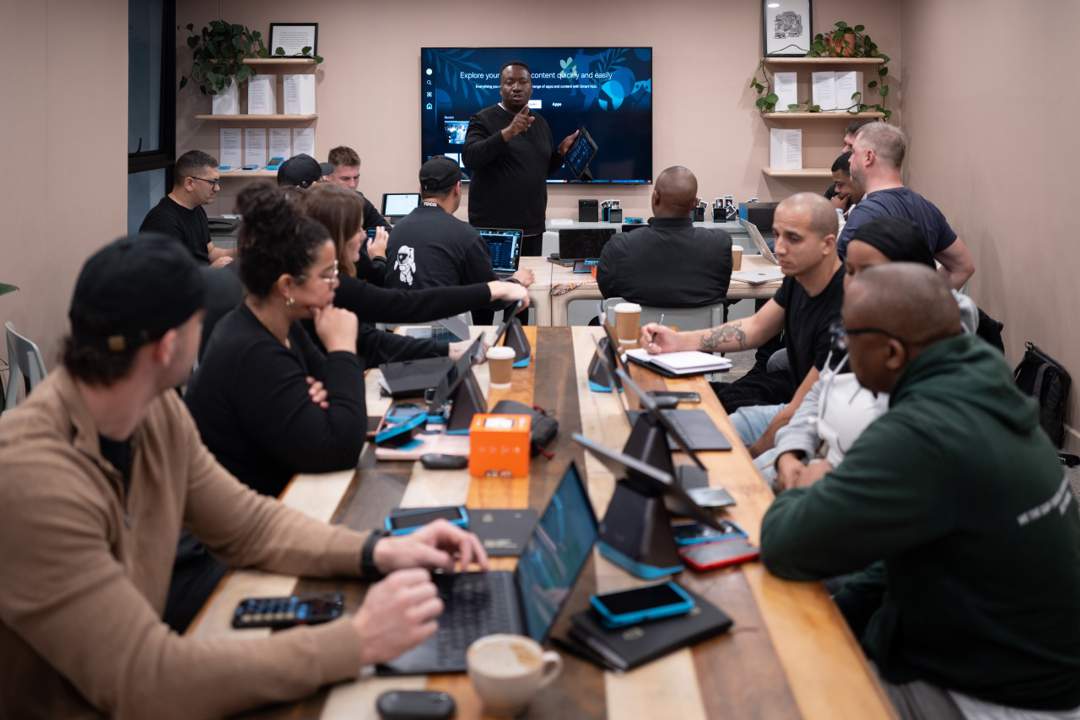
Yoco's famous office table has followed the growing business from a small startup to its multi-storey office in Gardens.

The story of Yoco’s famous office table.

Yoco's famous office table has followed the growing business from a small startup to its multi-storey office in Gardens.
Gregor Röhrig has documented Yoco’s journey from the beginning as a visual anthropologist. Today, he is head of cultural alignment and said the office layout was very intentional in telling the company’s story and staying true to its startup roots as more staff join its woven tapestry.
“From the beginning, we had to build the right team. The four founders built a very strong, small, agile team, including salespeople and tech developers, people who understood the payments side, to get the DNA right.”
READ | How a KZN mom’s farm kitchen built an SA-wide nougat empire
This, Röhrig says, was crucial, as they were going to enter a payment space owned by much larger institutions – and it required people willing to go door-to-door with their first prototype led by their first lead salesman, Ronald Makomba.
“We had this little black machine, and it was met with some level of scepticism at first. What was really amazing about Ronald’s door-to-door experience is that it wasn’t just a sales pitch. It was showing a little piece of our DNA, and it got us connected with our customers.”
At the core of Yoco’s uptake all those years ago was that it was solving a problem for small businesses. Yoco allowed merchants to onboard themselves, which was revolutionary at the time, and that conviction helped with the growth of not only Yoco, but the tap-and-go payments market in South Africa.
Both Röhrig and Ntsobe bought into this idea back then, and both have key moments when they realised the dream had taken off.
Turning points, a blue machine and a swag store
After a successful prototype phase, signing up 500 vendors, the business then moved to launch in 2015 and a funding round two years later.
Röhrig remembers the growing sentiment toward the Yoco machine at that time.
Suddenly, people were talking about the little blue card machine. It became a thing, and when people start talking about a payment device that made an impact in their minds, I found that bizarre. Have you ever come home and remembered the payment terminal you paid on? There was something so empowering about that.
The Yoco “blue” had always been a part of the company’s logo, and very early on they decided to make their black prototype carry some of that blue signature – which is now a mainstay at many customer-facing shops around South Africa.
“Around those early days, that was the first time we were looking at options. We wanted to be bold and disrupt and stay true to who we are and try the blue. It was a very deliberate choice, and that blue has now become a statement.”

The Yoco “blue” has always been a part of its identity, even going back to its first Beta products tested in 2014.

The Yoco “blue” has always been a part of its identity, even going back to its first Beta products tested in 2014.

The Yoco “blue” has always been a part of its identity, even going back to its first Beta products tested in 2014.
Growth was both steady and fast, and the team was eventually able to move offices – first to another block in Loop Street, and then later to Shortmarket Street – each step a visual reminder of the growth of the once one-table office.
“That was the first taste of what growth felt like in the organisation,” says Ntsobe. “We were now a team, and there were departments, like marketing and sales. We even had a toilet and a kitchen,” he laughs.
Röhrig remembers one specific event launch a few years later in 2018 on a cold winter’s day in Braamfontein that cemented what Yoco is in his mind.
“People lined up to listen to our founders give a keynote speech. We had this swag store on the site and it was sold out in half an hour. And I remember thinking, ‘who buys a piece of swag with a fintech payments company logo on it?’ To me, it represented something else; people were believing in the mission and what we stand for. It wasn’t just a little device; it was helping small businesses grow.”
Products, professionalism and a new point of sale system
Today, Yoco is valued at just over R12 billion. What started out as a physical card machine prototype is now a full suite of digital products that help owners minimise the admin needed to run their businesses.
But like many companies, it also navigated difficult times during Covid-19, which forced the company to pivot to digital sales after physical sales went down to zero for a period at the heart of the first lockdown.
READ | This man quit his job, took out a loan, and drove 9 000km to chase his SA dream - and it worked
“We’re a lot more agile now. We adapt very quickly and that was accelerated by that Covid-19 period,” adds Ntsobe.
Since then, and looking forward, the company now focuses more intently on software products for their customers but is still building hardware, including a new physical device called Counter – a point of sale system for the retail environment.
“We get a lot of feedback from our customers that they need help looking more professional. That’s what a machine like that also does. It helps tell their customers that they are professional,” says Ntsobe.
Disrupters making a difference
Through these success story interviews, many of the subjects get to relive their own journeys over the many years involved. When asked for their final thoughts and memories that stand out, Ntsobe felt it was all about the difference made.
In our early days, I remember reading an article that our devices were attached to businesses contributing around 1% to the South African economy. That, for me, was when I realised we were actually making a difference. We were showing the government what small businesses can contribute to the economy of South Africa.
He also gets to tell his dad that he didn’t make a mistake.
And for Röhrig, who has watched and captured the company’s growth from the very small startup it once was, he is proud that the ambitious disrupters back then never veered from doing things their way.
“We always did it our way; the way we decided on product strategy or how we go to market. I’m proud because we haven’t just said yes to how the industry says we should do things. We’ve been allowed to do things slightly out of the ordinary.”
*This is News24’s second story in our new series SA Success Stories – inspiring origin stories of successful SA businesses, NGOs and individuals, proudly sponsored by Old Mutual Wealth.
If you have an inspiring success story to tell, email [email protected].
Newsletter
Weekly
Wake Up To Good News
Good News editor Paul Herman delivers a morning round-up of stories that remind you why you fell in love with South Africa.



















 English (US) ·
  French (CA) ·
  French (FR) ·