

PROTECT YOURSELF with Orgo-Life® QUANTUM TECHNOLOGY
Orgo-Life the new way to the future Advertising by Adpathway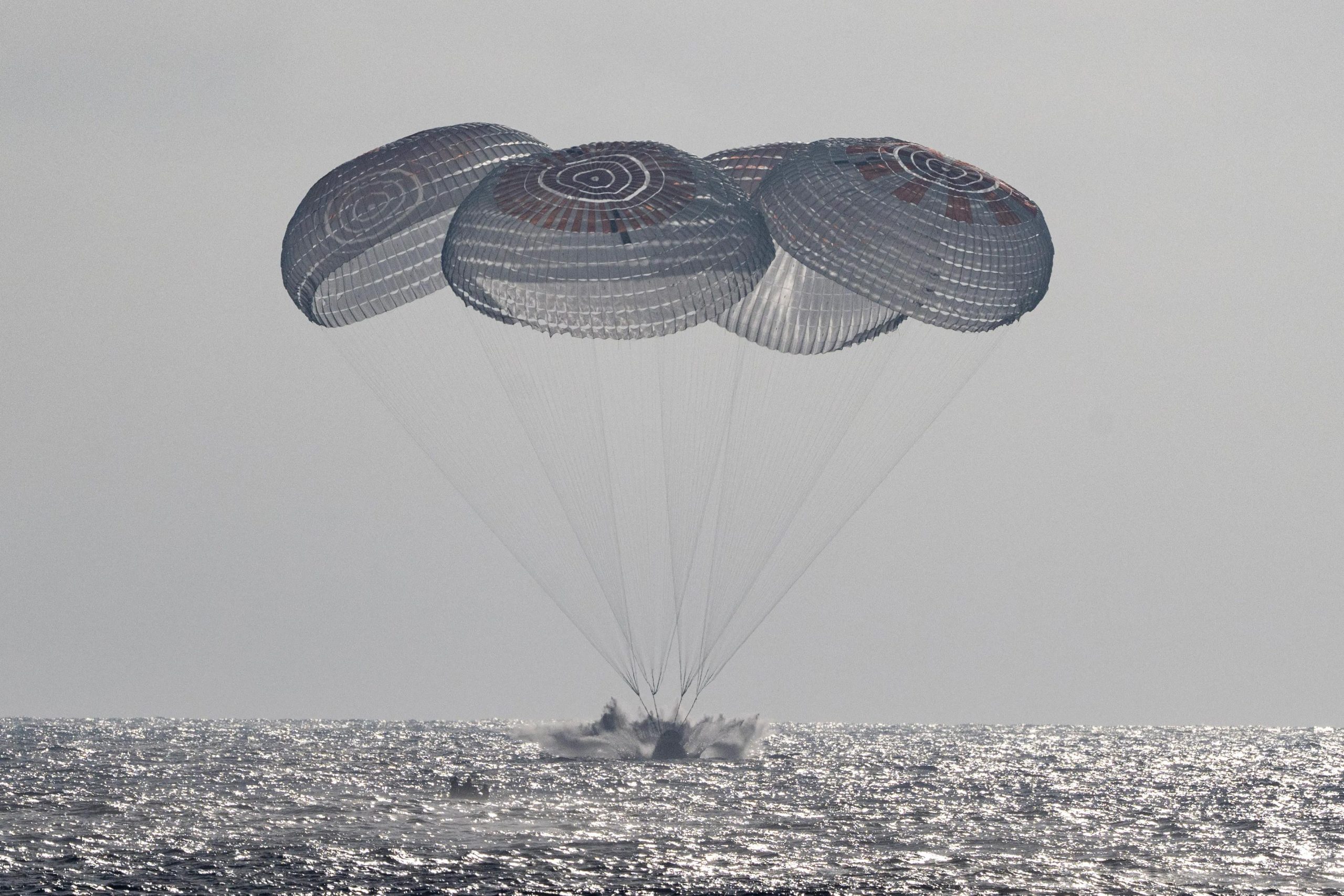 The SpaceX Crew Dragon Freedom spacecraft is seen as it lands with NASA astronauts Jessica Meir, Jack Hathaway, ESA (European Space Agency) astronaut Sophie Adenot, and Roscosmos cosmonaut Andrey Fedyaev aboard in the Pacific Ocean off the coast of Los Angeles on October 8, 2026. Credit: NASA/Keegan Barber
After spending more than seven months aboard the International Space Station (ISS), four astronauts from NASA’s SpaceX Crew-12 mission have returned safely to Earth. Their spacecraft splashed down Thursday in the Pacific Ocean near Los Angeles, bringing an extraordinary journey of 237 days and more than 100 million miles to an end.
The astronauts will share details about their mission and scientific accomplishments during a news conference scheduled for 3:30 p.m. EDT on Thursday, October 15, at NASA’s Johnson Space Center in Houston.
“Jessica, Jack, Sophie, and Andrey spent 237 days living and working in orbit, traveled more than 100 million miles, advanced important science, and returned safely home because of the extraordinary expertise and competence of thousands across NASA, SpaceX, and our international partners,” said NASA Administrator Jared Isaacman. “Building the capability, experience, and confidence to do this repeatedly is exactly what will allow us to go farther, and I am grateful to Crew-12 and their families for their service to humanity’s greatest adventure.”
NASA Crew-12 Returns After 237 Days in Space
The returning crew included NASA astronauts Jessica Meir and Jack Hathaway, ESA (European Space Agency) astronaut Sophie Adenot, and Roscosmos cosmonaut Andrey Fedyaev.
Their spacecraft touched down in the Pacific at 8:34 a.m. PDT. SpaceX recovery teams aboard specialized vessels reached the capsule shortly afterward and brought the spacecraft and its passengers aboard. Following routine medical evaluations, the astronauts were scheduled to travel to shore before returning to NASA’s Johnson Space Center in Houston.
“NASA’s activities supporting the International Space Station — transporting crew, conducting impactful research, and maintaining critical national assets — enable the science, engineering, and risk‑reduction needed for future missions across the solar system,” said Dana Weigel, manager of NASA’s Low Earth Orbit Program at the agency’s Johnson Space Center. “We’re grateful for the dedication across the human spaceflight team that makes this possible, and we’re thrilled to welcome Jessica, Jack, Sophie, and Andrey home.”
Over the course of their 237-day expedition, the astronauts completed more than 3,792 trips around Earth, covering a combined orbital distance of over 100 million miles.
For Meir and Fedyaev, the flight marked their second journey into space. Hathaway and Adenot, meanwhile, completed their first missions. Crew-12 launched on February 13 at 5:15 a.m. EST and arrived at the space station the following day.
Space Experiments Could Help Future Missions to the Moon and Mars
While living aboard the orbiting laboratory, Crew-12 devoted hundreds of hours to experiments designed to advance human space exploration and produce scientific insights with potential benefits on Earth.
One area of investigation involved growing stem cells in space, an approach that could eventually support new cell-based medical treatments. The astronauts also tested technology capable of producing IV fluids when needed, an important capability for future missions in which carrying large quantities of medical supplies could be difficult.
Other experiments investigated how pneumonia-causing bacteria may contribute to lasting heart damage, potentially improving scientists’ understanding of related health problems on Earth.
The crew additionally participated in nutrition research and examined how differences in physical characteristics could influence blood circulation during spaceflight. Understanding these effects is essential for protecting astronaut health during extended missions far from Earth.
Together, these studies are helping researchers investigate the challenges of long-duration spaceflight while developing and evaluating technologies that could support future human journeys to the Moon and Mars.
Historic Spacewalks Mark Another Milestone
Beyond their scientific work, Crew-12 astronauts achieved important milestones outside the space station.
Meir performed four spacewalks during the mission, increasing her career total to seven. That achievement places her third among NASA women in career spacewalks, behind former astronauts Peggy Whitson and Suni Williams.
Adenot also made history by completing three spacewalks, becoming the first French woman to venture outside the International Space Station.
With their mission complete, the four astronauts have returned from an expedition that combined extensive scientific research, historic achievements, and hundreds of millions of miles of orbital travel, contributing valuable experience toward NASA’s ambitions for deeper human exploration of the solar system.
Never miss a breakthrough: Join the SciTechDaily newsletter.
Follow us on Google and Google News.

















 English (US) ·
  French (CA) ·
  French (FR) ·