

PROTECT YOURSELF with Orgo-Life® QUANTUM TECHNOLOGY
Orgo-Life the new way to the future Advertising by Adpathway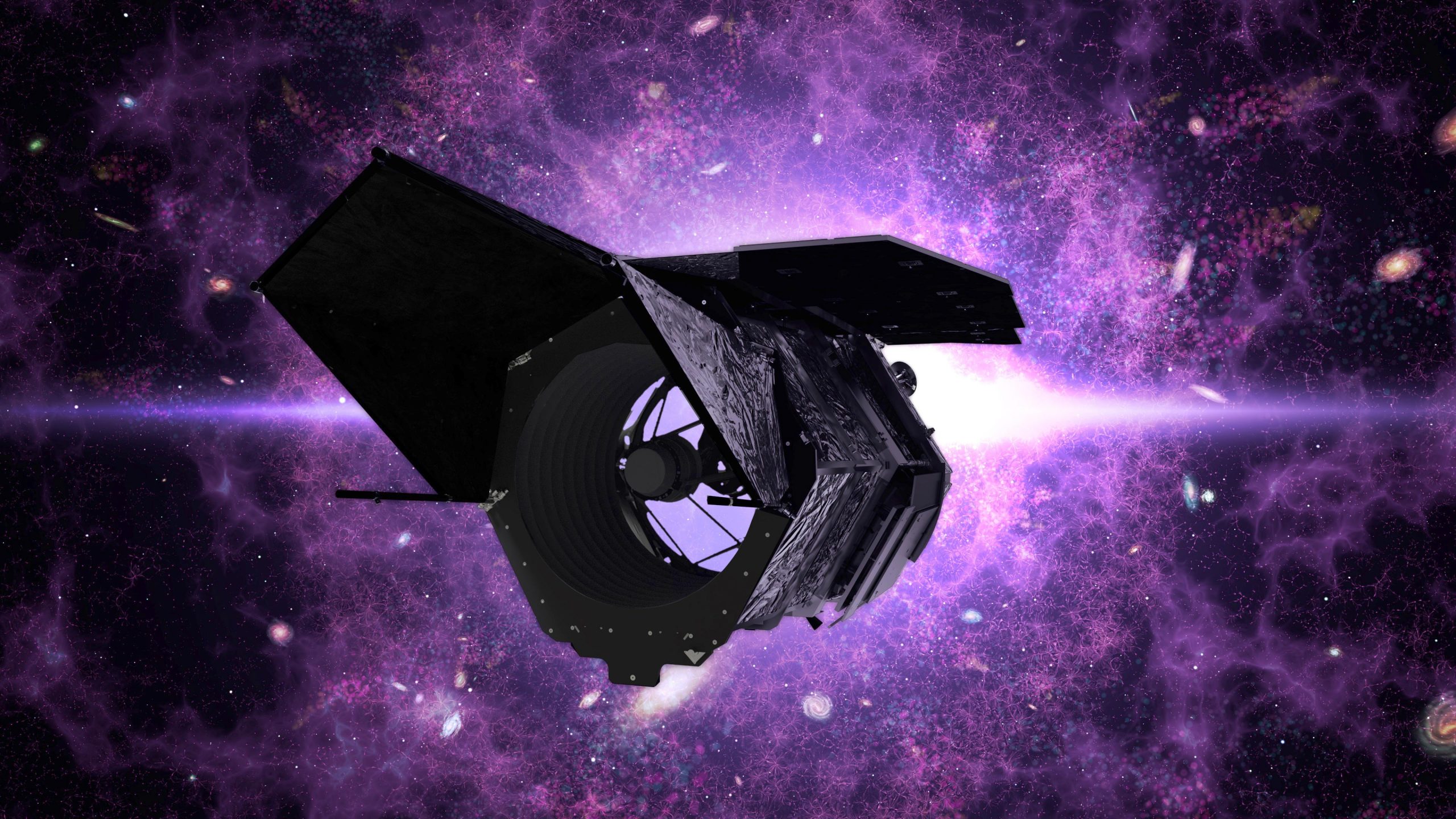 The Roman Space Telescope is a NASA observatory designed to unravel the secrets of dark energy and dark matter, search for and image exoplanets, and explore many topics in infrared astrophysics. Credit: NASA
NASA’s Nancy Grace Roman Space Telescope has reached one of the final major milestones before launch. On August 21, teams sealed the observatory inside the protective fairing of the SpaceX Falcon Heavy rocket at the Payload Hazardous Servicing Facility at NASA’s Kennedy Space Center in Florida.
The fairing is the large protective shell that surrounds a spacecraft at the top of a rocket. Roman’s fairing stands 43 feet tall and will protect the sensitive observatory while it is transported and during the first stages of its journey into space.
While Roman remains on the ground, the fairing and its support equipment maintain a carefully controlled environment around the telescope. They also allow teams to safely move the enclosed spacecraft out of the processing facility as preparations for liftoff continue.
Protecting Roman During Its Fiery Ride to Space
A rocket launch exposes a spacecraft to extreme conditions. As Falcon Heavy accelerates through Earth’s atmosphere, Roman will experience intense sound vibrations, aerodynamic pressure, and heating.
The fairing acts as a shield during this demanding part of the flight. Once the rocket has climbed high enough that those environmental hazards have diminished, the protective shell will no longer be needed.
A few minutes after liftoff, the two halves of the fairing will separate and fall away, leaving Roman free to continue its journey through space. SpaceX plans to recover both fairing halves after they return to Earth.
Roman will ultimately travel toward Sun-Earth Lagrange point 2 (L2), a location in space that provides a useful environment for astronomical observatories. From there, the telescope will be positioned to carry out extensive observations of the distant universe.
Falcon Heavy Launch Preparations Enter Final Stages
Before that journey can begin, Roman still needs to be joined with its rocket. Teams will soon transport the encapsulated observatory to SpaceX’s hangar at Launch Pad 39A.
There, Roman will be mounted on Falcon Heavy. The fully assembled rocket and spacecraft will then be moved to the pad at Launch Complex 39A for the final preparations before liftoff.
NASA and SpaceX are targeting no earlier than 7:26 a.m. EDT Sunday, August 30, for the launch.
Hunting Thousands of Worlds Beyond Our Solar System
Once operational, Roman is expected to discover thousands of exoplanets. Exoplanets are worlds that orbit stars beyond our solar system, and studying large numbers of them could help researchers understand how other planetary systems compare with our own.
Scientists are especially interested in determining how closely some of Roman’s discoveries might resemble the planets that orbit the Sun. By finding and studying many distant worlds, Roman could give astronomers a much broader picture of the variety of planetary systems throughout the galaxy.
Probing Dark Matter and Dark Energy
Roman’s ambitions extend far beyond planet hunting. Scientists will also use the telescope to investigate dark matter and dark energy, two of the biggest mysteries in modern astronomy.
Dark matter cannot be seen directly, but its gravitational effects indicate that it plays an important role in shaping galaxies and other large structures in the universe. Dark energy is the name scientists use for the poorly understood phenomenon associated with the accelerating expansion of the cosmos.
By observing the universe on an enormous scale, Roman will give researchers new ways to investigate these hidden components of the cosmos and explore how the universe’s expansion has changed over time.
Never miss a breakthrough: Join the SciTechDaily newsletter.
Follow us on Google and Google News.












 English (US) ·
  French (CA) ·
  French (FR) ·