

 4 hours ago
5
4 hours ago
5
PROTECT YOURSELF with Orgo-Life® QUANTUM TECHNOLOGY
Orgo-Life the new way to the future Advertising by Adpathway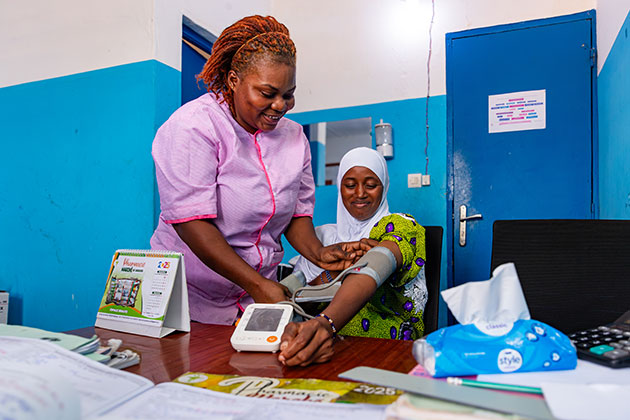 Ouattara, senior midwife and head of the maternity unit at the Ayaou-Sokpa Health Centre in Côte d'Ivoire, consults with Awa, a pregnant woman, during a routine antenatal visit. Credit: UNFPA Côte d'Ivoire/Miléquêm Diarassouba
NEW YORK / ADDIS ABABA, September 7 (IPS) - Tonight, thousands of women across Africa will give birth. Whether they survive to see daylight will largely depend on where they live, how quickly they reach care, and whether the health system around them is ready to respond.
Maternal deaths in Africa have dropped 40 percent since 2000, but progress is now stalling. Africa still accounts for more than 70 percent of all maternal deaths worldwide. A woman facing pregnancy complications on the continent is around 130 times more likely to die than a woman in Europe or North America.
Most of these deaths are preventable. Postpartum hemorrhage remains the leading direct cause of maternal death, while indirect causes such as HIV, malaria, and anemia also account for a substantial share. What connects them is delay: delay in seeking care, delay in reaching a health facility, and delay in providing the best treatment to save a woman’s life. The fact that so many maternal deaths occur within health facilities is telling: the problem is not only the absence of care but also weaknesses in facility readiness, referral systems, teamwork, and emergency response.
Throughout the continuum of maternal care, a well-educated midwife can recognize danger signs before they become emergencies: managing complications, including coordinating timely referrals; and delivering respectful and high-quality care. Midwives already deliver up to 90 percent of essential sexual, reproductive, maternal, and newborn health services, often in communities where health systems are weakest. But midwives cannot do this alone and their impact depends on the strength of the health system: functioning primary health care, community referral and transportation systems, reliable medicines and blood supplies, and access to emergency obstetrical and neonatal care when complications arise. Despite this indispensable role, midwives remain one of Africa’s most overlooked and underfunded health workers.
Based on the latest comparable WHO and UNFPA data, only four of 51 reporting African countries meet the WHO needs-based benchmark of 9.23 midwifery personnel per 10,000 population. Forty-seven remain below the benchmark. But the numerical shortage is only part of the story. Even where midwives are educated, roughly 34 percent of midwifery personnel in reporting countries are unemployed. The challenge, in other words, is not simply to educate more midwives—it is to integrate those already educated and deploy and retain them where needs are greatest.
Ending preventable maternal mortality by 2030 has become one of the continent’s greatest tests of leadership, equity, and health sovereignty.
With the appointment of H.E. Dr. Samia Suluhu Hassan, President of the United Republic of Tanzania, as the AU Champion on Maternal and Child Health, our collective quest to end maternal deaths is elevated with the highest level of political support. In a recent op-ed, President Hassan called on African leaders and partners to rally around a simple yet powerful roadmap: the Three Zeros framework. It includes achieving zero home deliveries where women are cut off from skilled care and emergency referrals; zero preventable maternal and newborn deaths by shifting from access alone to quality, respectful, and emergency-ready care; and zero unvaccinated children by placing zero-dose children at the center of primary health care and last-mile delivery. Investing in midwives is fundamental to achieving these Three Zeros.
The case for investment is not just moral — it is economic. The UNFPA midwifery investment case reveals that investing in midwives can generate as much as a ten-fold return through combined social and economic gains. In Sierra Leone, modeling shows that universal care provided by midwives could save 2,278 maternal lives, save 19,029 newborn lives, prevent 39,970 stillbirths, and avert almost 860,000 unintended pregnancies by 2035. Beyond these clinical and economic gains, midwifery is also a powerful engine for women’s economic empowerment. Since the vast majority of midwives are female, expanding this workforce translates directly into thousands of stable, skilled, and dignified formal-sector jobs for women—particularly in rural and underserved communities where employment opportunities are often scarce. Converting informal, unpaid caregiving into salaried careers saves lives and builds financial independence for women, while strengthening Africa’s broader economic development.
Investing in midwives alongside multi-skilled community health workers creates a stronger continuum of care—from the household and community to the primary health facility and referral hospital. Community health workers can support early identification of pregnancy risks, promote antenatal care attendance, encourage skilled birth attendance, strengthen immunization uptake, and facilitate timely referrals, while midwives provide the skilled clinical care required to prevent maternal and newborn deaths. Together, this workforce forms the backbone of a people-centered primary health care system capable of delivering the AU’s vision of health sovereignty.
Africa has already shown political leadership in achieving a strong health workforce. In 2016, Africa committed to train and deploy two million community health workers as part of addressing the chronic health workforce gap—a target already half met. Under the leadership of H.E. Bola Ahmed Tinubu, President of the Federal Republic of Nigeria and AU Champion for Human Resources for Health and Community Health Delivery Partnership (CHDP), the continent is committed to accelerating progress towards the target of two million multi-skilled community health workers by 2030.
Midwifery deserves the same political ambition, together with a clear continental target to close the midwifery gap.
Any midwifery target must sit within a broader health workforce agenda. Accelerating the reduction of maternal deaths depends on a wider multidisciplinary workforce, including nurses, doctors, anesthesia providers, laboratory personnel, pharmacists, blood service staff, and emergency transport teams. This model promotes integrated community health systems where trained, supported, and professional community health workers deliver a comprehensive package of essential services, including health promotion for maternal and child health, disease prevention, immunization, early identification of pregnancy risks, referrals, and links to health facilities.
Just as Africa united around scaling up community health workers, leaders should now rally around a target to educate, deploy and retain the midwives needed to end preventable maternal and newborn deaths on the continent and enhance the health outcomes.
The following priorities, supported by the evidence-driven global initiative The Midwifery Accelerator, offer a practical roadmap:
First, increase and institutionalize financing for the health workforce, including midwives, as a strategic investment for health security and sovereignty.
This means accelerating the Lusaka Agenda and Accra Reset and prioritizing domestic funding for workforce compacts to strengthen primary health care systems in high-burden countries for maternal and child deaths. Establishing dedicated workforce budget lines, and improving the efficiency of workforce financial management through digitalization will require strengthened public finance management capacity and capabilities and cross-ministerial coordination. Aligning partner contributions strategically with national health workforce development plans will improve efficiency and address issues linked to the transition from donor support.
Second, expand equitable access to skilled maternal and newborn care by deploying midwives strategically to underserved high-burden and rural areas.
We must educate, deploy, and retain enough midwives to improve the quality, continuity, and responsiveness of maternal and newborn care. This will require ensuring quality midwifery education aligned to international and national standards, financing new posts and absorbing unemployed midwives, educating more only where the needs are unmet. Retention is equally critical as poor conditions; limited career growth, low pay and migration continue to drain skilled midwives from many African countries. Building a resilient workforce requires investing in decent work, professional recognition, and supportive, accountable workplaces.
Third, we must advocate and empower midwives, building midwifery leadership, strengthening coalitions, and amplifying the voices of women and communities.
Midwives should play a central role in designing models of care, not just delivering them. Professional associations must be seated at policy and financing tables, the Chief Midwifery Officer Network should be formalized, and communities need a stronger say in holding health systems accountable.
Fourth, maternal survival must be addressed as a whole-of-government responsibility.
Backed by political and financial commitments, this requires engagement beyond health ministries, including the finance, education, gender, and planning portfolios, alongside local government and civil society partners.
Through the AU Champion Roadmap on Maternal and Child Health, the AU Commission is collaborating with Member States, Africa CDC, UNFPA, and other partners to strengthen accountability, data systems and peer-to-peer learning. Accountability must drive this agenda: every maternal death should be counted, reviewed, and used to strengthen health systems. What gets measured gets prioritized, and what gets prioritized gets funded.
The AU Champion Roadmap calls for sustained, African-led domestic financing for maternal, newborn and child health. Investing in midwives is an investment in maternal and newborn survival, women’s economic empowerment, resilient primary health care systems, and Africa’s future prosperity. Preventing maternal deaths protects families, creates decent jobs, strengthens trust in public institutions, and safeguards the continent’s greatest asset—its people.
Africa has shown that shared ambition can drive transformative change. That same ambition must be matched with sustained resolve and support to ensure that no woman or newborn’s life is cut short for reasons we can prevent. A strong and resilient midwifery health workforce is within our collective reach – let us use it to secure Africa’s health sovereignty, sustainable development, and future prosperity.
Dr. Diene Keita, Executive Director, United Nations Population Fund (UNFPA), and
Dr. Jean Kaseya, Director General, Africa Centres for Disease Control and Prevention (Africa CDC)
IPS UN Bureau



© Inter Press Service (20260907051407) — All Rights Reserved. Original source: Inter Press Service




















 English (US) ·
  French (CA) ·
  French (FR) ·