

 1 month ago
52
1 month ago
52
PROTECT YOURSELF with Orgo-Life® QUANTUM TECHNOLOGY
Orgo-Life the new way to the future Advertising by AdpathwayKey Facts
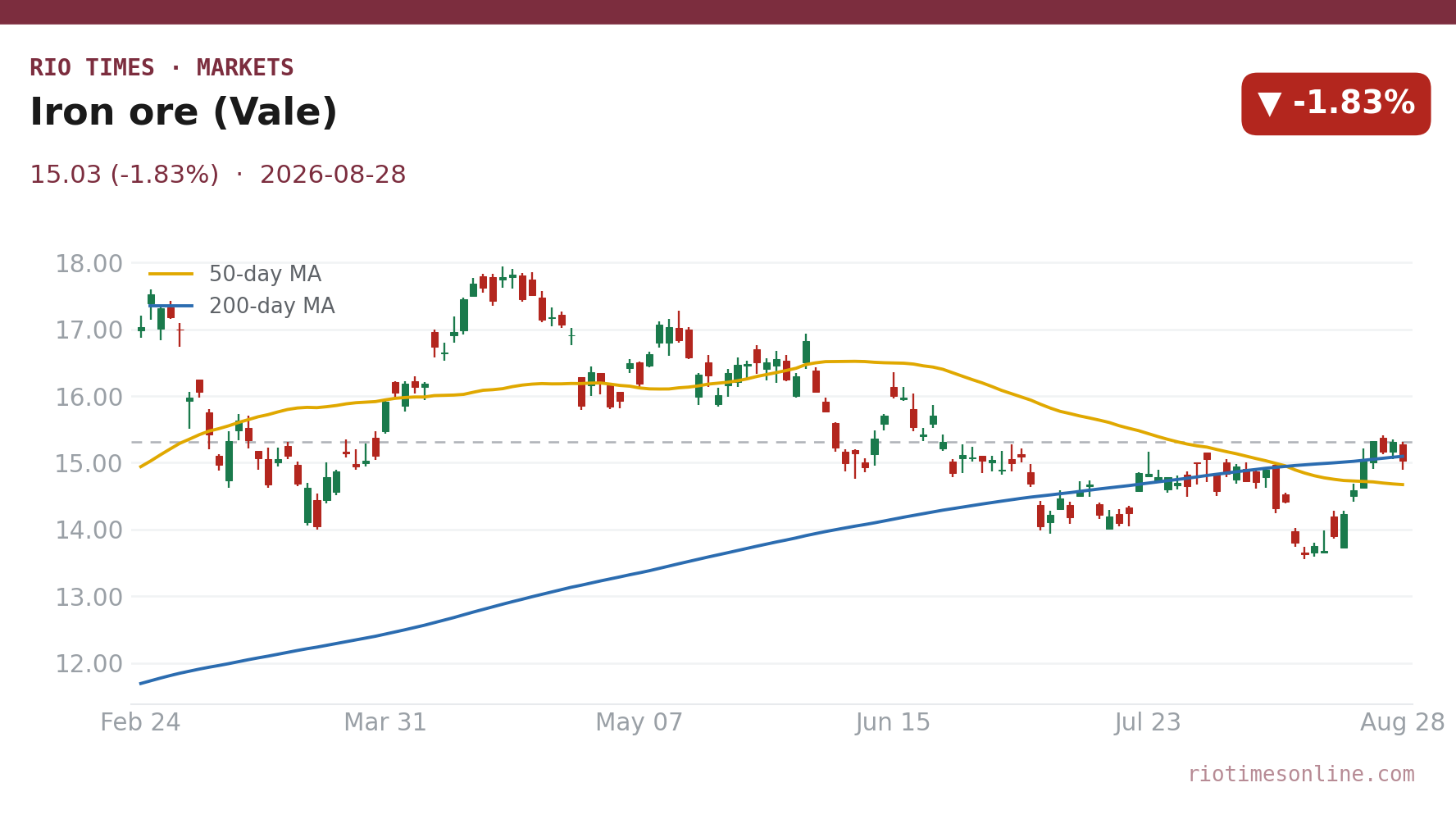
- Vale’s New York shares fell 1.83% to US$15.03 in Friday’s session, diverging from a steady benchmark price.
- Benchmark 62% iron ore futures settled at US$95.84 per tonne on Friday, up 0.17% on the day.
- CSN Mineração slipped 0.17% to R$6 in São Paulo, a far milder move than its larger peer.
- Rio Tinto dropped 1.41% to US$103.30 in US trading, matching the cautious tone among global miners.
- China imported about 736.84 million tonnes of iron ore in the first seven months of 2026, up roughly 6% year-on-year.
- Manufacturing steel demand in China is forecast at about 344 million tonnes for 2026, up around 3.3% from 2025.
Today’s Focus
Iron ore stocks pulled back on Friday, August 28, 2026, even as the underlying commodity held steady near the middle of its two-month trading band.
Vale’s New York-listed shares fell 1.83% to US$15.03, while Rio Tinto declined 1.41% to US$103.30 and Brazil’s CSN Mineração eased 0.17% to R$6.
Benchmark 62% iron ore futures for delivery into China settled at US$95.84 per tonne, up 0.17% on the day and still inside the US$93 to US$100 range held since June 2026.
The divergence reflects investor caution about Chinese steel margins, even as robust import volumes and slow new supply keep the raw material from sliding.
What matters today. China’s construction slowdown is squeezing steel margins, but record imports and delayed new supply are keeping iron ore prices unusually calm.

01 The session in one read
Iron ore stocks traded lower on Friday, August 28, 2026, while the commodity itself barely moved. Vale’s US-listed shares led the decline, falling 1.83% to US$15.03.
That drop came despite benchmark futures settling at US$95.84 per tonne, up 0.17% on the day. The split between steady commodity prices and falling miner shares signals investor unease about Chinese steel demand rather than any collapse in iron ore itself.
Assessment — Benchmark steady, miners cautious HIGH
The slide in Vale and Rio Tinto shares looks like a positioning move rather than a verdict on the iron ore price itself, which nudged higher on Friday. With Chinese imports up about 6% year-on-year through July and Simandou still ramping slowly, downside for the commodity appears limited in the near term. The variable to watch is whether Chinese rebar prices keep falling into September, which would tighten steel mill margins and test the patience of iron ore bulls.
02 The board
Vale’s New York shares closed at US$15.03, down 1.83% in a session that saw global mining stocks under pressure. Rio Tinto fell 1.41% to US$103.30, tracking the same cautious tone.
In São Paulo, CSN Mineração slipped just 0.17% to R$6, a more muted move that suggests domestic Brazilian investors were less rattled than their US counterparts. The benchmark 62% iron ore futures contract held at US$95.84 per tonne, up 0.17% for the day.
| Iron ore (Vale) | US$15.03 | -1.83% |
| CSN Mineração | R$6 | -0.17% |
| Rio Tinto | US$103.30 | -1.41% |
Source: RT close, 2026-08-28. Where a commodity has no spot feed, an exchange-traded tracker or leading producer is shown as a labelled proxy.
Live Market IntelligenceThe live market boardInside: market breadth, the sector heatmap, currencies & rates, the Latin America scoreboard and the full instrument board.Rio Times · Live Market Intelligence
Latin America — Cross-Market Board
Regional
Aug 31, 2026 · 05:28
Ibovespa · benchmark
175,664.62 +0.30%
L 167,142day rangeH 168,310
+21.85% over 12 months
Market breadth · 5 names
0% advancing
0 ▲ advancing5 declining ▼
Currencies, rates & key inputs
Latin America scoreboard
IndexLastTodayStrength
IbovespaBrazil 175,664.62 +0.30%
S&P/BMV IPCMexico 65,484.32 -0.53%
S&P IPSAChile 11,445.90 -0.22%
S&P MERVALArgentina 2,979,472 -0.72%
MSCI COLCAPColombia 2,457.87 -1.28%
BVL S&P PerúPeru 60,779.49 -1.40%
Full instrument board
| IBOV | 175,664.62 | +0.30% | +21.85% | 175,135.41 | 168,310 | 167,142 | — |
| IPSA | 11,445.90 | -0.22% | — | 11,470.79 | 11,210 | 10,984 | 1,513,213,483 |
| IPC MEX | 65,484.32 | -0.53% | +12.17% | 65,829.98 | 66,121 | 65,405 | 108,886,187 |
| MERVAL | 2,979,472 | -0.72% | +30.51% | 3,022,485 | 3,042,365 | 2,991,150 | — |
| COLCAP | 2,457.87 | -1.28% | — | 9.04 | 9.05 | 9.02 | 4,133 |
| BVL PERÚ | 60,779.49 | -1.40% | — | — | — | — | — |
| USD/BRL | 5.16 | +0.01% | -5.13% | 5.16 | 5.18 | 5.14 | — |
| EUR/BRL | 5.95 | +1.01% | -5.83% | 5.89 | 5.98 | 5.94 | — |
| USD/MXN | 17.06 | -0.24% | -8.58% | 17.10 | 17.08 | 17.01 | — |
| USD/CLP | 913.98 | +0.04% | -5.67% | 913.65 | 915.11 | 906.68 | — |
| USD/COP | 3,140 | +0.03% | -22.04% | 3,139 | 3,141 | 3,105 | — |
| USD/PEN | 3.36 | -0.66% | -4.82% | 3.38 | 3.38 | 3.35 | — |
| USD/ARS | 1,493 | +0.10% | +12.96% | 1,491 | 1,494 | 1,480 | — |
| USD/UYU | 40.27 | +1.24% | +1.80% | 39.77 | 40.27 | 40.23 | — |
| USD/PYG | 5,939 | +1.68% | -19.54% | 5,841 | 5,939 | 5,925 | — |
| USD/BOB | 11.64 | -0.76% | +72.04% | 11.73 | 11.72 | 11.64 | — |
| USD/DOP | 58.34 | +1.25% | -3.44% | 57.62 | 58.34 | 58.04 | — |
| USD/CRC | 445.92 | +0.89% | -9.71% | 441.97 | 448.50 | 445.92 | — |
Largest moves today
USD/PYG 5,939 +1.68%
BVL PERÚ 60,779.49 -1.40%
COLCAP 2,457.87 -1.28%
USD/DOP 58.34 +1.25%
USD/UYU 40.27 +1.24%
EUR/BRL 5.95 +1.01%
USD/CRC 445.92 +0.89%
USD/BOB 11.64 -0.76%
The session read
The Ibovespa rose 0.30%, with breadth negative — 0 of 5 names higher. IPSA led, while BVL PERÚ lagged.
V
◆ Live Company Intelligence
Vale
NYSE: VALEVALE3Basic MaterialsOther Industrial Metals & Mining65,805 employees
$63.96B
Market cap
Analyst target $16.74
Wall Street view
3.9Moderate Buy/ 5
14 Buy12 Hold0 Sell
Avg. price target $16.74 · +11% vs 200-day
Valuation & profitability
Market cap$63.96B
Revenue (TTM)$218.07B
P / E ratio30.1
Profit margin4.8%
Return on equity4.1%
Price & risk
52-wk low
$9.3052-wk high
$17.44
Beta (volatility)0.75
200-day average$15.10
Revenue trend · 6y
20202025
Latest $38.23B
Ownership
Institutions20.8%
Shares outstanding4.26B
Top holderCapital World Investors
Institutional holders5+ funds
Dividend
Yield35.8%
Payout ratio2.0%
Fwd. annual$1.20
What Vale does. Vale S.A., together with its subsidiaries, produces iron ore and nickel in Brazil, Asia, the Middle East, North Africa, Europe, the Americas, and Oceania. The company operates in two segments, Iron Ore Solutions and Vale Base Metals. It extracts, produces, and distributes iron ore, iron ore pellets, briquettes, nickel, copper, other ferrous…
03 What moved it
The pressure on iron ore stocks reflects a widening split inside China’s steel industry. Construction-related demand is weakening, with rebar prices in mid-August lower than at end-July and finished steel inventories at major mills rising compared with 2025.
Yet manufacturing-linked steel demand is forecast at about 344 million tonnes for 2026, up roughly 3.3% year-on-year. That shift toward less property-intensive sectors is keeping overall demand from falling too sharply.
China imported about 736.84 million tonnes of iron ore in the first seven months of 2026, up around 6% from 2025. That voracious appetite, equal to about 75% of global seaborne demand, has cushioned the market from a steeper correction.
04 The Latin American read
For Brazil, Vale remains the crucial bridge between global iron ore markets and Latin American capital. Its New York shares are the most liquid proxy for the commodity, and Friday’s 1.83% drop shows foreign investors are wary of Chinese steel margins.
Vale’s latest quarterly results reinforced that caution: earnings per share missed analyst estimates even as revenue slightly exceeded expectations. The company also raised its cost guidance for iron ore, a signal that Brazilian operations are facing higher input and logistics expenses.
Vale’s strategic focus on the Carajás region and improved water-use efficiency at its processing plants underscores its long-term supply reliability. That matters because Brazil is the world’s second-largest iron ore exporter, and any supply hiccup from Vale ripples through China’s steel mills.
05 The names to watch
Vale is the headline name, with its US-listed shares acting as the cleanest equity read on iron ore. At US$15.03, the stock sits well below the levels implied by a US$99 average price forecast from analysts such as BMI, a Fitch Solutions company.
Rio Tinto’s US$103.30 close shows global miners are not immune to the same China demand worries. CSN Mineração at R$6 is the domestic Brazilian play, offering lower liquidity but closer ties to local steel demand.
Guinea’s Simandou project remains the wild card on the supply side. Its slow ramp-up is one reason analysts expect the US$93 to US$100 range to hold, as new tonnes have not yet flooded the seaborne market.
06 The outlook
The iron ore price appears stuck in a comfortable range, but miner shares are pricing in a more pessimistic scenario. If Chinese rebar prices keep sliding into September, steel mill margins will tighten further and could eventually force output cuts.
The bullish case rests on Chinese import volumes, which remain historically strong, and the delayed arrival of Simandou supply. The bearish case points to falling construction demand and rising steel inventories at major Chinese mills.
For Vale and its peers, the next test is whether benchmark futures can hold above US$93 per tonne if Chinese steel data continues to disappoint.
07 What to watch
- Chinese rebar prices: A further decline would tighten steel mill margins and pressure iron ore prices below the current range.
- Simandou ramp-up: Any acceleration in Guinea’s new supply could break the US$93 to US$100 trading band.
- Vale cost guidance: Higher iron ore costs could squeeze Vale’s margins even if prices stay flat.
- China import volumes: Sustained imports near 6% growth year-on-year are the main prop under seaborne iron ore.
Frequently Asked Questions
Why did Vale fall if iron ore prices rose?
Vale’s shares track investor expectations about future Chinese steel demand, which is weakening in construction even as the spot iron ore price holds steady.
What is the benchmark iron ore price?
Benchmark 62% iron ore futures settled at US$95.84 per tonne on Friday, August 28, 2026, up 0.17% on the day.
How much iron ore does China buy?
China imported about 736.84 million tonnes in the first seven months of 2026, roughly 75% of global seaborne demand.
Is Simandou a threat to Vale?
Simandou’s slow ramp-up is limiting new supply for now, but any acceleration could pressure seaborne prices and Vale’s market share.
Market data: RT
This article was produced by The Rio Times’ automated newsroom system. How we use AI · Report an error
LatAm Markets: Live Signals → — real-time movers, turnover leaders and FX across Latin America.
The Rio Times · Power Map
See who really holds power in Latin America
Click to open the Power Map →



















 English (US) ·
  French (CA) ·
  French (FR) ·