

 1 month ago
46
1 month ago
46
PROTECT YOURSELF with Orgo-Life® QUANTUM TECHNOLOGY
Orgo-Life the new way to the future Advertising by AdpathwayGUATEMALA · UNITED STATES
Key Facts
—ICE visit: Senior officials of US Immigration and Customs Enforcement held talks in Guatemala this week on regional security and repatriation processes, the US Embassy confirmed on 31 August.
—Washington’s praise: The embassy called Guatemala a “strong ally” for its reception of returnees; no details were given on the delegation, its counterparts or any agreements reached.
—Deportation scale: Guatemala received 49 deportation flights with 4,871 returnees in March 2026 alone; with Honduras it accounts for 41 percent of US expulsion flights this year.
—Trade anchor: The Reciprocal Tariff Agreement signed in Washington on 30 January keeps 70.4 percent of Guatemalan exports to the United States duty-free.
—Market weight: The US took 30.3 percent of Guatemala’s exports last year, worth US$4.3 billion (about Q32.8 billion); two-way trade neared US$18.7 billion (around Q142.5 billion) in 2024.
—Not covered: Some vegetables, non-traditional fruits, aquaculture and some manufactures keep a 10 percent tariff; steel and aluminum remain at 50 percent.
Guatemala US relations deepened on two tracks this week: senior ICE officials held security and repatriation talks in Guatemala City while the tariff deal signed in January keeps 70.4 percent of exports to the United States duty-free.
One-stop reference
Company Intelligence
Every listed company in Latin America — financials, ownership and structure for 1,450+ companies across 26 exchanges, in one place.
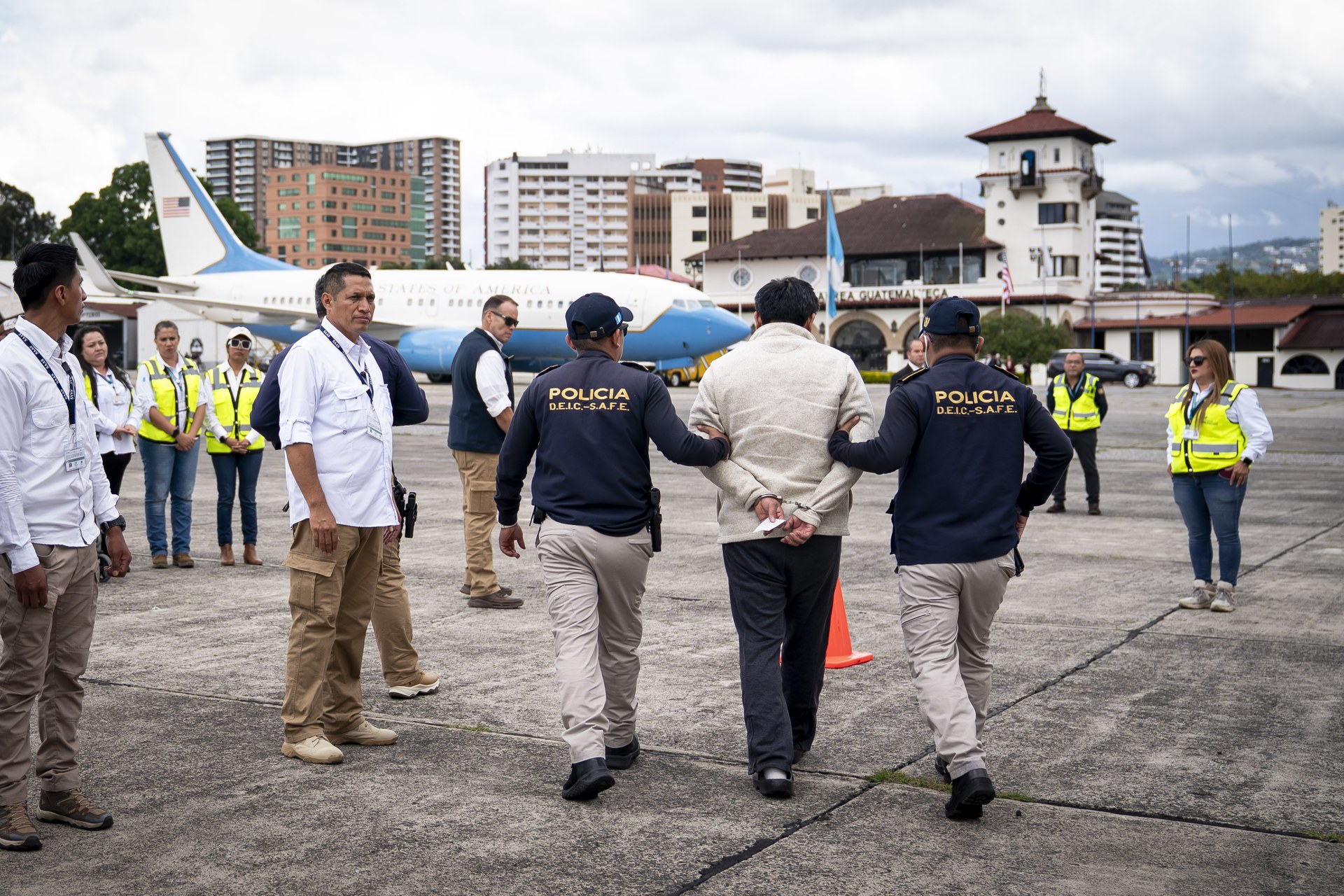
ICE Talks in Guatemala City
High-level personnel from US Immigration and Customs Enforcement visited Guatemala this week and held meetings on regional security and repatriation processes, Prensa Libre reported on 31 August.
The US Embassy said its chargé d’affaires, Jorgan Andrews, welcomed the delegation. In its statement, the embassy praised Guatemala as “a strong ally in the region with its reception of returnees, a leadership that reflects the shared commitment to regional security and reducing illegal migration.”
ICE added on its own channels that “strong partnerships remain essential to advancing shared security priorities.” Neither institution disclosed who joined the delegation, how long it stayed, which Guatemalan officials it met, or whether any agreements were reached.
The visit comes as Guatemala remains a corridor for thousands of Central American migrants who cross the country each year trying to reach Mexico and, from there, the United States.
The Deportation Numbers Behind the Visit
The talks land on top of an already intense repatriation flow. The United States ran 225 deportation flights in March 2026, up from 135 in the same month of 2025, according to the Ice Flight Monitor kept by Human Rights First.
Guatemala took 49 of those March flights, bringing home 4,871 citizens, an average of 99 per flight. The number of people returned to Guatemala has doubled compared with a year earlier.
Together, Guatemala and Honduras concentrate 41 percent of all US expulsion flights so far this year. That weight explains why Washington frames the relationship around Guatemala’s readiness to receive returnees.
The Other Track: The Tariff Deal
Guatemala US relations also run on a commercial track. On 30 January, the two countries signed the Reciprocal Tariff Agreement in Washington after negotiations that began in May 2025.
Under the deal, 70.4 percent of Guatemalan exports to the United States carry a zero tariff, President Bernardo Arévalo announced. Exports worth more than US$3.3 billion (about Q25.1 billion) recovered preferential access after the general 10 percent US tariff was rolled back for qualifying goods.
The agreement complements rather than replaces the DR-CAFTA free trade treaty. It also commits Guatemala to trade facilitation, simpler and digitalized procedures and stronger intellectual-property enforcement.
The quetzal traded at about Q7.62 per US dollar on 1 September 2026. The United States took 30.3 percent of Guatemala’s exports last year, worth US$4.3 billion (about Q32.8 billion), and two-way trade in goods and services reached almost US$18.7 billion (around Q142.5 billion) in 2024, with a US goods surplus of US$4.7 billion (about Q35.8 billion).
What the Deal Delivers — and What It Leaves Out
Duty-free status now covers flagship farm exports such as coffee, bananas, plantains, mango, papaya, ornamental plants, cut flowers and palm oil. Some 89 percent of textiles and apparel, Guatemala’s signature manufacturing line, also ship tariff-free under CAFTA origin rules.
Left outside are several vegetables and non-traditional fruits, aquaculture products and a range of manufactures, which still face 10 percent. Steel and aluminum remain under a separate 50 percent rate in force since June 2025.
We tracked the negotiation and its product-by-product fallout in our report on the US–Guatemala reciprocal trade deal and its tariff map.
The two tracks of Guatemala US relations — migration enforcement and trade — give the Arévalo government leverage abroad even as it faces pressure at home, from a stalled fuel-subsidy bill to this week’s transporter blockades that shut the Mexican border crossings.
Frequently Asked Questions
Why did ICE officials travel to Guatemala?
Senior ICE officials held meetings in Guatemala this week on regional security and repatriation processes, a core file in Guatemala US relations, according to the US Embassy. Neither the embassy nor ICE disclosed the agenda’s details or whether agreements were reached.
How many deportation flights does Guatemala receive?
Guatemala received 49 US deportation flights with 4,871 returnees in March 2026 alone, and the number of people returned has doubled in a year. Guatemala and Honduras together account for 41 percent of US expulsion flights in 2026.
What does the US–Guatemala tariff deal cover?
The Reciprocal Tariff Agreement, signed on 30 January 2026, keeps 70.4 percent of Guatemalan exports to the United States duty-free. It restored preferential access for more than US$3.3 billion (about Q25.1 billion) in exports and complements the DR-CAFTA treaty.
Which Guatemalan products still face US tariffs?
Some vegetables, non-traditional fruits, aquaculture products and certain manufactures still pay 10 percent. Steel and aluminum remain subject to a separate 50 percent tariff in force since June 2025.
This article was produced by The Rio Times’ automated newsroom system. How we use AI · Report an error
The Rio Times · Power Map
See who really holds power in Latin America
Click to open the Power Map →















 English (US) ·
  French (CA) ·
  French (FR) ·