

PROTECT YOURSELF with Orgo-Life® QUANTUM TECHNOLOGY
Orgo-Life the new way to the future Advertising by Adpathway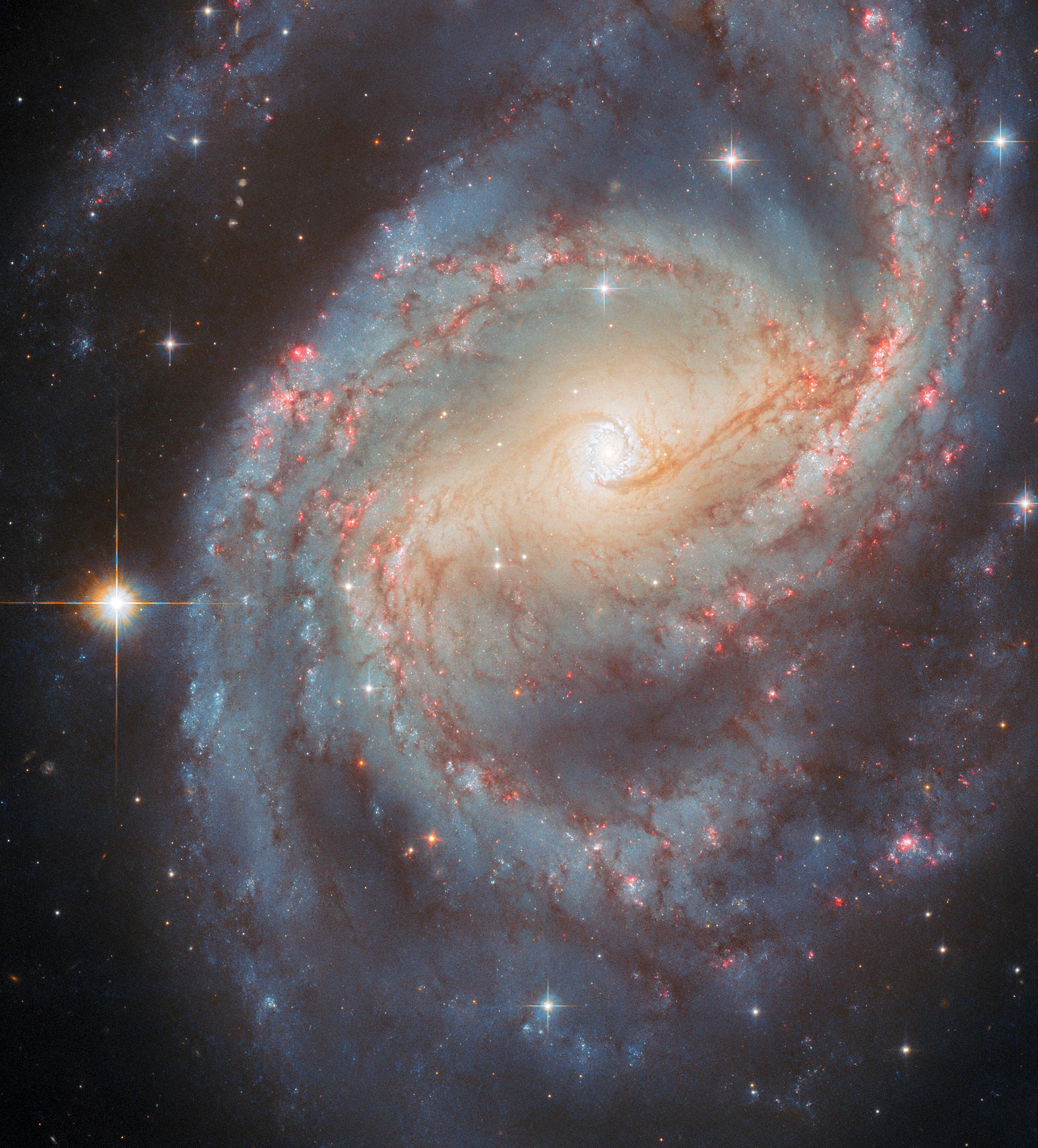 About 70 million light-years away, the stunning spiral galaxy NGC 6951 glows with swirling arms of stars and dust and a radiant golden center. At its heart lies a brilliant circumnuclear starburst ring, where gas funneled by a central bar fuels a frenzy of star birth. Credit: ESA/Hubble & NASA, L. C. Ho, G. Brammer, A. Filippenko, C. Kilpatrick
NGC 6951 shines 70 million light-years away, its spiral arms feeding a brilliant central starburst ring bursting with new stars. This cosmic powerhouse reveals how bars shape galaxies and sustain stellar creation across eons.
The brilliant galaxy featured in this Hubble Space Telescope Picture of the Week is NGC 6951, located roughly 70 million light-years from Earth in the constellation Cepheus.
This image reveals NGC 6951 as a striking spiral galaxy filled with intricate structures. Its most prominent features are the sweeping spiral arms, dotted with glowing red nebulae, luminous blue stars, and wisps of dark dust. These arms wrap gracefully around a radiant golden center, where older stars shine together in a warm glow. The central region also appears stretched and elongated, showing the presence of a slowly rotating bar made of stars.
The Mystery of the Starburst Ring
Astronomers believe this bar plays a key role in shaping one of NGC 6951’s most fascinating features: a pale, bluish-white ring that surrounds its bright core. Known as a circumnuclear starburst ring, it marks a region of intense star formation encircling the galaxy’s nucleus. The bar channels gas inward toward the center, where it gathers into a ring about 3,800 light-years wide. Two dark lanes of dust that run alongside the bar trace where this gas flows into the ring.
A Stellar Nursery in Full Bloom
This dense ring of gas provides the ideal conditions for creating vast numbers of new stars. Using Hubble observations, scientists have pinpointed more than 80 likely star clusters within NGC 6951’s ring. Many of these stars are relatively young, having formed less than 100 million years ago, while the ring itself may have persisted for an astonishing 1–1.5 billion years.
A Favorite Target for Astronomers
Hubble has returned to NGC 6951 many times for different studies, including research on the distribution of dust in nearby galaxies, investigations into the structure of galactic centers, and observations of recent supernovae (NGC 6951 has hosted five or six such stellar explosions).
Never miss a breakthrough: Join the SciTechDaily newsletter.
Follow us on Google, Discover, and News.






















 English (US) ·
  French (CA) ·
  French (FR) ·