

PROTECT YOURSELF with Orgo-Life® QUANTUM TECHNOLOGY
Orgo-Life the new way to the future Advertising by Adpathway New research points to a possible link between a cocoa-derived compound and markers of healthier biological aging. By examining molecular indicators in large population datasets, scientists observed patterns suggesting slower aging processes tied to this compound. Credit: Shutterstock
A naturally occurring dietary compound has been linked to biological signs of slower aging.
Higher levels of theobromine in the blood have been linked to signs of slower biological aging in humans. Theobromine is a naturally occurring compound found in cocoa, and the results suggest it may play a role in supporting healthier aging over time.
Biological aging is often studied through epigenetic changes, which reflect how gene activity shifts as the body ages. These changes are measured using blood-based markers such as DNA methylation patterns and telomere length. Together, these indicators provide a more informative picture of aging than chronological age alone.
This research was published in the journal Aging and was led by Ramy Saad from King’s College London and Great Ormond Street Hospital for Children NHS Foundation Trust, alongside Jordana T. Bell from King’s College London.
Validation Across Independent Cohorts
To strengthen their conclusions, the researchers examined data from two large population studies in Europe. Among 509 women in the TwinsUK cohort, higher concentrations of theobromine were linked to slower biological aging, particularly when assessed using GrimAge, an epigenetic clock designed to estimate the risk of age-related disease and premature death.
The same association was observed in a separate group of 1,160 men and women from the German KORA study, confirming the consistency of the findings across different populations.
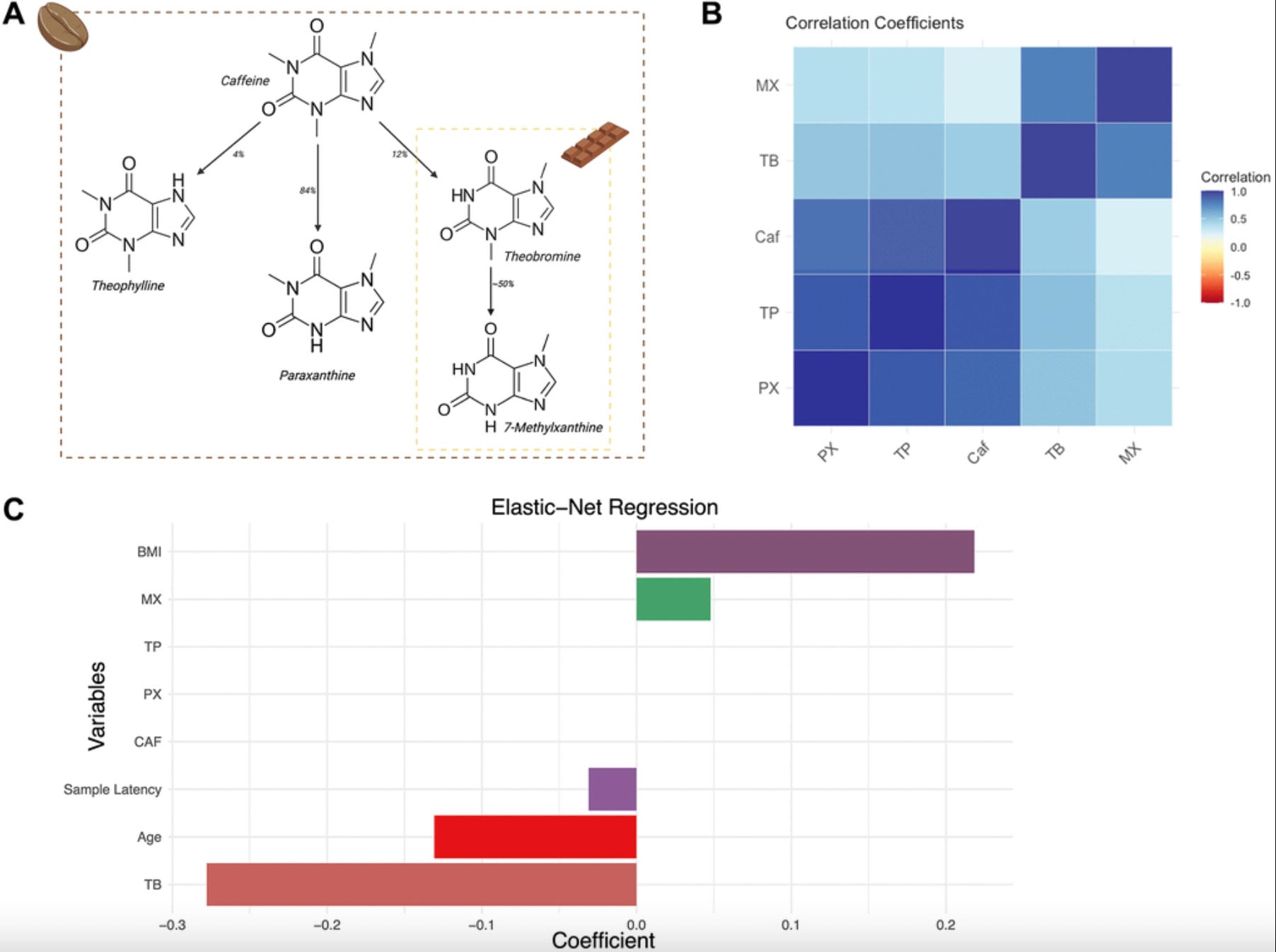 Major dietary sources of methylxanthines and their correlations in the TwinsUK sample. (A) Schematic presenting key methylxanthines, their respective dietary sources and their derivation as secondary metabolites. (B) Correlation heatmap of coffee-related metabolites in the TwinsUK sample. (C) Bar plot representation of the Elastic-net Regression coefficients with 10-fold cross-validation of variables against GrimAgeAccel in the TwinsUK sample. Credit: 2025 Saad et al. (CC BY 4.0)
According to the researchers, “We initially tested for the association between six metabolites found in coffee and cocoa, and epigenetic measures of aging in blood samples from 509 healthy females from the TwinsUK cohort (median age = 59.8, IQR = 12.81, BMI = 25.35).”
Importantly, theobromine’s effects were independent of related compounds such as caffeine. Even after adjusting for these other substances and different lifestyle factors, the association with slower aging remained strong. The study also associated higher theobromine levels with longer telomeres, another marker of healthy aging.
Implications and Future Directions
While theobromine is commonly found in cocoa and chocolate, the study does not suggest increasing chocolate intake. However, it highlights the potential of everyday dietary components such as theobromine to influence aging.
These findings support growing evidence that certain plant-based compounds may play a role in promoting long-term health. By identifying a connection between theobromine and slower biological aging, the study opens new directions for research into nutritional strategies for healthy aging.
Reference: “Theobromine is associated with slower epigenetic ageing” by Ramy Saad , Ricardo Costeira , Pamela R. Matías-García , Sergio Villicaña, Christian Gieger, Karsten Suhre, Annette Peters, Gabi Kastenmüller, Ana Rodriguez-Mateos, Cristina Dias, Cristina Menni, Melanie Waldenberger and Jordana T. Bell, 10 December 2025, Aging.
DOI: https://doi.org/10.18632/aging.206344
Never miss a breakthrough: Join the SciTechDaily newsletter.
Follow us on Google and Google News.

























 English (US) ·
  French (CA) ·
  French (FR) ·