

PROTECT YOURSELF with Orgo-Life® QUANTUM TECHNOLOGY
Orgo-Life the new way to the future Advertising by AdpathwayIn 1934, writing from his prison cell, Antonio Gramsci reflected on the sweeping transformations reshaping industrial production in the United States. The rise of the automobile and the wider Fordist factory, he argued, signaled a new economic and moral order, one that imposed discipline upon the worker, imbued the wage with ethical significance and blurred the line between production and private life. Of the industrial innovations underpinning this order, the assembly line and vertical integration were most significant.
Article continues after advertisement
Ford had introduced the moving assembly line in 1913, subjecting workers to repeating the same easily learned task again and again—boosting productivity and disciplining laborers. Simultaneously, the direct management of inputs and distribution—from rubber plantations to railway tracks—permitted lower production costs, translating not only to lower prices but also to higher-than-average wages. After the invention of the internal combustion engine in 1885, the auto industry had comprised skilled laborers producing a few bespoke vehicles—affordable only to an upper stratum of society. Fordist industrial methods, however, made cars increasingly available and began to organize the “whole life of the nation” around production.
If “the history of industrialism has always been a continuing struggle against the element of ‘animality’ in man,” as Gramsci posed, it is telling that Ford found his inspiration for worker discipline in industrial abattoirs. Visiting slaughterhouses in Chicago and Cincinnati, he saw animal carcasses moving between butchers on overhead conveyor belts. Translating this logic to cars, Ford devised an assembly line where parts moved between stationary laborers, “taking the work to the men rather than the men to the work.” This echoed Frederick Winslow Taylor’s idea of scientific management, which sought efficiency through control and standardization of the labor process. Also intent on taming animal spirits, Taylor aimed to eliminate the “human content” from work, leaving in its place what he infamously described as a “trained gorilla.” With labor rendered interchangeable, it was not uncommon for fifty different languages to be spoken on Detroit’s shop floors. Migrants to the auto plants came mostly from the American south and European countries, with many also coming from the Middle East to Ford’s Dearborn factories.
The formulation “industry of industries” thus draws attention to the raw materials the car is made from and the myriad economic practices it enables.
Fordism was never confined to the factory. The vertically integrated, rationalized production process was complemented by, in Gramsci’s words, “extremely subtle ideological and political propaganda” in which workers were not only compensated for their labor, but also their conduct: their temperance, thrift and domesticity. Ford and his inspectors in the company’s Sociological Department monitored his employees’ private lives—what they ate and drank and how they lived. Though eventually abandoned due to cost, this system of surveillance endeavored to equate producers with virtue. More than a disciplined laborer, Ford desired a moral industrial citizen—a “master in industrial method” who would volunteer “for the mines and the railroads” should “the fires of a hundred industries threaten to go out for lack of coal.” His ambition, then, was to “mould the political, social, industrial and moral mass into a sound and shapely whole.”
Such expectations were sustained by relatively high wages. Before the five-dollar day in 1914, the annual turnover of workers at Ford was so high the company had to recruit nearly a thousand employees to retain just a hundred. This new pay packet, judged a “family wage,” was the basis for the male-breadwinner model, or the “Fordist family,” accentuating the wage’s “moral dimension” while granting legitimacy and a certain degree of bourgeois respectability to sections of the working class. It also supported emergent norms of working-class consumption. “I’m not saying our workers will sing Caruso or govern the state. No, we can leave such ravings to the European socialists. But the workers will buy automobiles,” Ford announced. Separation from the means of production was redeemed through consumption; investing the working class more deeply in the relations of production.
While ensuring control of inputs and distribution served to lower production costs, there was also an ideological motive behind Ford’s pursuit of vertical integration: to limit his dependence on others. Ford owned and financed his projects internally, as he “loathed banks and outside investors and was determined to maintain total control of his company.” His disdain for finance capital was inseparable from his full-throated anti-Semitism. Openly espousing Jewish hatred, Ford was “a major organ of anti-Semitic conspiracy theories,” distributing The Protocols of the Elders of Zion and The International Jew, a serialized diatribe of conspiracies, through his newspaper, the Dearborn Independent. Throughout the 1920s and 1930s, the paper was circulated across the company’s dealership network, with many dealers putting a copy of the Independent in the glove box of every new car.
Ideologically, these practices and beliefs coalesced into what Stefan Link has called an “industrial moral economy,” wherein a community of producers struggled against financiers and idle profiteers. Ford praised the man who “earned his bread” and rebuked those “who gamble with the fruits of other men’s labors.” His rhetoric echoed late nineteenth-century Midwestern populism, wherein the producer contributes to the nation’s wealth while the rentier and financier siphon from it. “The negation of the industrial idea,” wrote Ford, “is the effort to make a profit out of speculation instead of out of work.” The logic underpinning this moral economy, then, aligns with the core tenets of “producerism”: an ideology distinguishing those who contribute to the prosperity of their community and those who live off the resources that they did not produce—the virtuous maker versus the parasitic taker.
The industrial moral economy of Fordism became especially attractive in Italy, Germany, Russia and Japan—all countries wishing to escape the grip of British and American financiers. Throughout the 1930s, specialists from this “transnational illiberal modernist network” visited Detroit, spending “weeks, months, even years at River Rouge to learn the American secret of mass production.” “Only a single great man,” to the chagrin of the Jews, “still maintains full independence,” Adolf Hitler wrote admiringly of Ford in Mein Kampf. He hung Ford’s portrait in his office, and in 1938 the Nazi regime awarded him an official honorific: the Grand Cross of the German Eagle. Another senior Nazi on trial in Nuremberg—Baldur von Schirach—credited a collected volume, The International Jew, as the source of his bigotry. The flowering of nationalist imaginations, it seems, often has cosmopolitan roots.
Both Hitler and Mussolini conceived grand projects for mass auto production with VW at Wolfsburg and Fiat at Mirafiori. For Hitler, cars were “mankind’s most marvelous means of transport”; his ambition was to build “a people’s car” that sold for under a thousand reichsmarks. Originally it was called the “Kraft durch Freude Wagen” (“strength-through-joy car”), later changed simply to “Volkswagen.” For Minister of Propaganda Joseph Goebbels, Germans would be “a happy people in a country full of blossoming beauty, traversed by the silver ribbons of wide roads, which are open to the modest car for the small man.” This vision of modernity, oriented towards the future, never materialized in the way its architects foresaw.
Limited by fuel and rubber shortages, and reliant on forced labor, not a single finished car reached a civilian as war consumed Europe and millions lost their savings in deposit schemes: the people ’s car was a “disastrous flop.” Yet some of the silver ribbons were built. Germany and Italy expanded motorway networks—the Autobahn and the autostrada—laying the foundations for the automobile’s privileged position in this modernity. When a delegation of British MPs inspected the newly minted Autobahnen before the war, the team were dazzled by the “sheer clean beauty” and “vigorous sweeping curves” of the road, which seemed to conform to the natural landscapes: a blueprint to follow.
On the eve of the Second World War, a transnational template for modernity had been set. According to Link, exchanges throughout the 1930s “laid the groundwork for the infrastructure of global Fordism.” Yet it was the shift to a war footing that accelerated its spread: the principles of mass production were embraced in the armaments factories of Nazi Germany and the Soviet Union alike, even though the latter never developed a substantial automobile industry. Volkswagen’s factory in Wolfsburg, built partially with confiscated trade union funds, shifted to military production, and was preserved by the Allies seeking to rebuild West Germany in the war’s aftermath. Meanwhile, in the United States, the coming of war and the promise of lucrative federal contracts dramatically reoriented the relationship between industrial capital and the New Deal state. Detroit, temporarily suspending its identity as Motor City, was rechristened the “Arsenal of Democracy” by Roosevelt. The carmakers now “built tanks, airplanes, radar units, field kitchens, amphibious vehicles, jeeps, bombsights, and bullets—billions and billions of bullets.”
*
In 1946, business analyst Peter Drucker identified auto manufacturing as the pinnacle of “modern industry.” It is “to the twentieth century what the Lancashire cotton mills were to the early nineteenth century: the industry of industries.” We can take from this a double meaning: the car industry was not only a prototype for the wider industrial economy, given that the production of this one commodity was emblematic of wider shifts in economic organisation. It was also its pacesetter, with the car dictating the tempo for associated industries. The formulation “industry of industries” thus draws attention to the raw materials the car is made from and the myriad economic practices it enables, situating the car as the coordinating node for expanding quantities of matter and energy, a lynchpin in wider productive interrelations.
This union of fossil energy and physical resources is consummated in those regions building infrastructure for private mobility, which rapidly escalated after the Second World War.
From this perspective, automobility can be seen as a central driver widening the “metabolic rift” a term used describe the rupture between humanity and its natural conditions. With humanity’s ecological interchange with nature subsumed and directed by capital’s endless circuits of accumulation, the exploitation of natural resources and the aggregation of waste ensues. Upstream, the automotive industry exists in productive symbiosis with steel, oil, glass, rubber, aggregates, concrete, electronics, engineering and construction, each transforming flows of matter first to value and then to waste.
Downstream, a radiating network of operations is set in motion after the car rolls off the assembly line—credit and insurance providers, marketing and sales showrooms, maintenance and repair workshops, petrol stations and car washes, distribution and logistics systems, the arterial networks of highways and roads, car-dependent retail parks and roadside restaurants—each with a distinct social and ecological metabolism. Capital accumulates through a spiraling network orbiting the car: activating numerous circuits, the system of automobility is an expression of self-expanding value in motion. Guided by the imperatives of capital accumulation, automobility deepens the metabolic rift on multiple fronts and prepares the ground for the “Great Acceleration” of ecological destruction. The car might well deserve the epithet of “the Anthropocene ’s battering ram.” No industry’s fortunes were more intimately tied to the car than oil.
At the beginning of the twentieth century, oil markets were threatened by the transition away from kerosene and gas lighting towards electric light. But primitive fossil capital was rescued by the automobile. Since their initial coming together, the oil and automotive industries have remained interlocked, the availability of oil influencing the character and direction of the car industry. When the east Texas oilfield was discovered in the interwar years, gasoline prices fell sharply, incentivizing bigger engines and vehicles, while encouraging longer journeys. With fewer domestic discoveries, high import tariffs and fragmented markets that curtailed economies of scale in production, such extravagances were unavailable to Europeans, who became accustomed to smaller, more efficient cars. Indeed, the “automobile revolution” was most advanced in the United States, which not only consumed more oil per vehicle, but also was home to the most vehicles in absolute terms, boasting four-fifths of the world’s car fleet on the brink of the Second World War.
At the same time, the booming car industry shaped the oil industry. Seemingly, the only thing that could slow down the automobile takeover was diminishing fuel supplies, fear of which had become a fixation of American oil companies and government officials after the Armistice. The First World War had been decisive: oil and autos became central commodities tied to national security and imperial ambitions. Inaugurating a new era of industrialized warfare, navies replaced coal with oil, cavalry was supplemented with tanks, and horse-drawn transport gave way to motorized vehicles. Not wishing to return to the wartime “gasolineless Sundays,” and with the US Geological Survey warning of an impending “gasoline famine” stemming from the automobile’s voracious demand, the head of that body, George Otis Smith, urged the US government to support domestic oil companies seeking overseas exploration. This was the dynamic that produced American oil’s pivot to the Middle East. Fittingly, a local agent of the Ford Motor Company intermediated the first negotiations in the early 1930s for Standard Oil of California’s rights to Saudi oil.
The forces of destruction accumulated through the Second World War. Soldiers were increasingly displaced by “extraordinarily powerful machines” requiring “growing quantities of raw materials and energy.” The United States, Drucker wrote, indulged in a “veritable orgy of natural-capital consumption,” leading to soil depletion and overconsumption of “irreplaceable fuels and ores.” As wars became more deeply integrated into the industrial system, the relationship between society and nature was further brutalised. Tanks, manufactured in Allied and non-Allied auto factories alike, were a “developmental model” for clear-cutters, harvesters, bulldozers and other “brute force technologies” later used to level forests, buildings and land. The demands of war vastly expanded productive infrastructure. The network of pipelines and refineries necessary for military airfields, for example, was foundational for the petrolization of societies. In short, military mobilization was industrial mobilization.
As automobility spread across society, writes Adam Hanieh, “it was no longer just industry and the military that demanded ever-increasing quantities of petroleum: oil consumption was now propelled forward by the daily needs of the individual and the house-hold.” Beyond powering vehicles, the wider machinic complex also depended on fossil fuels. The infrastructure required to get oil from basin to fuel tank involves refineries, pipelines, tankers, storage facilities and service stations—demanding tonnes of coke-produced steel. If coal and oil infuse the finished product, they also bind together the hardware they run on: asphalt and cement, the core components of roads, are generally both dependent on coal. This union of fossil energy and physical resources is consummated in those regions building infrastructure for private mobility, which rapidly escalated after the Second World War.
_______________________________
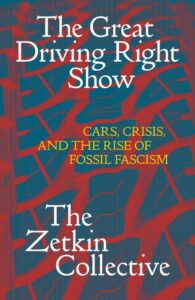
From The Great Driving Right Show: Cars, Crisis, and the Rise of Fossil Fascism by The Zetkin Collective. Copyright © 2026. Available from Verso Books.



















 English (US) ·
  French (CA) ·
  French (FR) ·