

 3 weeks ago
25
3 weeks ago
25
PROTECT YOURSELF with Orgo-Life® QUANTUM TECHNOLOGY
Orgo-Life the new way to the future Advertising by AdpathwayDiesel hits £2 a litre for first time
Newsflash: The average price of a litre of diesel in the UK has hit £2 for the first time.
New data from the RAC shows that diesel hit an average price of 200.01p a litre this morning.
That means diesel prices have surged by 40.5% since the start of the Iran war at the end of February, when diesel cost 142.38p a litre.
A 55-litre tank of diesel now costs £110.01 – £31.70 more than 28 February, the RAC says.
RAC head of policy Simon Williams says:
“This is a pump price threshold that no-one wanted to cross – the average price of a litre of diesel has risen to a record 200.01p and is showing no signs of slowing, heaping more misery onto motorists. The cost of filling up an average family car is now £110, almost £32 more than it was at the start of the US/Iran war.
This will be very challenging for households and companies that drive a lot of miles, from commuters, haulage and delivery firms, businesses with large fleets all the way through to sole traders. In a cruel twist, it’s diesel vehicles, which were once considered the most cost-effective option for lengthy journeys, that are now burning a hole in people’s pockets.
“For an average 45mpg diesel car, the cost works out at an extraordinary 20p per mile, so a driver covering 10,000 miles a year is now spending £2,020 on fuel a year. Households will be tightening the purse strings, while businesses may have no option but to pass these additional costs onto customers.
The previous highest price of 199.09p seen in June 2022 is already becoming a distant memory as the conflict in the Middle East continues with no sign of a deal to reopen the critical oil and gas shipping route through the Strait of Hormuz. Additionally, US threats of a diesel export ban could cause prices to rise even further. Once again, it’s ordinary people who are left footing the bill for events far away, as the UK remains heavily reliant on fossil fuels and imported diesel.
Key events
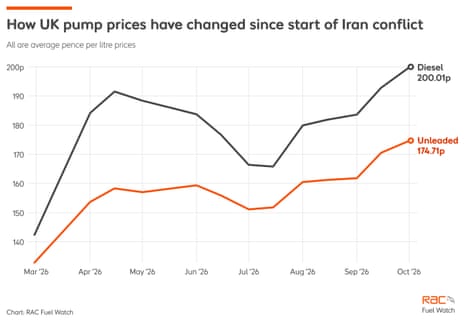
Petrol prices have risen again too.
The average price of a litre of unleaded has risen to 174.71p a litre, which is around 42p more than at the start of the Iran war.
Diesel hits £2 a litre for first time
Newsflash: The average price of a litre of diesel in the UK has hit £2 for the first time.
New data from the RAC shows that diesel hit an average price of 200.01p a litre this morning.
That means diesel prices have surged by 40.5% since the start of the Iran war at the end of February, when diesel cost 142.38p a litre.
A 55-litre tank of diesel now costs £110.01 – £31.70 more than 28 February, the RAC says.
RAC head of policy Simon Williams says:
“This is a pump price threshold that no-one wanted to cross – the average price of a litre of diesel has risen to a record 200.01p and is showing no signs of slowing, heaping more misery onto motorists. The cost of filling up an average family car is now £110, almost £32 more than it was at the start of the US/Iran war.
This will be very challenging for households and companies that drive a lot of miles, from commuters, haulage and delivery firms, businesses with large fleets all the way through to sole traders. In a cruel twist, it’s diesel vehicles, which were once considered the most cost-effective option for lengthy journeys, that are now burning a hole in people’s pockets.
“For an average 45mpg diesel car, the cost works out at an extraordinary 20p per mile, so a driver covering 10,000 miles a year is now spending £2,020 on fuel a year. Households will be tightening the purse strings, while businesses may have no option but to pass these additional costs onto customers.
The previous highest price of 199.09p seen in June 2022 is already becoming a distant memory as the conflict in the Middle East continues with no sign of a deal to reopen the critical oil and gas shipping route through the Strait of Hormuz. Additionally, US threats of a diesel export ban could cause prices to rise even further. Once again, it’s ordinary people who are left footing the bill for events far away, as the UK remains heavily reliant on fossil fuels and imported diesel.
Oil is continuing to drop, which would help to ease inflation pressures if this trend continues.
Crude is weakening following reports that exports of crude from the strait of Hormuz have largely returned to levels seen before the outbreak of the Iran war.
Brent crude is now down 2.7% to $99.54 a barrel.
Today’s jump in eurozone inflation from 3.2% to 3.8% marks the fastest jump since March, the first month of the Middle East war, reports ING economist Bert Colijn.
Colijn told clients:
Ouch. Eurozone inflation blew past expectations in September, soaring to its highest level since 2023. Energy inflation remained the main driver of the higher rate.
Despite oil prices remaining somewhat below peaks seen in 2022 and this spring, Euro 95 petrol prices have now reached an all-time high. This is weighing significantly on the inflation basket for the moment.
Eurozone inflation is three-year high
At 3.8%, eurozone inflation is the highest since September 2023.
Lale Akoner, global market strategist at investment platform eToro, argues that the European Central Bank doesn’t need to react immediately to this morning’s jump in inflation:
“Euro-area inflation at 3.8% makes ECB tightening more likely, but the composition of the increase matters. Much of the acceleration is being driven by energy, while core inflation matched expectations at 2.5%. That gives the ECB some room to wait rather than react immediately, particularly as higher bond yields are already tightening financial conditions and weakening demand.
The key risk is that the energy shock spreads into wages, services prices and corporate pricing. Services inflation rising to 3.2%, alongside higher consumer inflation expectations, means policymakers cannot assume the shock will fade. The ECB is therefore likely to retain a hawkish bias, even if an October hike remains uncertain.
For markets, this is an uncomfortable mix: higher inflation, weaker growth and less scope for rate cuts. It supports the euro, keeps pressure on government bonds and favours companies with pricing power and resilient balance sheets over rate-sensitive sectors and weaker consumers.”
Core inflation in the eurozone also inched up last month.
Inflation, excluding energy, food, alcohol & tobacco, rose to 2.5% in September up from 2.4% in August.
Eurozone inflation surges to 3.8%
Newsflash: Inflation across the eurozone has surged to almost double the European Central Bank’s 2% target.
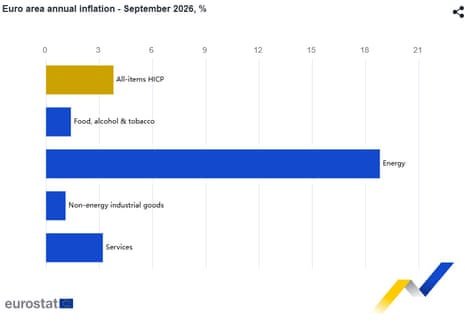
The euro area inflation rate is expected to be 3.8% in September, statistics body Eurostat has reported, up from 3.2% in August 2026.
Energy prices were the biggest driver of inflation across the eurozone – prices were 18.8% higher than in September 2025. That’s an acceleration on August, when energy prices were 14.3% higher year-on-year.
Services inflation rose to 3.2%, up from 3.0% in August.
Food, alcohol & tobacco inflation inceased to 1.4%, up from 1.1%.
But industrial goods inflation slipped to 1.1%, down from 1.2% in August).
This jump in inflation could put more pressure on the European Central Bank to raise interest rates (even though that wouldn’t fix the causes of the energy prices shock), to prevent ‘second round effects’, where prices push up wages.
World food prices near four-year high in September
Newsflash: World food prices rose in September to their highest in nearly four years as farmers were hit by hot weather and logistics disruptions.
The United Nations’ Food and Agriculture Organization’s Food Price Index, which tracks a basket of food commodities, has jumped to its highest level since November 2022.
The index rose to averaged 136.0 points this month, up from 134.0 for August, with the prices of sugar, meat, oil, dairy and cereals all rising during the month.
The report, which gives a great insight into the global food market, reports:
The Sugar Price Index surged by 11.9% in August, to its highest level since June 2025.
This was riven by fears of weak global sugar supply outlook in the 2026/27 season, partly due to El Niño fears.
The FAO says:
Persistent hot and dry weather led to a downward revision of sugarbeet yield forecasts in the European Union, where planted area was already anticipated to decline from the previous season, while El Niño-related weather conditions continued to affect production prospects in key producing countries in Asia.
Lower sugar production in Brazil’s key Center-South growing region also contributed to the tighter supply outlook. Additionally, India’s announcement of duty-free raw sugar imports further contributed to the increase in international sugar prices.
The Cereal Price Index rose by 2.2% in August, to its highest level since May 2024 due to “robust demand, weather-related concerns over crop prospects in key producing regions, and continued uncertainty surrounding Black Sea export flows.”
Wheat prices were pushed up by persistent disruptions to Black Sea export logistics, and lower production prospects in parts of Europe following hot and dry weather.
[Reminder, the UK is thought to have suffered its worst harvest since detailed records began in 1984].
The Vegetable Oil Price Index rose by 0.6%, its third consecutive monthly increase, to the highest level since June 2022.
Higher world palm and soy oil prices, more than offset lower quotations for sunflower and rapeseed oils, with palm oil prices pushed up, in part, by concerns over the potential impact of El Niño-related weather conditions.
The Meat Price Index rose 1% in August, due to higher poultry, pig and ovine meat prices.
The FAO says:
International poultry meat prices rose, reflecting a rebound in Brazilian export prices amid strong global import demand. Pig meat quotations also surged, principally driven by higher prices in the European Union, where high temperatures continued to slow animal growth, limiting the availability of slaughter-ready pigs.
And….The Dairy Price Index jumped by 2.3% in August, driven by higher milk powder and cheese prices.
French 10-year bond yields are very slightly lower this morning, at 4.925%.
Yesterday they rose as high as 4.96%, the highest level since July 2002.
Global bond market steadying
The global bond market appears to be steadying this morning.
UK government bond prices are recovering some of their recent losses, which is pulling down borrowing costs (yields).
The yield on two-year UK bonds has dropped by over six basis points (0.06 of a percentage point) to 4.767% – that could help ease the pressure on mortgage rates.
Benchmark 10-year UK bond yields are down 5.5bps to 5.369%, away from the 19-year highs set earlier this week.
30-year bond yields, which hit their highest level since 1998 yesterday, are down too – dropping by 5bps to 5.92%.
Bond yields are dropping in sync with the Brent crude oil price, which is down 1% today to $101.19 a barrel.
Fears that sharply high oil prices will keep pushing up inflation, forcing central banks to raise interest rates, have been a prime factor behind the bond sell-off.
Mark Haefele, chief investment officer at UBS Global Wealth Management, argues that the bond market sell-off presents good opportunities for investors, including in France:
“We remain Attractive on fixed income and see the rise in European yields as creating selective opportunities in high-quality bonds. Our core preference remains for short- to medium-term maturities.
Within France, we see attractive risk-reward in select agency, covered, and corporate bonds. We also favor stronger investment grade issuers across medium maturities, while higher-risk credit should remain relatively short-dated.”
Lord O’Neill: letting UK fiscal buffer fall might be 'wisest thing to do'
The jump in UK borrowing costs in recent weeks to the highest level in many years has eaten into the ‘fiscal buffer’ which the government created to keep within its fiscal rules.
That buffer was £23.6bn back in March, but some economists estimate it could have halved – even before you account for new spending pledges.
This means John Healey could face a choice between reporting a smaller buffer (which increases the risk of breaking the fiscal rules), or lifting taxes to boost revenues.
Economist Lord O’Neill argues that Healey should accept the buffer will have to be smaller, pointing out that we are facing “remarkable circumstances”.
Jim O’Neill told Radio 4’s Today Programme that this might be the wisest thing to do, given the huge unpredictability surrounding Donald Trump and the Iran war.
The situation could be very different by the budget, or a few weeks later, and oil prices might have dropped, he argues.
As Lord O’Neill puts it:
Rather than risking some tax increases in the way previous governments have to just magically hit some number and keep the buffer bigger, in this instance I personally suspect it might be the wisest thing to do.
He also argues that the UK economic situation is somewhat better than some people realise, pointing out that the economy grew at an annual rate of 2% in the first half of this year.
Euro near 17-month low
The euro is trading close to the 17-month low hit yesterday, when the single currency fell by over 0.75% to as low as €1.1214.
Ipek Ozkardeskaya, senior analyst at Swissquote, says jitters about France are hurting the euro:
The sharp weakening of appetite for French debt is a big issue for the broader euro area and the euro itself. France is the euro area’s second-largest economy — we used to call it the ‘core’, along with Germany, back during the 2012 sovereign debt crisis!
So, if concerns spread, other heavily indebted members could also face higher borrowing costs, tightening financial conditions across the region. For the euro, that means weaker growth prospects and a growing risk premium. The EURUSD tanked to 1.1215 yesterday, as the market’s focus shifted from the central-bank convergence/divergence story towards the euro area sovereign debt story.
France’s budget 'offers no quick relief for bond markets'
France’s government did try to cool the situation yesterday, by proposing a budget for next year including €43bn in cuts and tax rises.
Under the proposed plan, the tax burden would rise while spending growth would be slowed through slashing state spending, and capping increases to pensions and civil servant salaries.
Finance minister Roland Lescure explained it was important to put France back on track for deficit reduction.
But even with this plan, the French budget deficit would only fall to 5% of GDP next year.
Analysts at ING warn that this deficit would be “far too high” to prevent France’s national debt (already 119% of GDP) from rising higher.
In a note titled France’s budget offers no quick relief for bond markets, ING say:
France’s fiscal package would prevent the deficit from reaching 6.5% of GDP next year, but it would not stabilise public debt. With a difficult political process ahead, French bonds are likely to remain under pressure, while the threshold for ECB intervention remains high
Introduction: French bond sell-off 'reminiscent of the euro crisis'
Good morning, and welcome to our rolling coverage of business, the financial markets and the world economy.
Turmoil in the government bond market is reviving memories of the eurozone debt crisis 15 years ago – but this time France is in the firing line.
Concerns over Paris’s fiscal position are pushing its borrowing costs up, amid a global sell-off of sovereign debt. This pushed the gap between France and Germany’s borrowing costs, a key measure of investor concern, to its widest level since 2012.
Yesterday, the yield on French 10-year government bonds (or OATs) yields jumped to their highest level since 2002, before dipping back as the bond rout eased.
Investors are reluctant to eat their OATs due to political uncertainty, with presidential elections scheduled for 2027, and concerns over France’s public debt which has climbed to a record high.
Jim Reid, Deutsche Bank strategist, points out that yesterday the Franco-German 10 year spread (+13.9bps) saw its biggest daily jump since March 2020 at the height of the Covid turmoil.
Reid told clients this morning:
Markets stumbled yesterday as we began Q4, with mounting signs of financial stress focused on Europe. In fact, the daily moves were reminiscent of the Euro crisis in many respects, with sovereign contagion a big talking point.
Inflation fears are also pushing up bond yields – and at 10am we get the first reading on how fast prices rose across the eurozone in September.
If that doesn’t rock the market, then the latest US jobs report might, as pressure mounts on the US Federal Reserve to consider raising interest rates.
The agenda
-
9am BST: UN’s FAO Food Price Index
-
10am BST: Eurozone flash inflation reading for September
-
1.30pm BST: US non-farm payrolls employment report
-
3pm BST: US factory orders report for August
























 English (US) ·
  French (CA) ·
  French (FR) ·