

PROTECT YOURSELF with Orgo-Life® QUANTUM TECHNOLOGY
Orgo-Life the new way to the future Advertising by AdpathwayBusinesses and bureaucrats got an early indicator this week of whether the World Cup was worth the cost for Los Angeles — beer sales.
Although there were some struggling sectors and important lessons to apply before the Olympics, the number of people pounding pints at pubs was unprecedented.
At Ye Olde King’s Head in Santa Monica, the line for England games formed four hours before the game began. Customers ordered full English breakfasts and Guinnesses and sang national anthems.
In an industry that hasn’t seen traffic come back since COVID-19 and was further pummeled by the Palisades fire last year, it was a welcome sight for Lisa Powers, the restaurant’s operations manager.
“The city felt alive again,” she said.
The British pub had prepared for months, buying televisions, modifying seating, hiring staff and creating a World Cup cocktail menu. Employees were still surprised by the turnout.
“A lot of businesses have closed down around us, and we’ve had some scary times,” she said. “Hopefully people will return with their families and make it how it used to feel.“
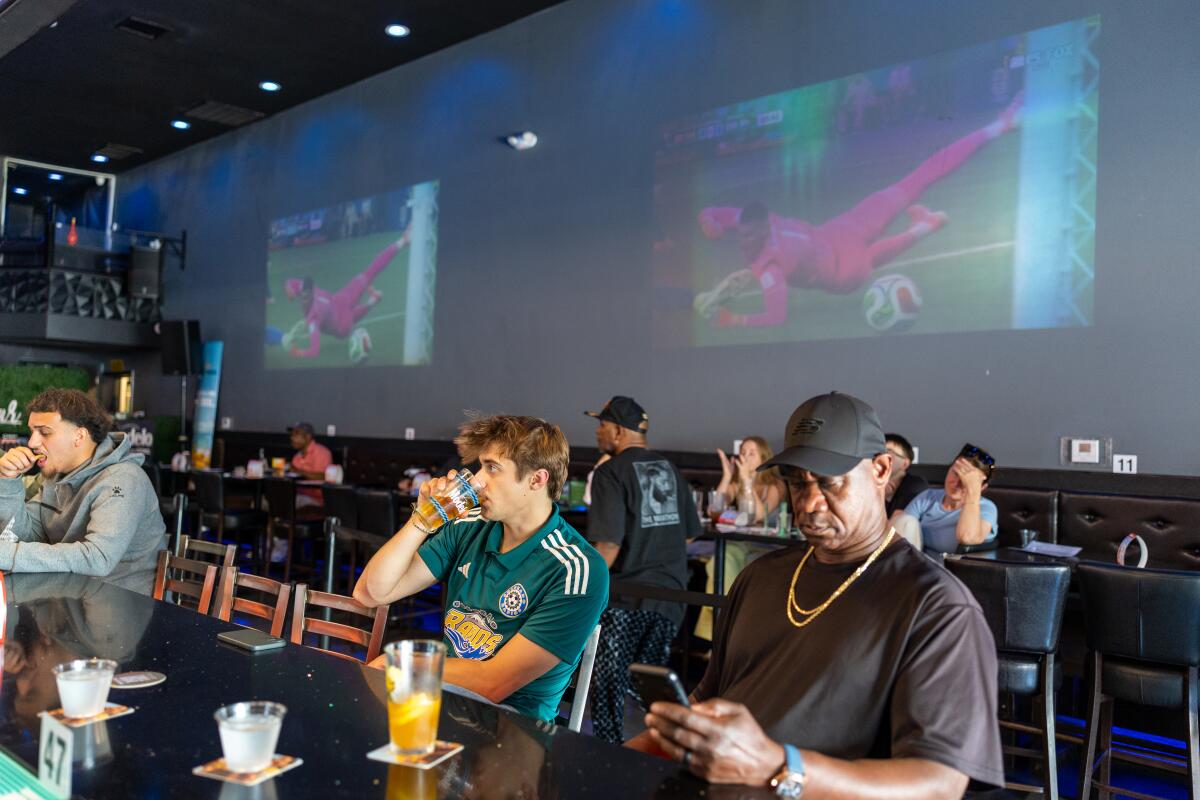
Tom Navratil, 22, center, of Thousand Oaks, watches Croatia play England at the Nile Restaurant and Bar.
(Allen J. Schaben / Los Angeles Times)
According to data from the Beer Institute, many bars and restaurants in the area felt the same effects. In California, the World Cup resulted in a 15% increase in beer sales in restaurants, bars and stadiums. That’s a much bigger bump than other host states saw and the equivalent of close to 5 million bottles of beer.
Other local businesses, including In-N-Out, Trader Joe’s and Erewhon, also saw a surge.
Los Angeles and other host cities needed soccer fans to spend money to make the event worth all the time, effort and money spent.
A rosy 2024 report projected the World Cup could bring hundreds of millions of dollars and thousands of jobs to the L.A. region as 180,000 people converge on the area to sleep, eat and spend.
There were early concerns people weren’t turning up for the event because of the high ticket prices and the difficulty of obtaining visas for citizens of some countries.
Stafford Nichols, a research manager at Beacon Economics, which helped with the financial analysis in L.A.’s 2028 Olympics bid, said that although people are excited about the boost the event did have, it wasn’t as much as expected.
The 2024 report predicting the economic impact of the World Cup in L.A. estimated a $160-million revenue increase for hotels. But according to Nichols, the number ended up closer to $100 million.
That was still a 10% increase compared with the year before, but Nichols said that from his analysis, that rise could be attributed more to hotels raising their rates than to an increase in occupants.
“The World Cup was good, it was helpful, but it wasn’t probably great,” he said. “And it seems like we charged a lot.”
Looking ahead to the Olympics, Nichols said he thinks policymakers should be wary of increasing taxes and pay attention to how international tourists will respond to price hikes.
“I just don’t want us to overplay our hand and kind of lose an atmosphere of goodwill and in the Olympics that could actually ultimately prove to be a longer-term economic benefit,” he said.
L.A. County is using lessons from the World Cup to prepare for 2028.
Stephen Cheung, the chief executive of the Los Angeles County Economic Development Corp., said the success of watch parties and other events at places all over the county were a sign of the potential.
“What needs to happen now is more education so that the businesses actually understand the scope,” he said.
The World Cup beer boom demonstrated the potential and the need to prepare.
In places within SoFi Stadium’s ZIP Code and surrounding neighborhoods, some bars sold two to three times the amount of beer they would usually sell over the same period.
That number may have been even higher at Joxer Daly’s, a sports bar in Culver City.
Restaurant manager Eugene Ganly was initially concerned that people wouldn’t come because there were so many watch parties happening all over the county; Ganly said he was quickly proved wrong.
He ended up hiring extra security during the World Cup because the bar was so overcrowded.
During a Mexico game, the bar ran out of beer and had to close down early and tell customers to leave.
“We couldn’t keep beer on the shelves,” he said. “They drank us dry. Mexico drank us dry.”
The crowds were a welcome boon for the bartenders, enlivening what is usually a lull at Joxer Daly’s, which is away from the beaches and beer gardens where customers gather in the summer.
“For a full six weeks it was just one big party,” Ganly said.













 English (US) ·
  French (CA) ·
  French (FR) ·