

 1 month ago
14
1 month ago
14
PROTECT YOURSELF with Orgo-Life® QUANTUM TECHNOLOGY
Orgo-Life the new way to the future Advertising by AdpathwayCOLOMBIA · ECONOMY
Key Facts
—The headline: Colombia created 578,000 jobs in twelve months, a solid recovery on paper.
—The exception: Agriculture lost 204,000 jobs over the same period — drought and low farm prices are biting.
—The quality problem: Seven of every ten jobs added in July were self-employment, not salaried work.
—The warning: The employers’ association says the earthquake’s economic fallout could push even more workers into informality.
Colombia jobs numbers look strong at first glance: 578,000 created in a year. Look closer and the picture splits — farming is shrinking, and most new work is self-employment without a safety net.
One-stop reference
Company Intelligence
Every listed company in Latin America — financials, ownership and structure for 1,450+ companies across 26 exchanges, in one place.
A recovery with a split personality
Colombia’s labour market added 578,000 jobs in the twelve months to July, according to the national statistics office DANE. The figure confirms a jobs recovery that has been building since the start of the year, driven by services, commerce and construction.
But the aggregate hides a divergence. The same data show agriculture shed 204,000 jobs over the year. The causes are stacking up: the El Niño drought that is also behind Medellín’s new water rationing has cut planting and harvest work, while low prices for several key crops have pushed small farms to reduce hired labour.
The countryside was once the shock absorber of the Colombia jobs market: when cities slowed, workers returned to family plots. With farm employment itself shrinking, that buffer is thinner than it used to be.
Where are the gains coming from? DANE’s breakdown points to commerce, restaurants and hotels — sectors still normalising after years of disruption — plus construction, lifted by public works and housing starts. Manufacturing, the traditional source of stable factory jobs, has contributed far less, reflecting weak export demand and competition from imports.
Seven of ten new jobs are self-employment
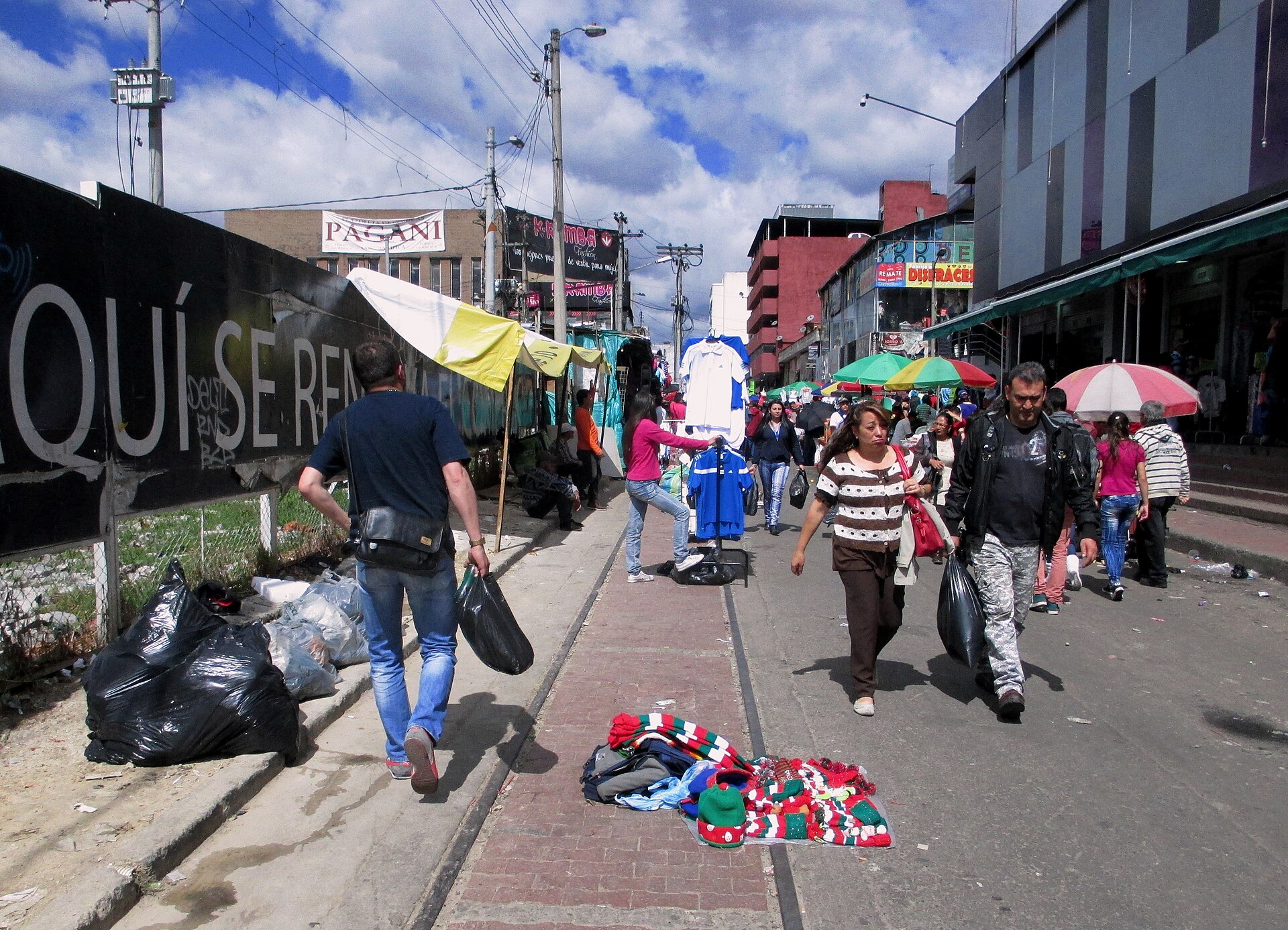
The deeper concern is what kind of jobs are being created. In July, seven of every ten new positions were self-employment — street vendors, delivery riders, freelancers and family workers — rather than salaried posts with contracts, pension contributions and health coverage.
Economists call this the informality trap. Self-employment keeps the unemployment rate low, which flatters the headline numbers. But it pays less, offers no protection against illness or dismissal, and swells the share of Colombians who work without a safety net — already close to half the workforce, as our earlier analysis of Colombia’s shadow labour market detailed.
The fiscal angle matters too. Informal workers do not pay income tax or full social-security contributions, so a labour market that grows through self-employment barely helps the public finances — an awkward detail for a government whose 2027 budget needs every peso of revenue it can find.
The unemployment rate itself has barely moved, which is precisely the point. In Colombia’s statistics, a person selling sweets at a traffic light counts as employed just as fully as an engineer on a payroll. The headline rate can look calm while the structure underneath deteriorates.
For foreign readers: in Colombian statistics, “self-employed” (cuenta propia) covers everything from a shop owner to someone selling coffee at a bus stop. When that category drives job creation, it usually means formal companies are not hiring — and that workers are creating their own subsistence instead.
The earthquake shadow
Into this fragile balance comes a new shock. The employers’ association has warned that the economic fallout from the recent earthquake could push still more workers into informality. The quake damaged businesses, roads and homes across affected regions, and insurance claims have tripled as the true cost emerges.
The mechanism is familiar from past disasters. Small businesses that lose premises or inventory often cannot keep salaried staff. Those workers rarely appear as unemployed for long — they reappear as informal vendors or day labourers, statistically employed but economically worse off. The association is asking the government for emergency credit lines and temporary payroll support in the affected zones.
Business leaders also point to the wider backdrop. With Colombia country risk at 142 basis points after the 2027 budget and the grid strained by drought, companies face higher financing and energy costs precisely when they are being asked to hire — a combination regional economists cited by Reuters describe as the central dilemma of Colombia’s second half.
What the numbers really say
Taken together, the Colombia jobs data tell a story of quantity over quality. The 578,000 new positions are real, and they matter for household income. But 204,000 lost farm jobs, a July intake dominated by self-employment, and an employer warning about post-earthquake informality all point the same way: the recovery is broad, but it is not deep.
The test for the coming months is whether formal, salaried hiring catches up. That depends on investment — and investment, as the markets signalled this week, depends on confidence in the budget and the energy supply. Until then, Colombia’s labour market will keep producing jobs that exist on paper but vanish at the first shock.
For the workers behind the statistics, the distinction is not academic. A formal contract means severance pay, sick leave and a pension. A self-made job means none of these. The government celebrates the headline number; the employers count what is underneath. Both are looking at the same 578,000 — and seeing different countries.
The next monthly readings will show whether July’s pattern was a blip or a trend. If salaried hiring recovers after the earthquake’s disruption, the Colombia jobs story can still become the genuine recovery the headline promises. If self-employment keeps doing all the heavy lifting, the number to watch will not be how many Colombians work — but how many work with protection.
This article was produced by The Rio Times’ automated newsroom system. How we use AI · Report an error
LatAm Markets: Live Signals → — real-time movers, turnover leaders and FX across Latin America.
The Rio Times · Power Map
See who really holds power in Latin America
Click to open the Power Map →





















 English (US) ·
  French (CA) ·
  French (FR) ·