

PROTECT YOURSELF with Orgo-Life® QUANTUM TECHNOLOGY
Orgo-Life the new way to the future Advertising by Adpathway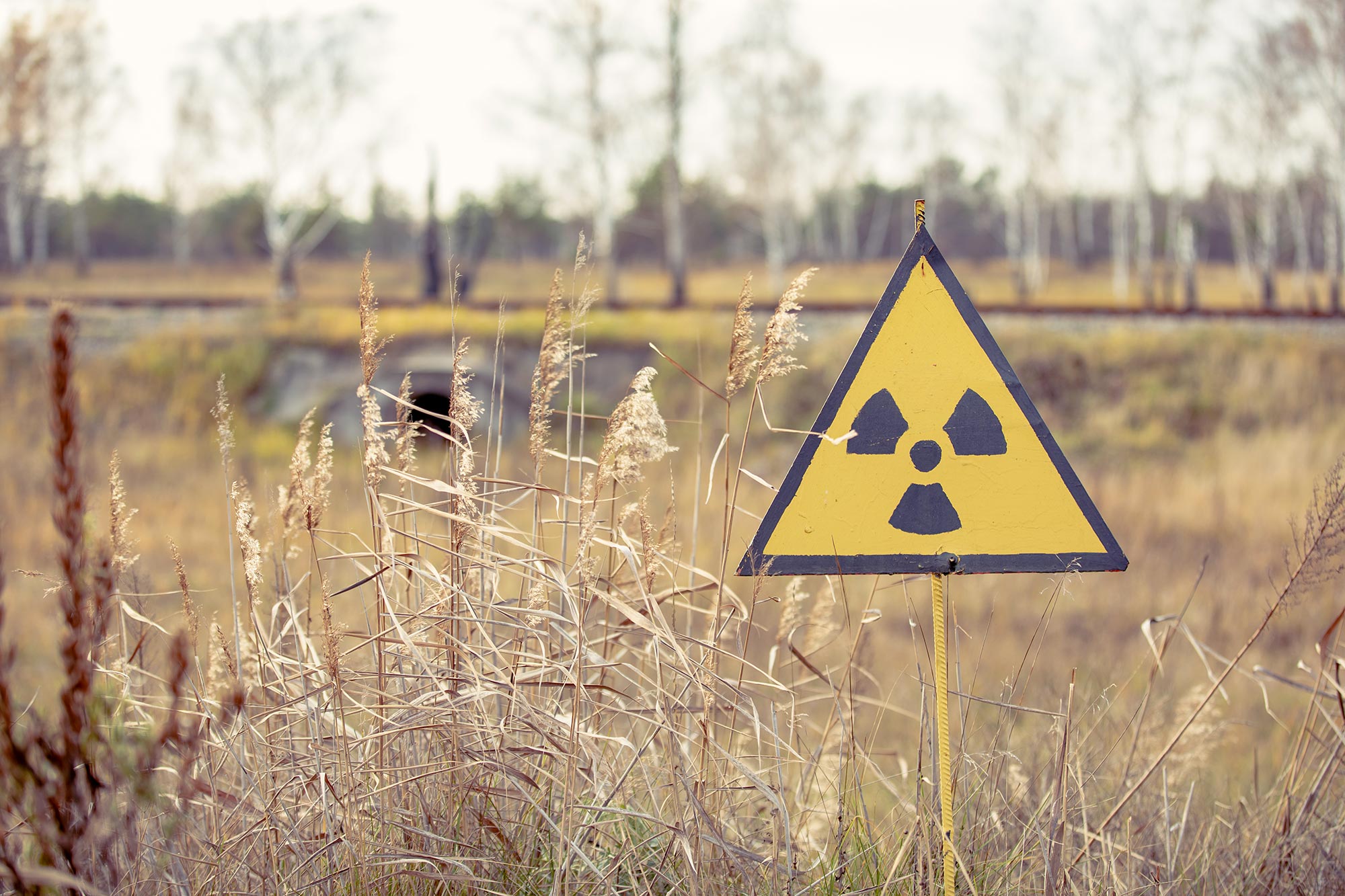 The Chernobyl disaster occurred on April 26, 1986, when a reactor at the Chernobyl Nuclear Power Plant in Soviet Ukraine exploded during a failed safety test. The accident released massive amounts of radioactive material into the atmosphere, contaminating large areas of Europe and forcing thousands of people to evacuate. Credit: Shutterstock
Some of Chernobyl’s radioactive debris is more resilient than scientists expected, offering clues to when the material trapped inside could escape into the environment.
Radioactive dust still contaminates the soil around Chernobyl four decades after explosions scattered debris from the nuclear reactor in Ukraine in 1986. The fragments measure just 8 to 50 micrometers across and remain highly radioactive. Assessing their risks requires understanding how quickly they break down and release radioactive substances, yet scientists still cannot fully explain why these “hot particles” weather at different rates.
An analysis of six fragments by researchers at Leibniz University Hannover and the Helmholtz-Zentrum Dresden-Rossendorf (HZDR) found that the nuclear fuel’s crystal structure has remained largely intact. The examined particles are chemically more stable than previously assumed, retaining fission products, substances created when atomic nuclei split. That could limit the release of radioactive material into surrounding soil and water, while helping researchers refine assessments of the risks these particles pose.
2,000 angles reveal each particle’s structure
Examining the fragments required complex synchrotron X-ray diffraction experiments, which reveal a material’s internal structure through the way it scatters X-rays. HZDR researcher and crystallographer Dr. Christoph Hennig carried out the first successful structural investigation of this kind at the Rossendorf Beamline in Grenoble, working with Tobias Weissenborn, a physicist and doctoral candidate at Leibniz University Hannover.
“The colleagues from Hanover and I used various methods to isolate the particles from Ukrainian soil samples and attach them to tungsten electrodes,” Weissenborn explains. The team secured the samples within several confinement layers before shipping them to Grenoble for examination by Hennig’s team.
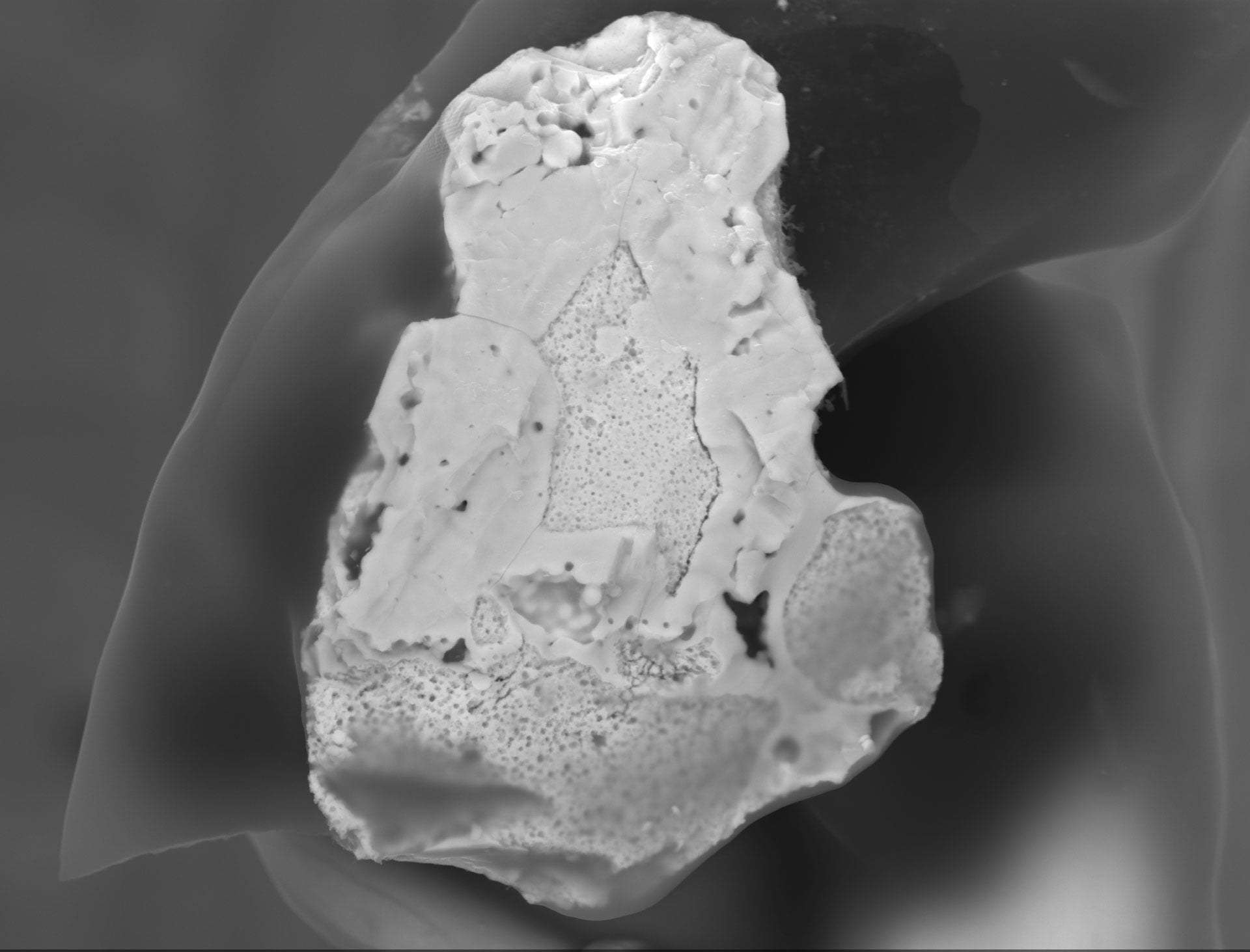 Hot particle from the 1986 reactor accident: The nuclear fuel particle is partially fused with zirconium oxide. Credit: Laura Stalmann
“First, we had to figure out how to examine the particle structure,” Hennig explains. “Ultimately, we fully rotated the particles in an X-ray beam focused down to 100 micrometers—about the thickness of a human hair. We measured each particle from 2,000 different angles to seamlessly capture all the reflections.”
Those measurements allowed the researchers to identify different oxide phases, or distinct crystalline forms, within the samples. This phase analysis can help estimate how quickly the fragments release radioactive substances as they deteriorate and form different uranium oxides.
Heat and fire reshaped the fuel
The particles’ structures reflect the different conditions the fuel experienced during the disaster. “There are three classes of these particles,” Weissenborn explains. “First, there are particles that are chemically and physically still very similar to the nuclear fuel uranium dioxide. Then, there are particles that are partially or fully encased in, or completely fused with, their zirconium layer.”
Particles containing fused fuel and zirconium formed when temperatures inside the reactor rose dramatically. The heat melted the fuel and bonded it to its surrounding protective layer of zirconium, a highly resistant metal.
“The third type of particle was created when the graphite-moderator caught fire,” Weissenborn adds. The graphite normally slowed fast neutrons to help sustain the nuclear chain reaction. During the accident, it burned for ten days.
“In the process, the fuel oxidized into various uranium oxides,” Weissenborn explains. These included U₃O₈, a mechanically unstable compound that readily breaks into microscopic particles that wind can carry away. Inhaling such radioactive dust poses severe health risks. Protective suits are still required to enter the affected areas.
Six particles cannot establish regional safety
The stability observed in the six examined fragments cannot yet be assumed to extend across the contaminated region. “However, every single particle has a different structure,” warns Weissenborn, “and our experiment only studied six such particles from two different locations.” Establishing broader patterns would require examining many more particles collected from far more locations.
“And even if we obtained some averages at some point, we still wouldn’t be able to make universal statements about health risks in the region,” Weissenborn cautions. “Because even if the particles decay in a largely uniform pattern, there will always be outliers, more persistent particles, that will release radionuclides at a later point in time.”
The findings therefore offer no basis for lifting restrictions on the Chornobyl Exclusion Zone anytime soon. Weissenborn and Hennig are already conducting follow-up experiments on the debris’s highly radioactive transuranic phases, which contain elements with atomic numbers higher than uranium’s.
Reference: “X-ray diffraction phase analysis of single hot particles from Chornobyl” by Tobias Weissenborn, Christoph Hennig, Laura Leifermann, Paul Hanemann, Eleanor Lawrence Bright, Florian Meurer, Aaron Lehnert, Kristina Kvashnina and Clemens Walther, 18 February 2026, Journal of Hazardous Materials.
DOI: 10.1016/j.jhazmat.2026.141533
This work was supported by the Federal Ministry of Research, Technology and Space (BMFTR, Germany) within the scope of the SOLARIS project (2020+ 02NUK075A).
Never miss a breakthrough: Join the SciTechDaily newsletter.
Follow us on Google and Google News.

























 English (US) ·
 French (CA) ·
 French (FR) ·