

PROTECT YOURSELF with Orgo-Life® QUANTUM TECHNOLOGY
Orgo-Life the new way to the future Advertising by Adpathway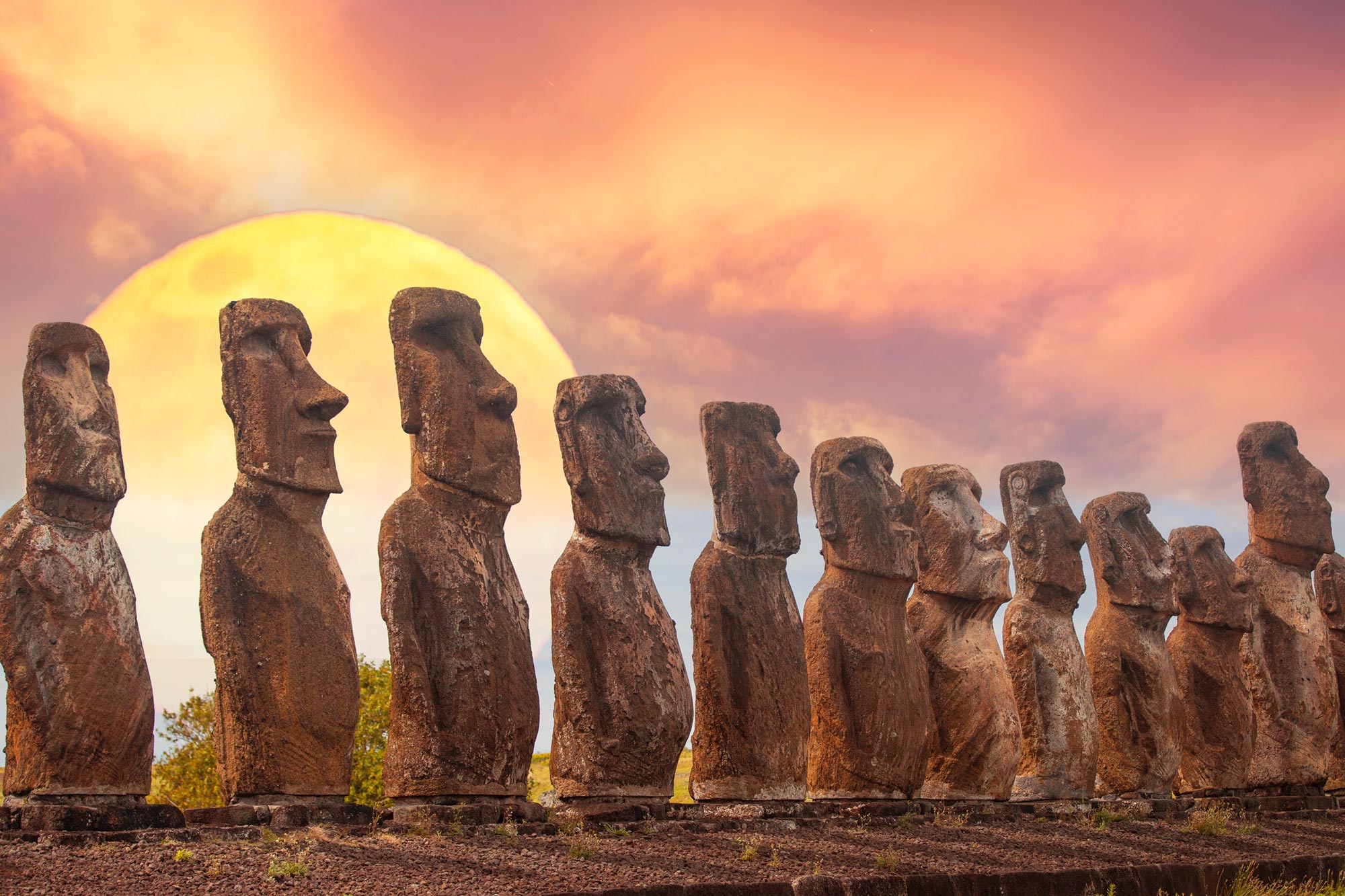 Easter Island, also known as Rapa Nui, is a remote island in the southeastern Pacific Ocean, famous for its enormous stone statues called moai. Located thousands of miles from Hawaii, the island was settled by ancient Polynesian voyagers whose remarkable seafaring abilities continue to intrigue scientists. Credit: Shutterstock
The DNA that traces Hawaii’s settlement also points to overlooked disease risks, with some globally rare variants common enough among Eastern Polynesians to warrant screening.
Hawaii and Easter Island lie about 7,000 kilometers (4,350 miles) apart, roughly the distance from San Francisco to Lima, Peru. New genetic evidence suggests that ancient sailors from the Easter Island region crossed that vast stretch of the Pacific to settle Hawaii. No written record describes their journey, but traces of it remain in the DNA of people living on the islands today.
Stanford Medicine researchers and collaborators uncovered the connection by analyzing genomes from more than 1,000 people throughout Polynesia. Their study, published Oct. 8 in Science, extends a settlement route that researchers previously thought had ended at Easter Island.
“What we uncover in this paper is where the native people of Hawaii had come from,” said Alexander Ioannidis, PhD, assistant professor of genetics and of biomedical data science at Stanford Medicine and co-senior author of the study. “Hawaii is the only Polynesian island in the Northern Hemisphere, so it’s a long way from everything.”
The study’s other co-senior author is Keolu Fox, PhD, an associate professor of anthropology at the University of California, San Diego, and a Native Hawaiian.
Hawaii’s ancestry points toward Easter Island
Across Polynesia, more than 1,000 islands occupy an expanse of ocean roughly equal to the combined areas of North and South America. Reconstructing connections among those islands, from tropical Hawaii to temperate Easter Island in the far South Pacific, requires evidence that can reach back through centuries of migration.
“People on the islands today have encoded in their genomes essentially the genealogy of all of their ancestors,” Ioannidis said.
To follow that ancestry, the researchers isolated genome segments of Polynesian origin, excluding more recent contributions from populations such as Europeans and Asians. They then compared stretches of DNA shared by people from different islands. These stretches, called identity-by-descent segments, come from a common ancestor. Longer shared segments generally indicate that two people shared an ancestor more recently.
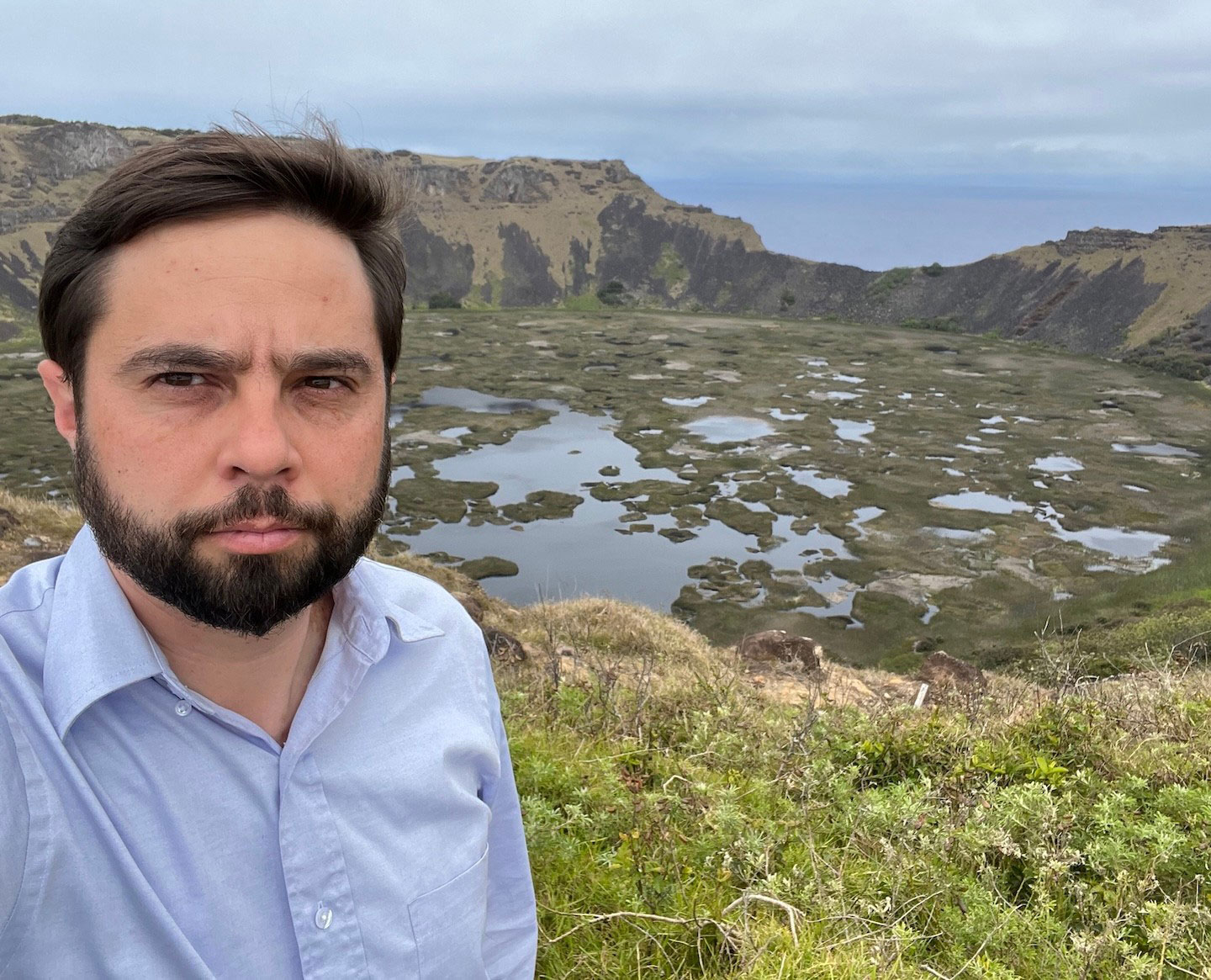 Alexander Ioannidis on Easter Island. Credit: Stanford Medicine
Among the populations compared, Native Hawaiians shared the most Polynesian ancestry with people on Easter Island, followed by people on Mangareva, nearly 3,000 kilometers (1,860 miles) from Easter Island. Ioannidis interprets that pattern as consistent with a culture capable of exceptionally long voyages. Seafarers who could reach Easter Island from Mangareva would also have had the capabilities needed to travel onward to Hawaii.
Double-hulled catamarans carried provisions such as taro, sweet potatoes, and bananas, which could supply food for weeks at sea and crops for a new settlement. An earlier study by the researchers found that members of the same long-distance voyaging population also reached South America and made contact with Native Americans.
The team’s previous genetic reconstruction had traced Polynesian settlement from Samoa to Fiji and Tonga, then gradually eastward through the Cook Islands, the Society Islands, which include Tahiti, and Mangareva. It placed settlement of Easter Island around 1210. The new findings suggest that this was another stop along an expanding migration route.
Tahiti’s founding generation estimated at 800
Genetic evidence also allowed the researchers to investigate how many people founded an island population and what happened afterward. Tahiti offered the largest collection of genomes in their dataset, making it the focus of a more detailed analysis. By comparing identity-by-descent segments among people from the island, the team estimated that its founding generation consisted of approximately 800 people who arrived about 34 generations ago, around 1070.
That estimate covers a single generation of people of reproductive age. It does not include children or elders who may have accompanied them.
“Archaeologists and others have long wondered how many people founded these islands. That’s not something that you can determine definitively from archaeology, but we can determine it from genetics,” Ioannidis said.
The analysis reconstructed rapid population growth on Tahiti after settlement, followed by a substantial population crash in the 1700s after European colonial contact. Similar reconstructions are underway for Easter Island and Hawaii, but they will require additional genomes.
Island settlements narrowed the gene pool
Each island settlement also shaped the genetic inheritance of later generations. When a small group separates from a larger population to establish a new one, it carries only part of the original population’s genetic diversity. This bottleneck, known as a founder effect, can make an otherwise rare variant more common among descendants, including variants associated with disease. Across Polynesia, small groups, perhaps only a few hundred people at a time, founded successive island populations over several centuries.
“We thought Easter Island was the end when we were first doing that study, but now it looks like it was part of this path to Hawaii, which is really incredible,” Ioannidis said. “By the time you’ve gotten all the way to Hawaii, you’re at the end of a series of founder effects, so it’s really intense.”
Founder effects have been extensively studied in populations of European descent, including the Amish, Ashkenazi Jews, and Finns. That research has led to standard screening for certain inherited conditions. The new analysis indicates that the scale of these effects among Eastern Polynesians has been overlooked.
“What we discovered is in the Eastern Polynesians, such as Native Hawaiians, the founder effects are more than an order of magnitude, so more than 10 times, larger than what we have in the populations of European descent we’ve studied so well,” Ioannidis said.
Disease variants common enough for screening
To examine the medical implications, the researchers analyzed three genetic variants recently linked to autosomal recessive conditions among Eastern Polynesians. These conditions generally develop when a person inherits a disease-causing version of the relevant gene from each parent. The variants occur in ADAMTSL4, associated with dislocation of the eye’s lens, PDE6B, associated with progressive vision loss, and FAN1, associated with kidney failure.
Although these variants are exceedingly rare worldwide and barely represented in international genome databases, the researchers found carrier rates of 2% to 3% among the Eastern Polynesians studied. Those rates meet standard thresholds for recommending genetic screening. Larger genomic studies could identify additional clinically relevant variants that are unusually common in Polynesian populations and help guide precision medicine.
“We should be doing more sequencing and trying to characterize more of these conditions among Native Hawaiians,” said Ioannidis, noting that the Native Hawaiian population is nearly twice the size of the Amish population. “We don’t have recommendations for genetic testing, and there’s no reimbursement from insurance because these are conditions we don’t even know about.”
“This is a population that should be getting research resources and attention from geneticists even more urgently.”
Reference: “Message in a bottleneck: Nested founder effects from French Polynesia to Rapa Nui and Hawaiʻi” by Cole Shanks, Edward C. Huang, Christophe Thomassin, Anne-Katrin Emde, Vahinetua Rodière, Mauricio Moraga, Karla Sandoval, Tony Merriman, Tristan Pascart, Andrés Moreno-Estrada, Stephane E. Castel, Keolu Fox and Alexander G. Ioannidis, 8 October 2026, Science.
DOI: 10.1126/science.aec7662
Support from the National Human Genome Research Institute (NHGRI), grants T32HG012344 (C.S.), U01HG007417 (A.G.I.), and U01HG007419.
Never miss a breakthrough: Join the SciTechDaily newsletter.
Follow us on Google and Google News.




















 English (US) ·
  French (CA) ·
  French (FR) ·